

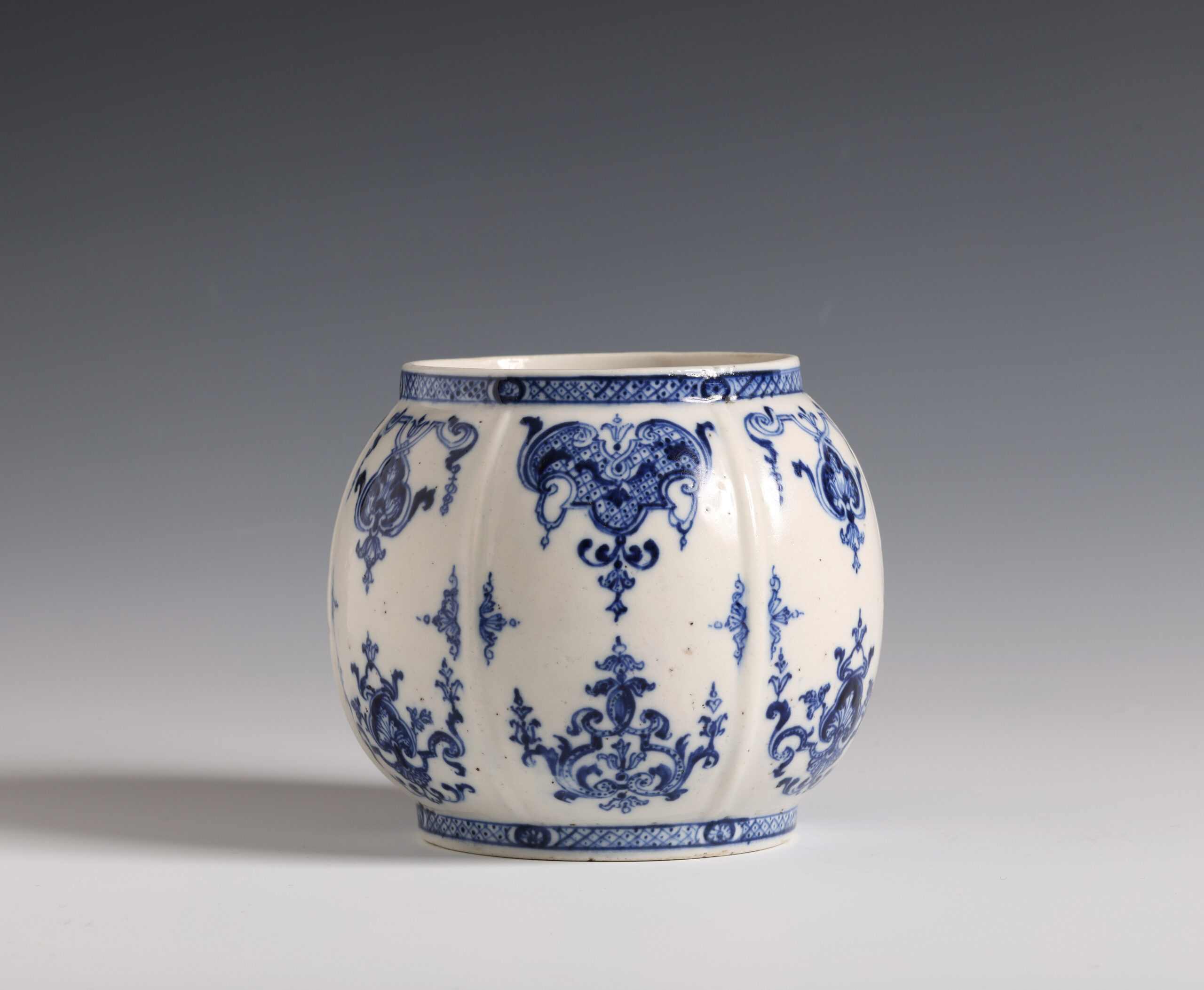
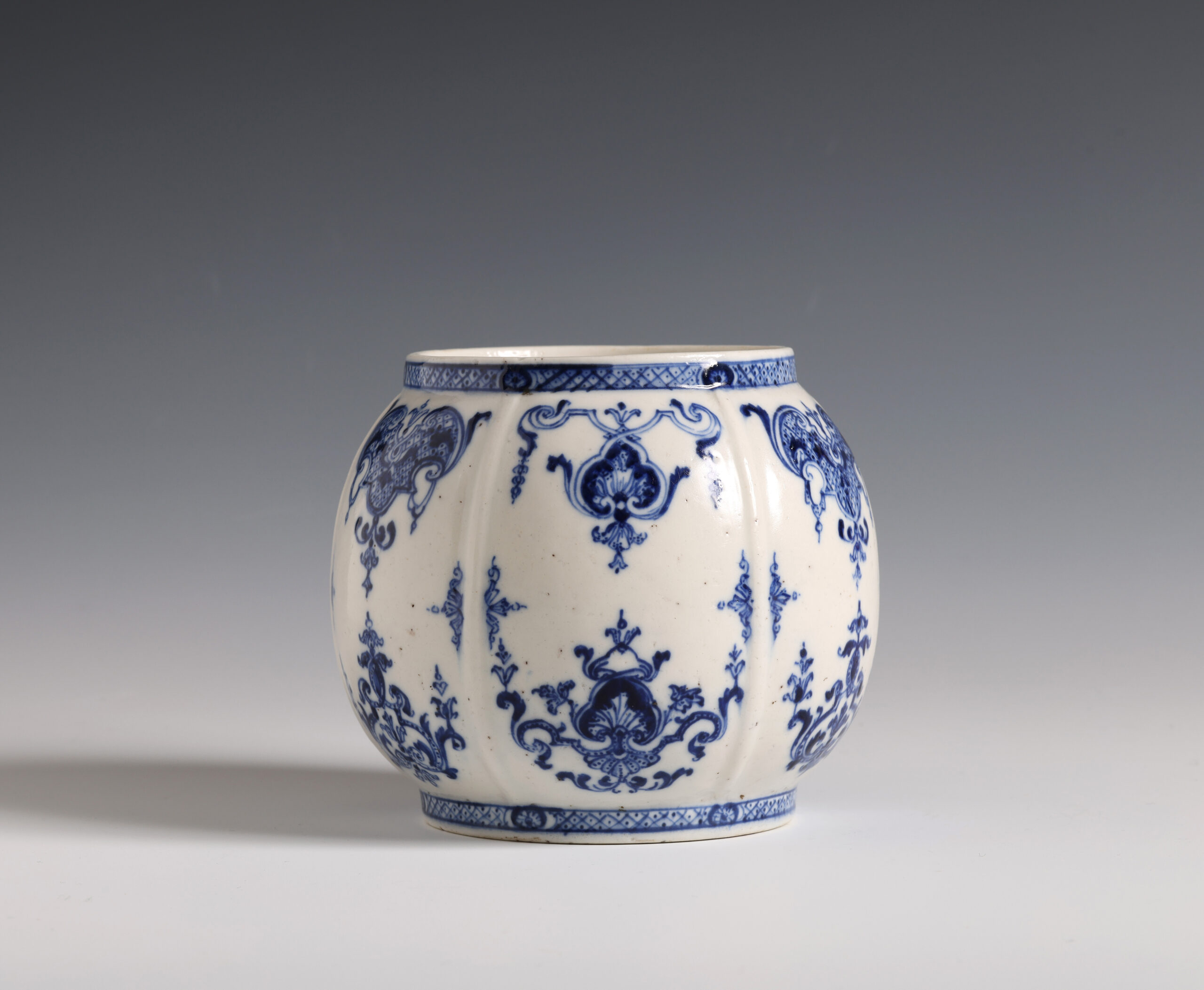
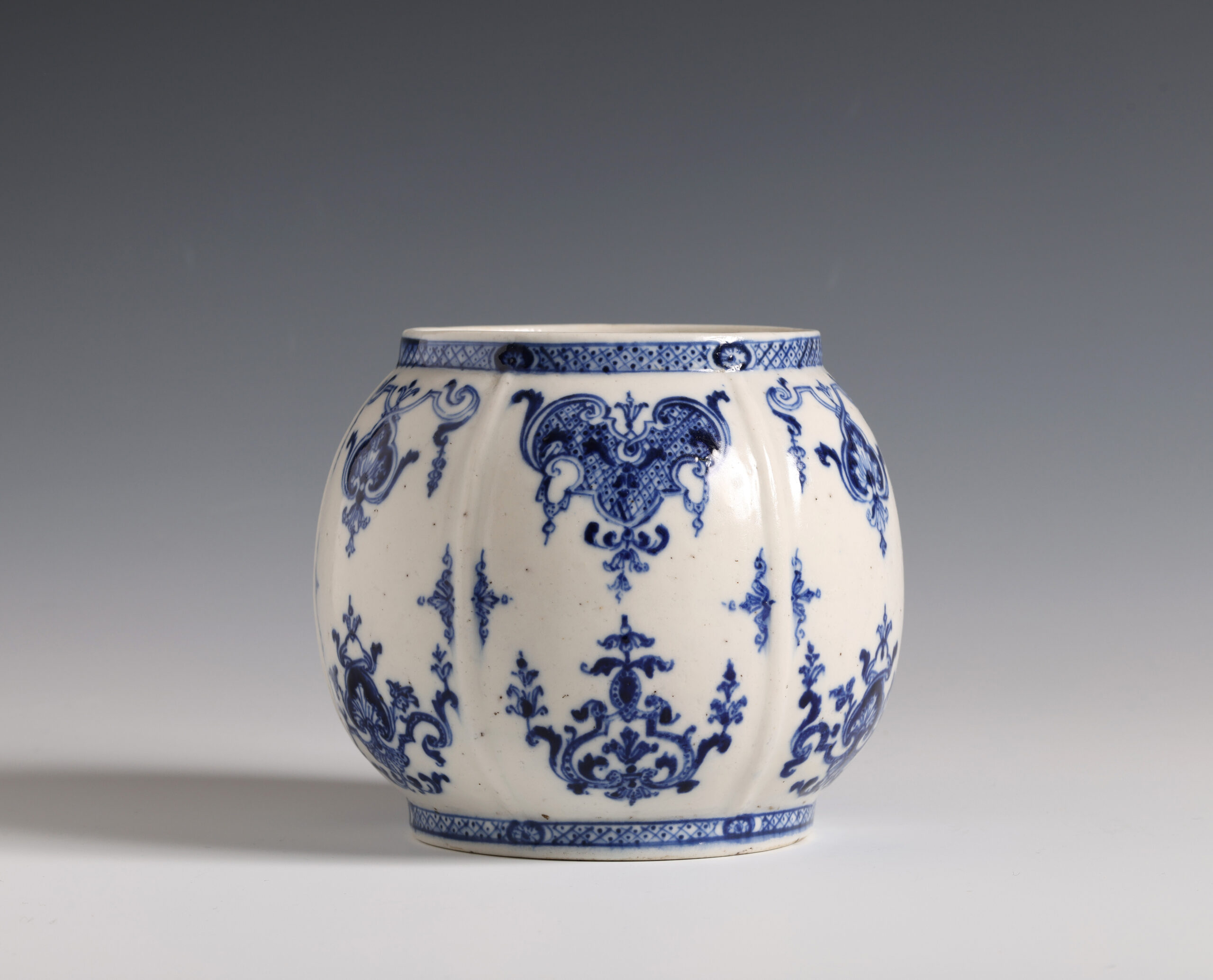
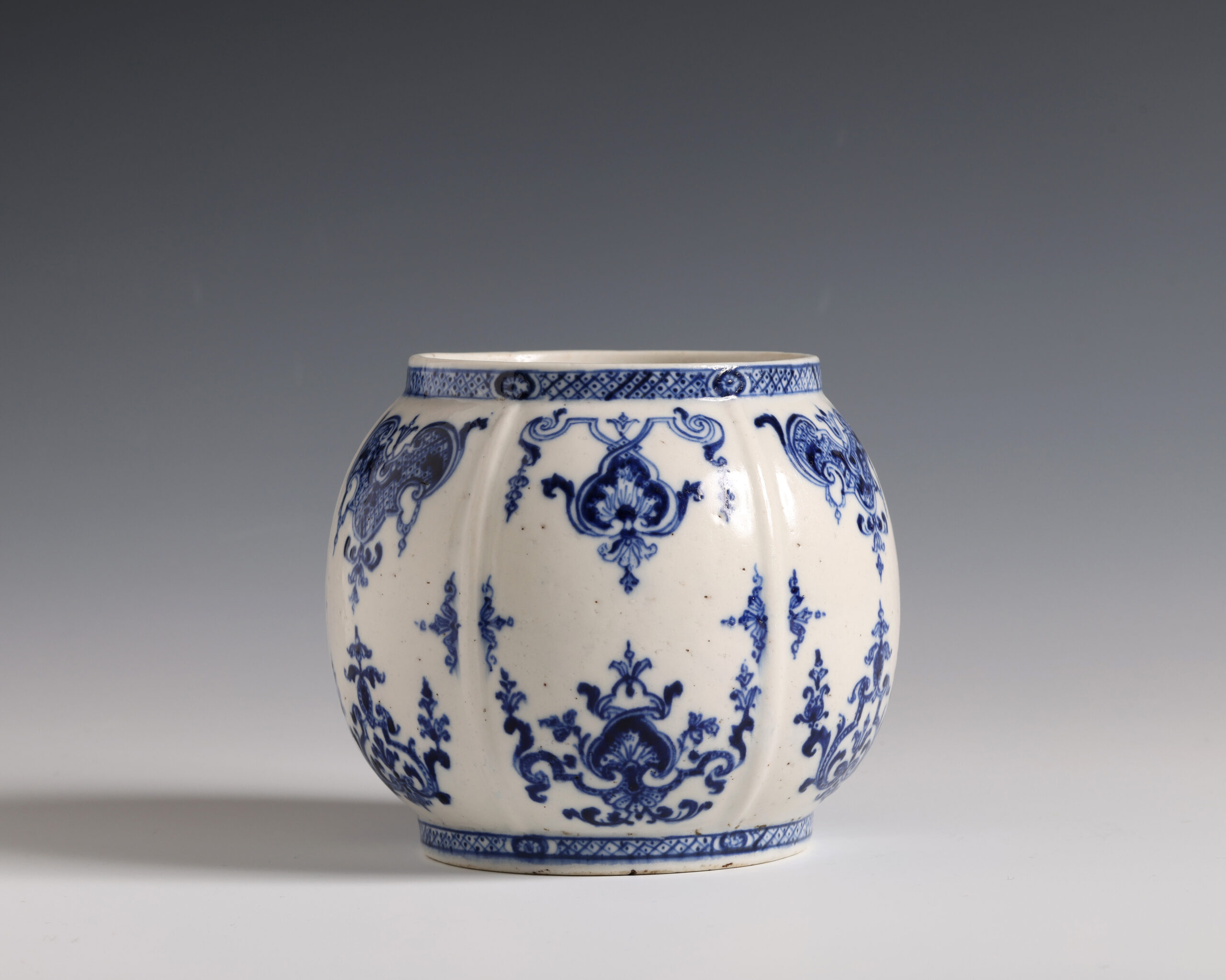
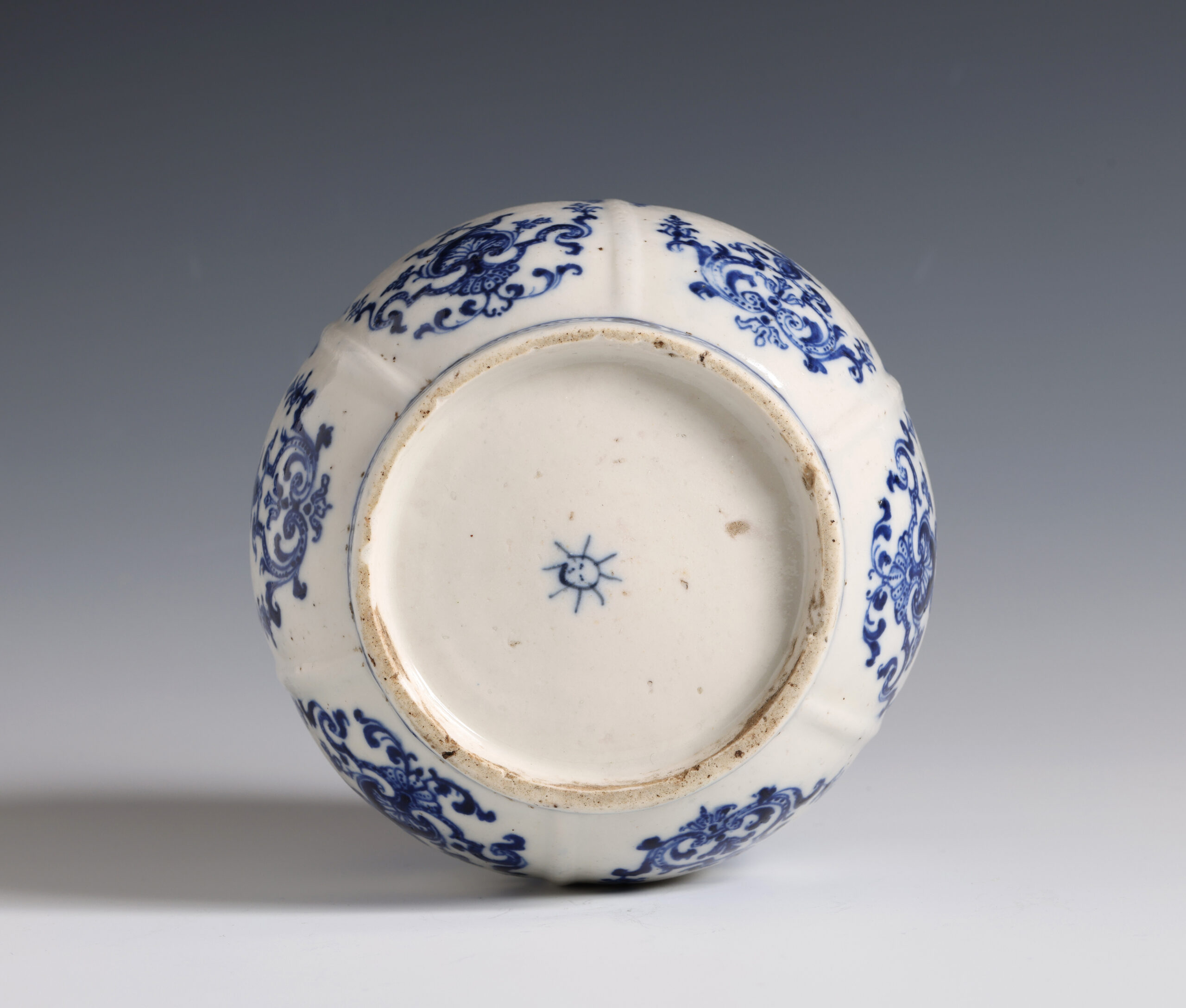
Of globular form with six panels decorated with underglaze blue berainesque lambrequin ornament divided by raised ribs.
In 1700 the Mercure de France reported that: ‘On the third of September, Madame la Duchesse de Bourgogne … stopped her carriage at the door of the house where the messieurs Chicannaux had established a few years ago a fine porcelain factory, which, without a doubt, has no equal in all of Europe .’[1] Until the establishment of Meissen ten years later, this bold observation was entirely correct: Saint-Cloud, alone in Europe, had mastered the secrets and processes of porcelain, albeit soft-paste porcelain, and brought its manufacture to commercial fruition.
Although they have rarely survived together, this form would have originally had a lid with holes around the border to be used as a pot-pourri. This example is notable for being slightly smaller and more globular than others of the same form and design.[2]

It is thought that the mark of a radiating sun indicates that it was made in the lifetime of Louis XIV who died in 1715.
The form of our pot-pourri is loosely based on Chinese transitional wares of the 1640s, with the addition of vertical ribs that compartmentalise the body and offer physical support.

A blue and white vase of similar outline is depicted in the ‘Portrait of a Woman’ by Nicholas de Largillière, in the Saint Louis Art Museum. The Berainesque decoration suggests a French rather than a Chinese origin, but it’s unlikely to be faience in such a rich and fashionable setting. If porcelain, then Saint-Cloud is the obvious candidate.[3] The painting is dated to around 1696 – exactly the moment when such a Saint-Cloud vase would have enjoyed startling novelty and prestige.
Condition:
Good condition, no restoration
References:
Brittle Beauty 2023
D’Agliano, Lehner-Jobst, Manners, Savill, Schwartz and Munger, Brittle Beauty: Reflections on 18th-Century European Porcelain, (Ad Ilissvm, 2023)
Chavagnac & Grollier 1906
Xavier de Chavagnac and Gaston de Grollier, Histoire des manufactures françaises de porcelaines, Paris 1906
———————————————————————————————————————————————————————————
[1] Chavagnac and Grollier 1906, p. 13, ‘Le trois septembre, madame la duchesse de Bourgogne … fit arrêter son carrosse à la porte de la maison où messieurs Chicannaux ont établi depuis quelques années une manufacture de porcelaines fines, qui, sans contredit n’a point de semblable dans toute l’Europe.’.
[2] For an example with a lid and a discussion of the form see Brittle Beauty 2023, pp. 22 – 27. No. 1.
[3] The even rarer porcelain of Louis Poterat’s factory, which never went into commercial production, is also a possibility.
SOLD