
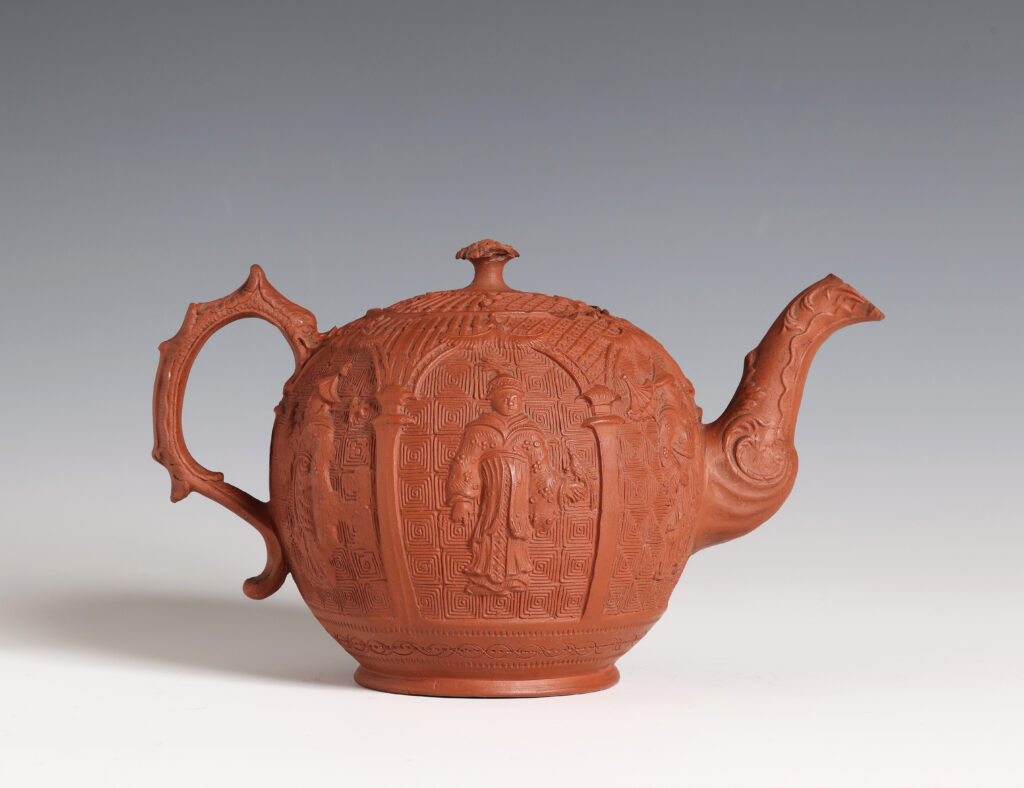
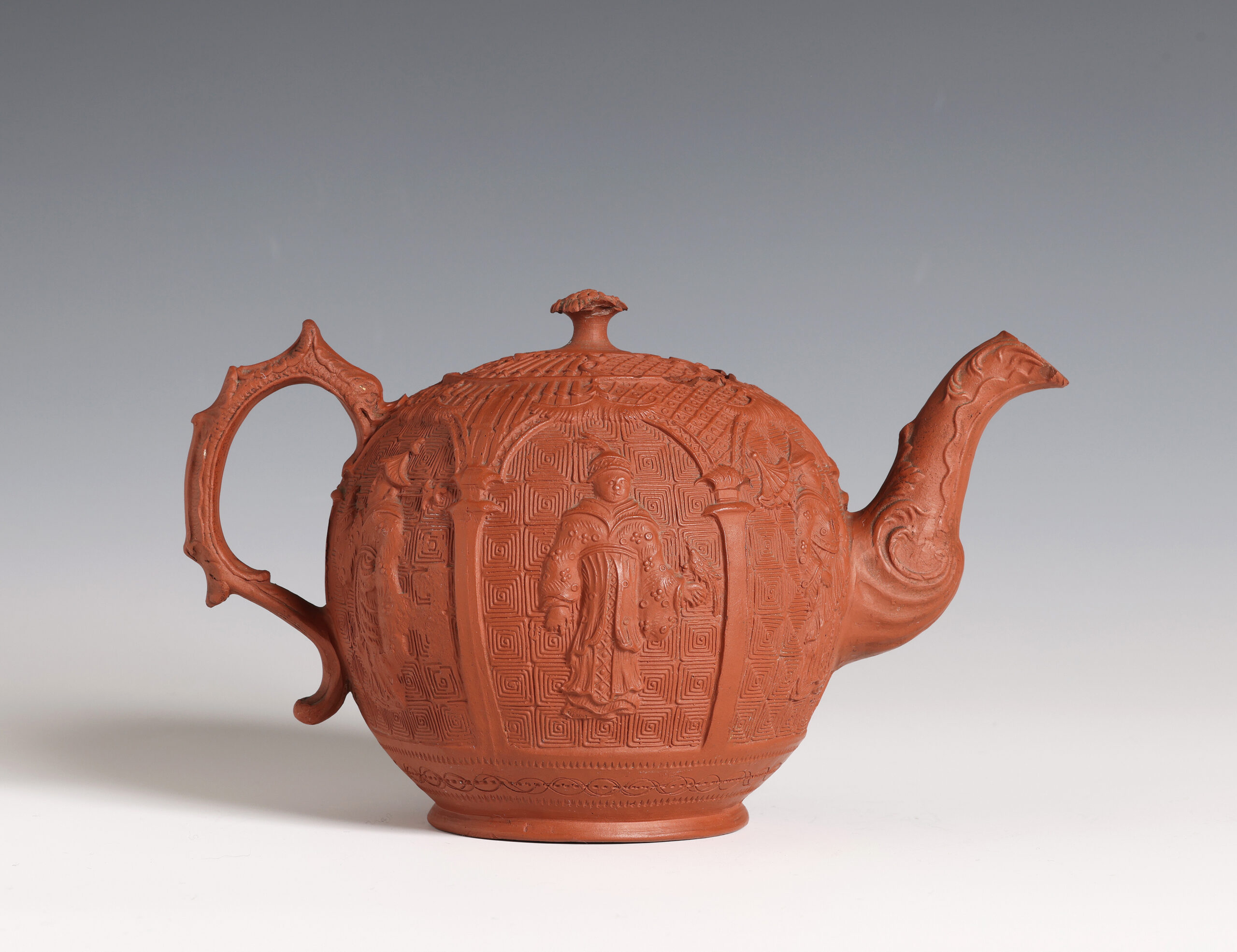
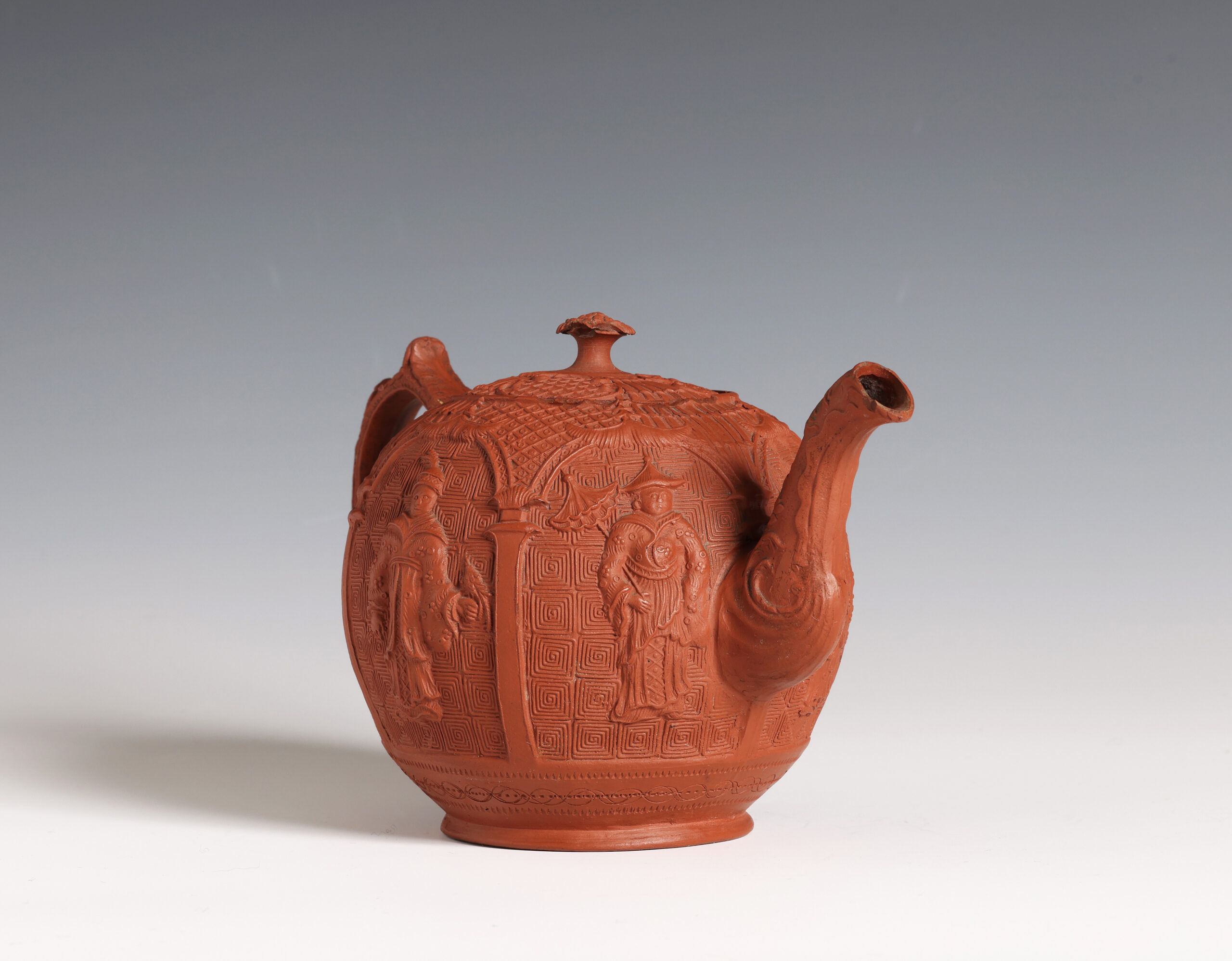
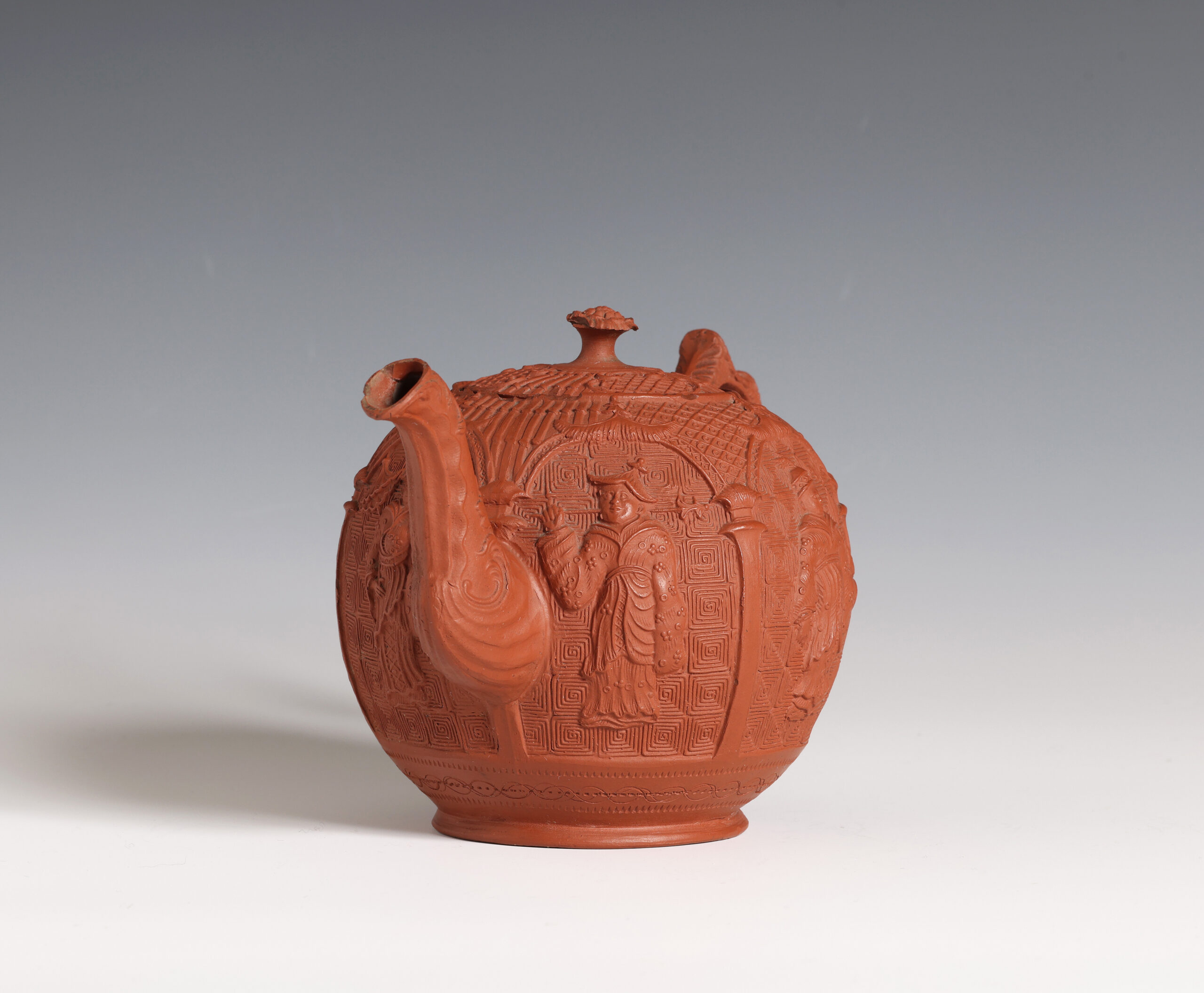
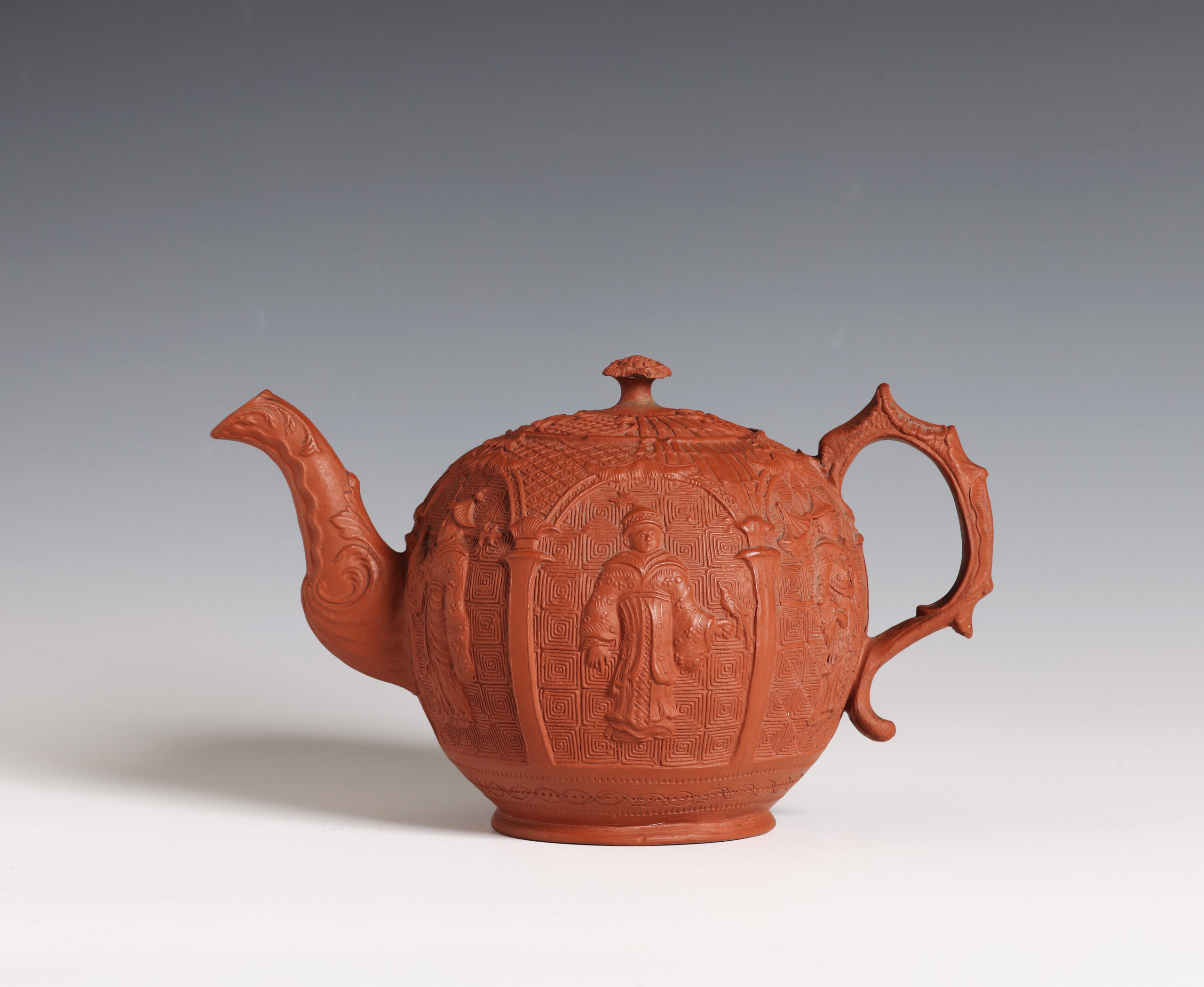
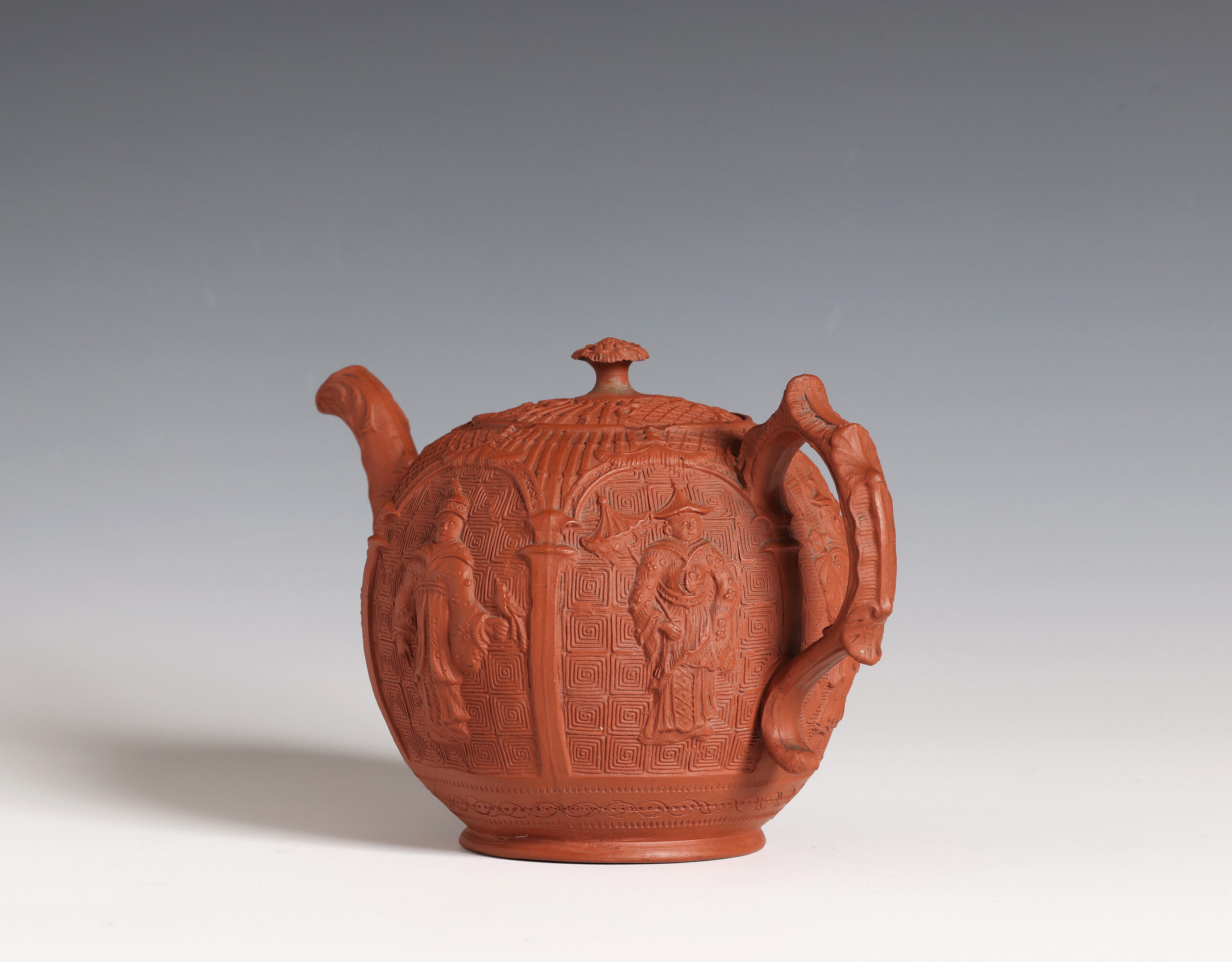
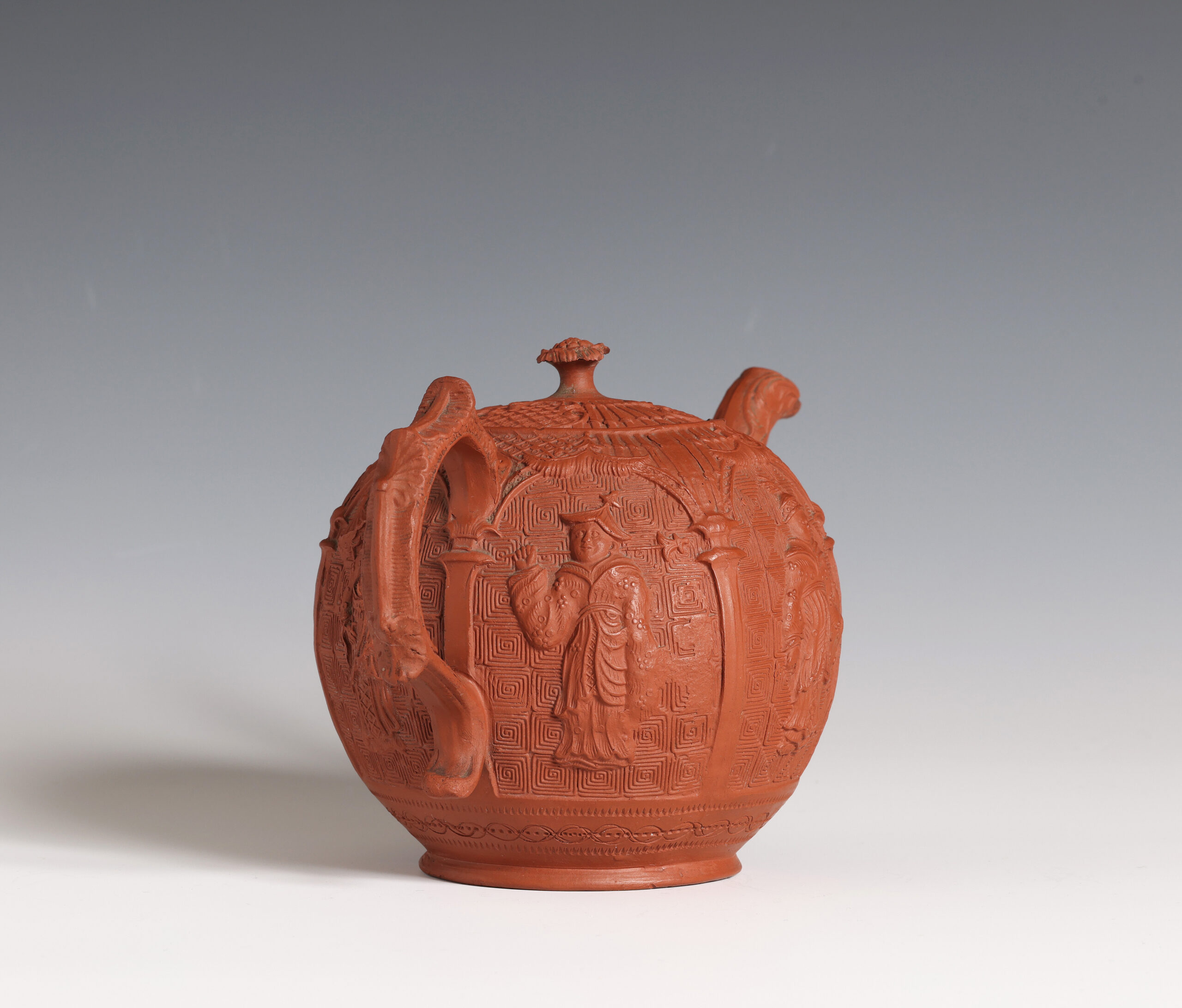
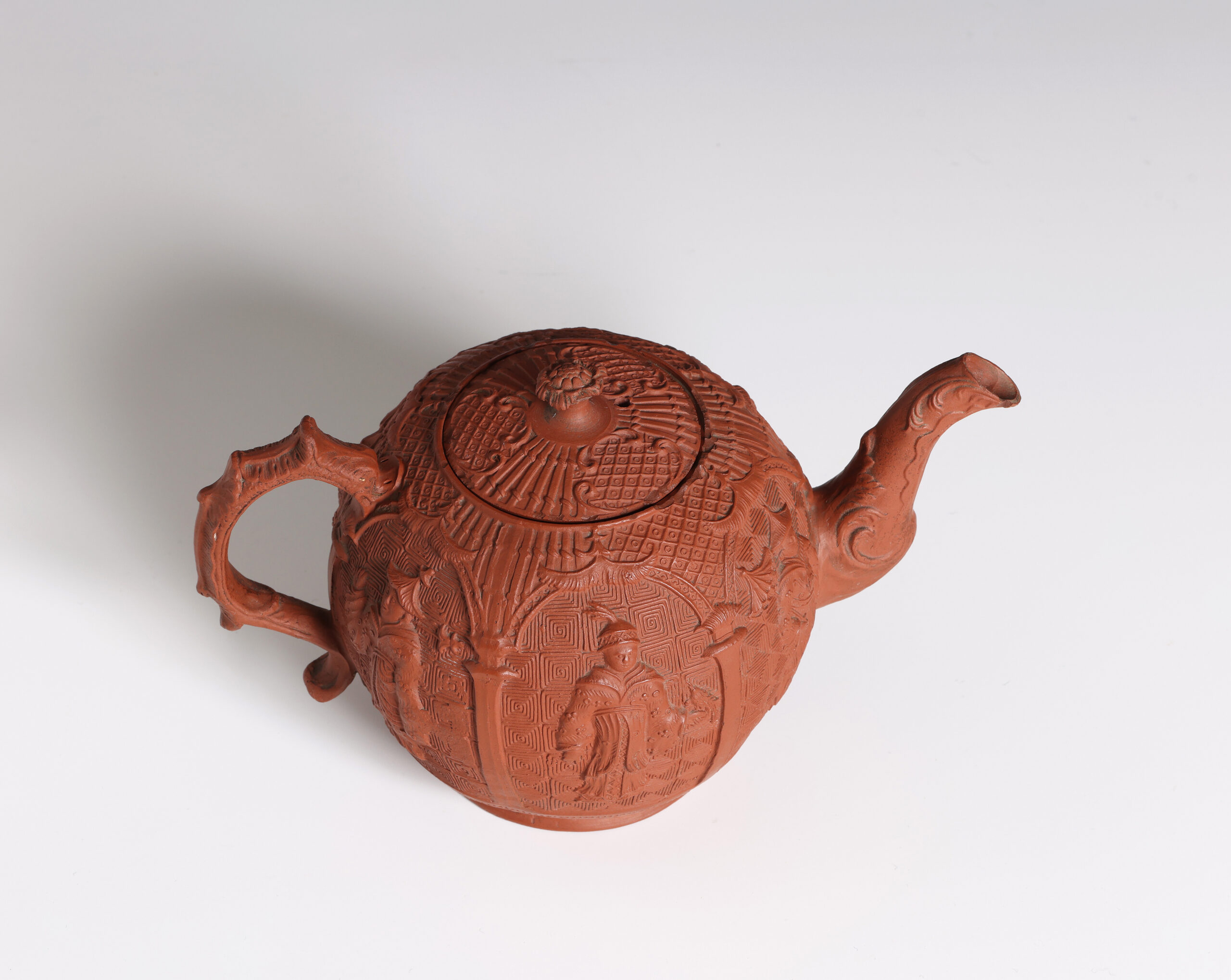
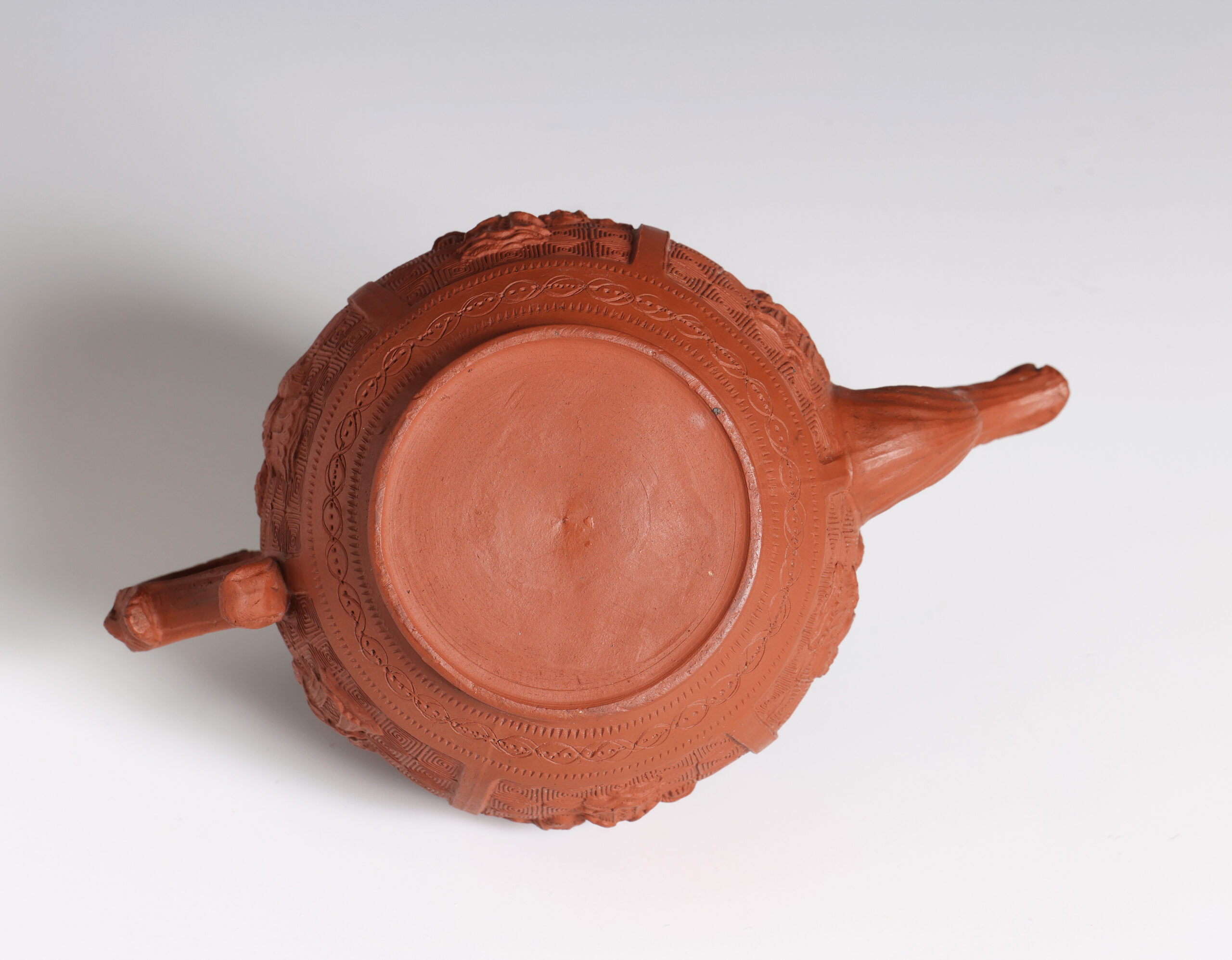
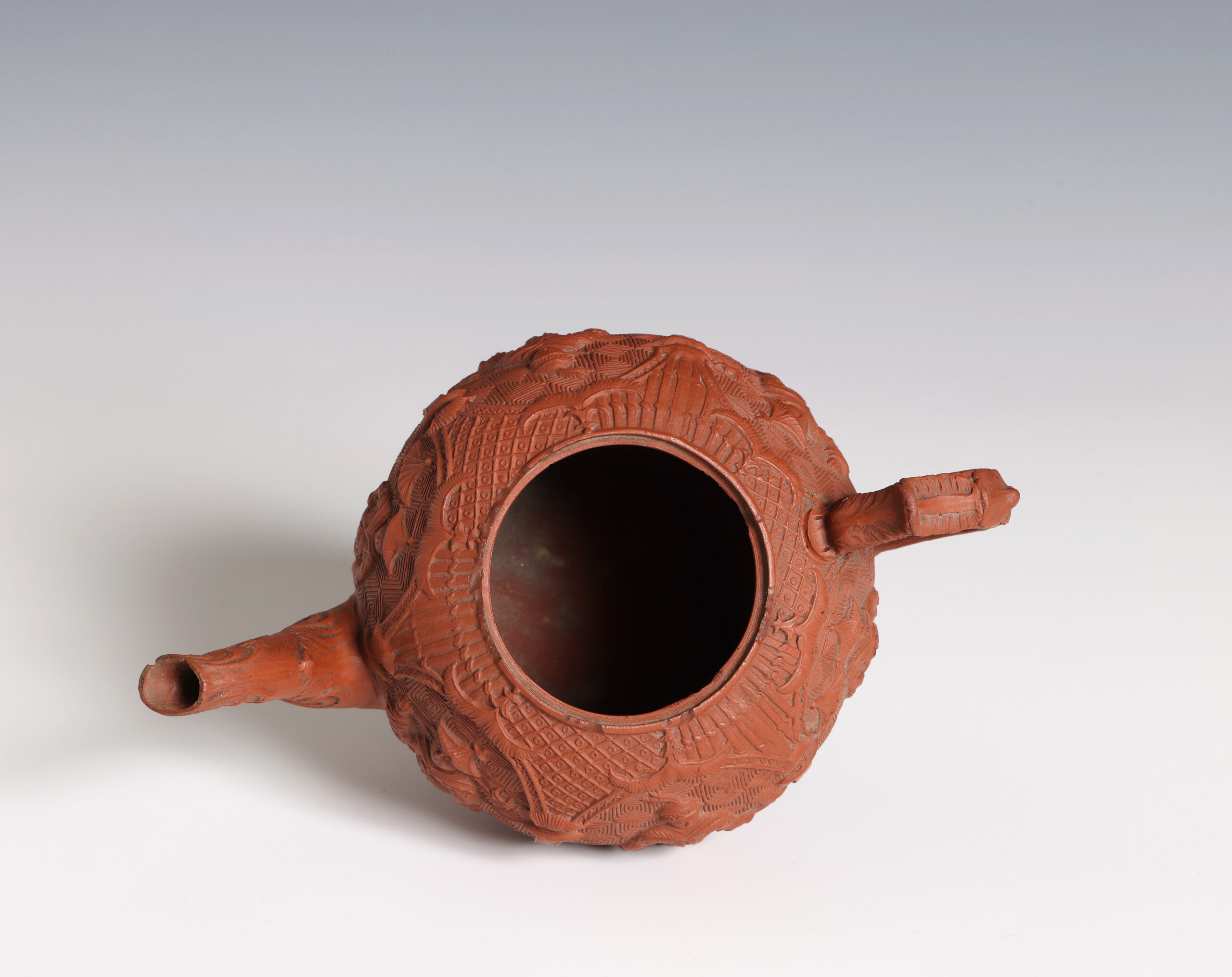
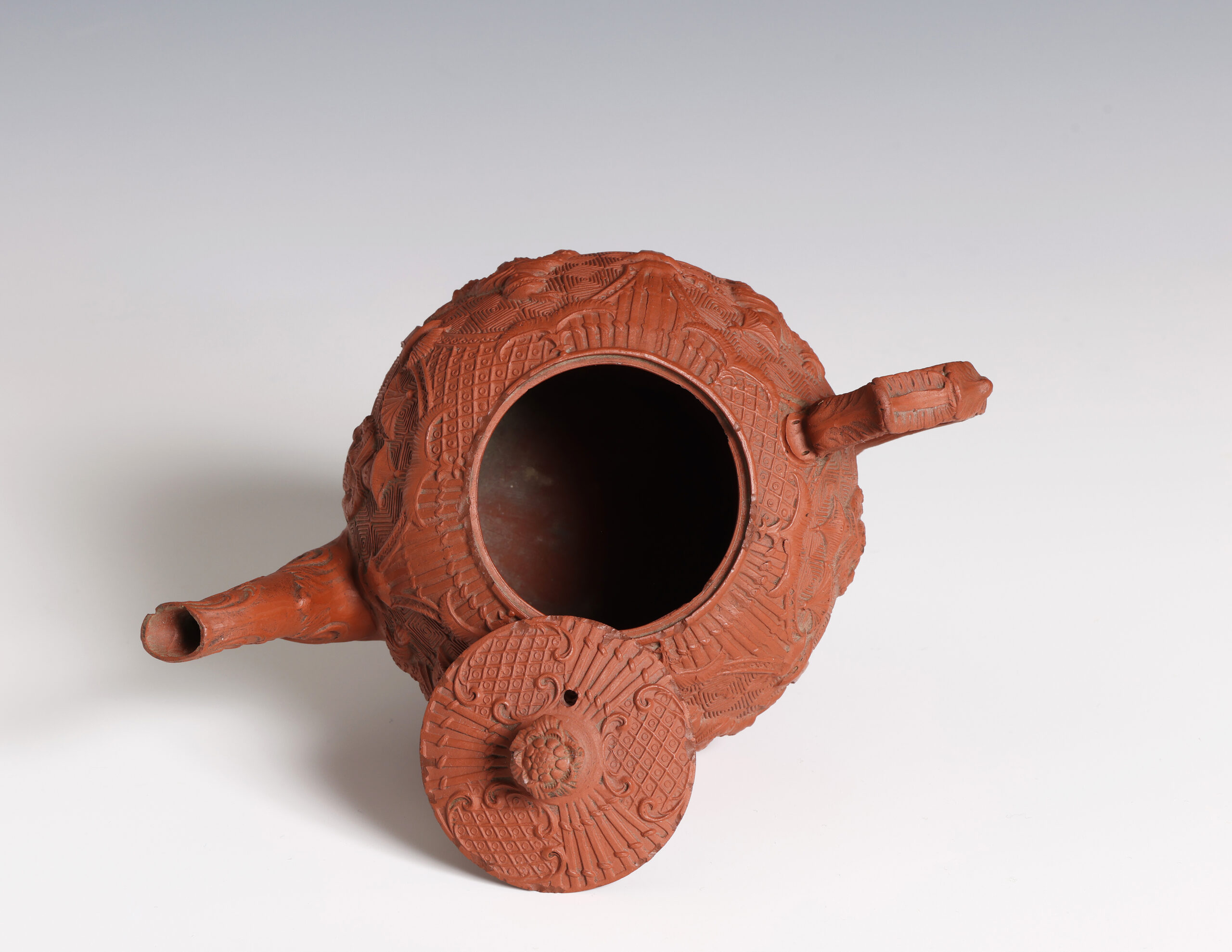
Press-moulded with six panels of standing Chinese figures on a cell pattern ground within arched trellises above a band of rouletting around the foot.
The exceptionally crisp moulding in high relief suggests that it must have been one of the first to have been taken from its three-part mould. Many Staffordshire factories produced red stonewares but without exact matches from archaeological sites, precise attribution is difficult. Plaster moulds for press moulding are said to have been introduced in the 1740s.[i] The same identical mould is also found on lead-glazed teapots of Whieldon type.[ii]
After the demise of the red stonewares of the Elers brothers in the late 17th century, red stoneware (as opposed to glazed red earthenware) was not revived in Staffordshire until the late 1740s. Most redware teapots were wheel-thrown with applied sprigged ornament, press-moulded ones were more time consuming to produce and are much rarer.
The first recorded reference to the production of red stoneware, according to Robin Hildyard, is in Dr Pococke’s Journey into England from Dublin (1751) which implies that it’s manufacture was then in its infancy. Referring to Madely Hill in the Potteries near Stoke-on-Trent he writes:
‘The red ware, in imitation of china, which they call the dry red china ware, to distinguish it from the glazed, is made of the red clay found here; but as it does not take among the common people, there is but little demand for it;’[iii]
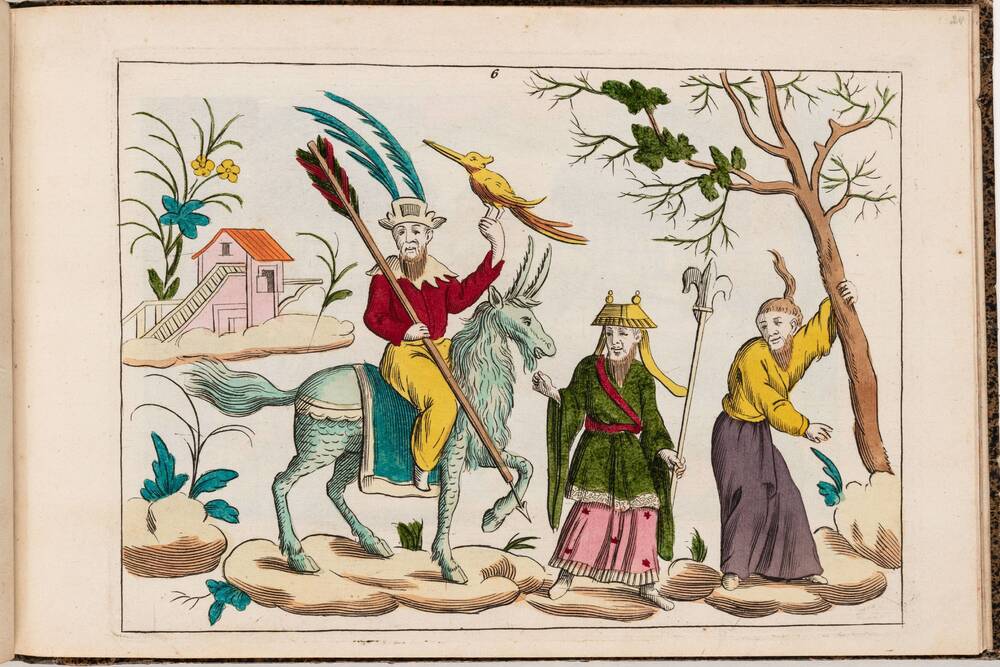
Johann Christoph Weigel, Nuremberg 1711-1726
Kupferstich-Kabinett, Dresden, B 1156,2 II/24
The Chinese figures are loosely based on popular engravings such as those of Christoph Weigel, Petrus Schenk or Johan Nieuhof.
We have only found one other example of this form, in the Burnap Collection in The Nelson-Atkins Museum of Art, Kansas City, which came from the collection of the Rev. C. J. Sharpe.[iv] The Reverend Sharpe assembled one of the great collections of teapots and had a reputation for eccentricity. He is said to have believed that he was a teapot and had a spout emerging from his forehead. He also collected young ladies riding crops.
Condition:
Chips to tip of spout, finial, rim of cover and edge of neck, no restoration
References:
Barker & Halfpenny 1990
David Barker & Pat Halfpenny, Unearthing Staffordshire, (City of Stoke-on-Trent Museum and Art Gallery, 1990)
Hildyard 2005
Robin Hildyard, English Pottery 1620-1840, (V& A Publications, 2005)
Taggart 1967
Ross E Taggart, The Frank P. and Harriet C. Burnap Collection of English Pottery in the William Rockhill Nelson Gallery, (1967)
Sotheby’s 1955
Sotheby & Co., London, ‘The Well-Known Collection of Fine English Teapots (The first Portion), The Property of the Rev. C. J. Sharpe, Shepreth Vicarage, Herts, March 1st, 1955, lot 17. Sold as Elers ware, Bought by Cecil Davis for £40.
———————————————————————————————————————————————————————————————————————————————————————————–
[i] Barker & Halfpenny 1990, p. 50.
[ii] For an example see The Herbert and Sylvia Jacobs Collection, Christie’s, New York 24 January, 1994, lot 102.
[iii] Hildyard 2005 p. 71.
[iv] Taggart 1967, no. 180. In this catalogue it is illustrated with a stand with which it came from the Sharpe collection, but it does not belong.
SOLD