

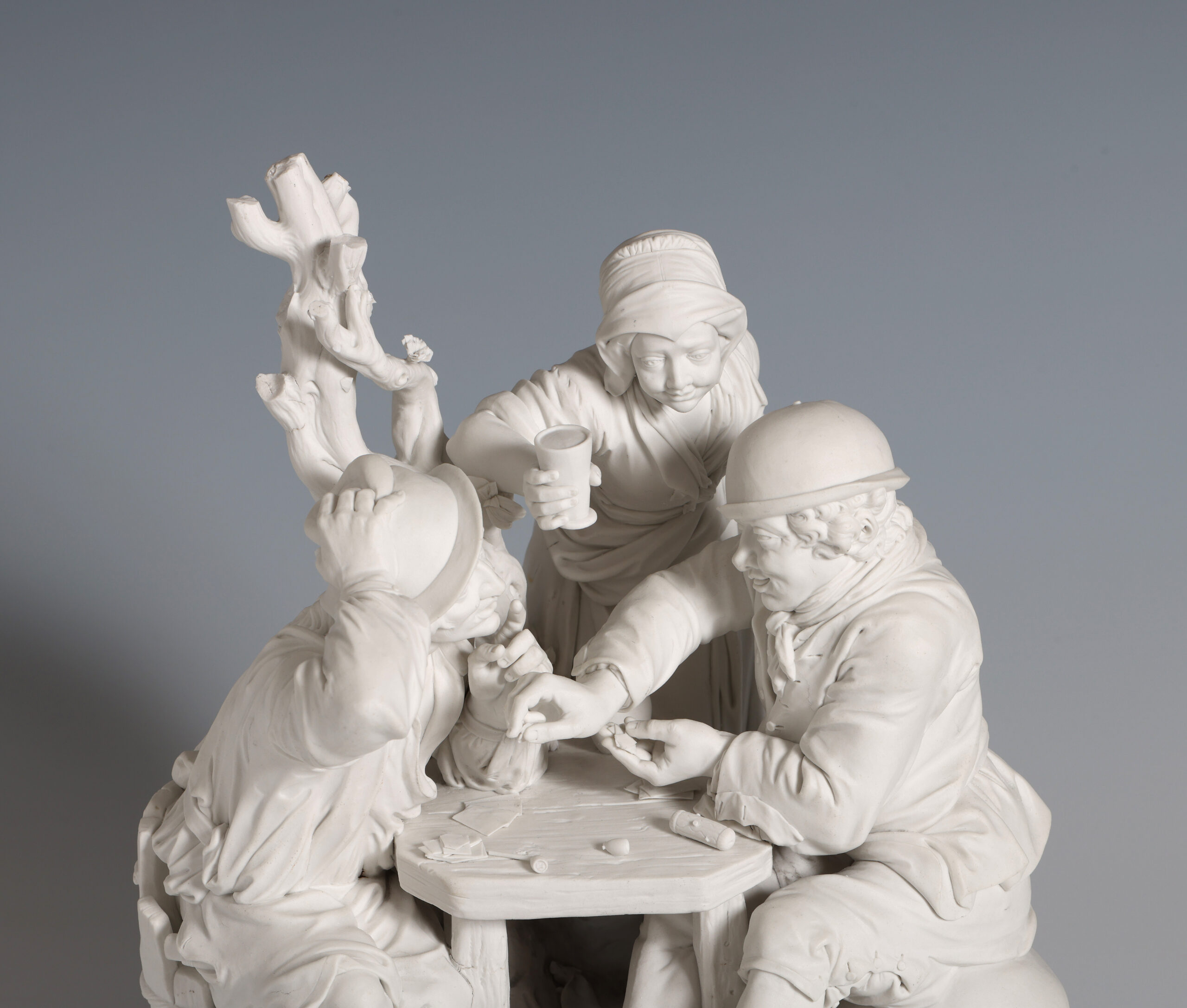
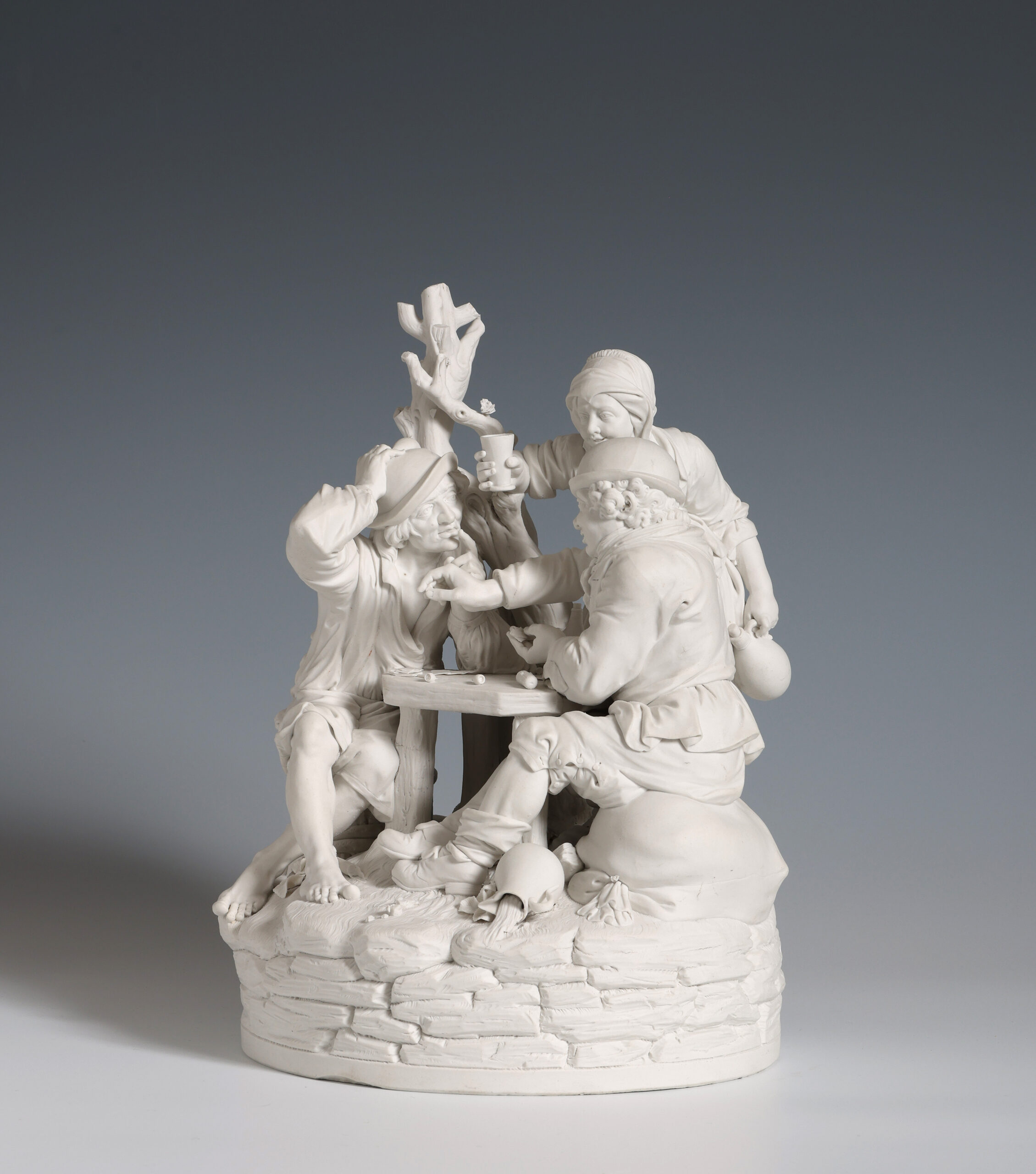
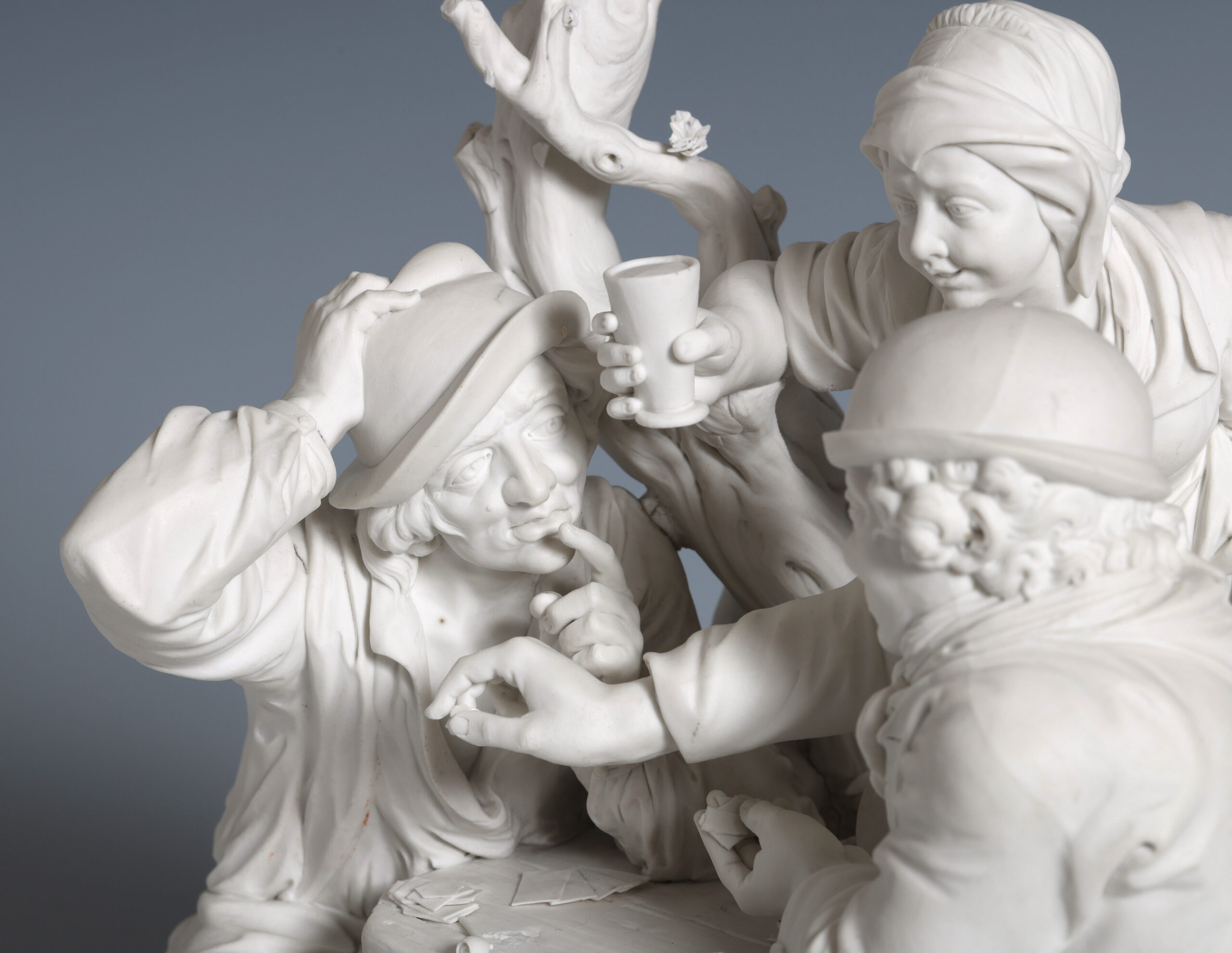
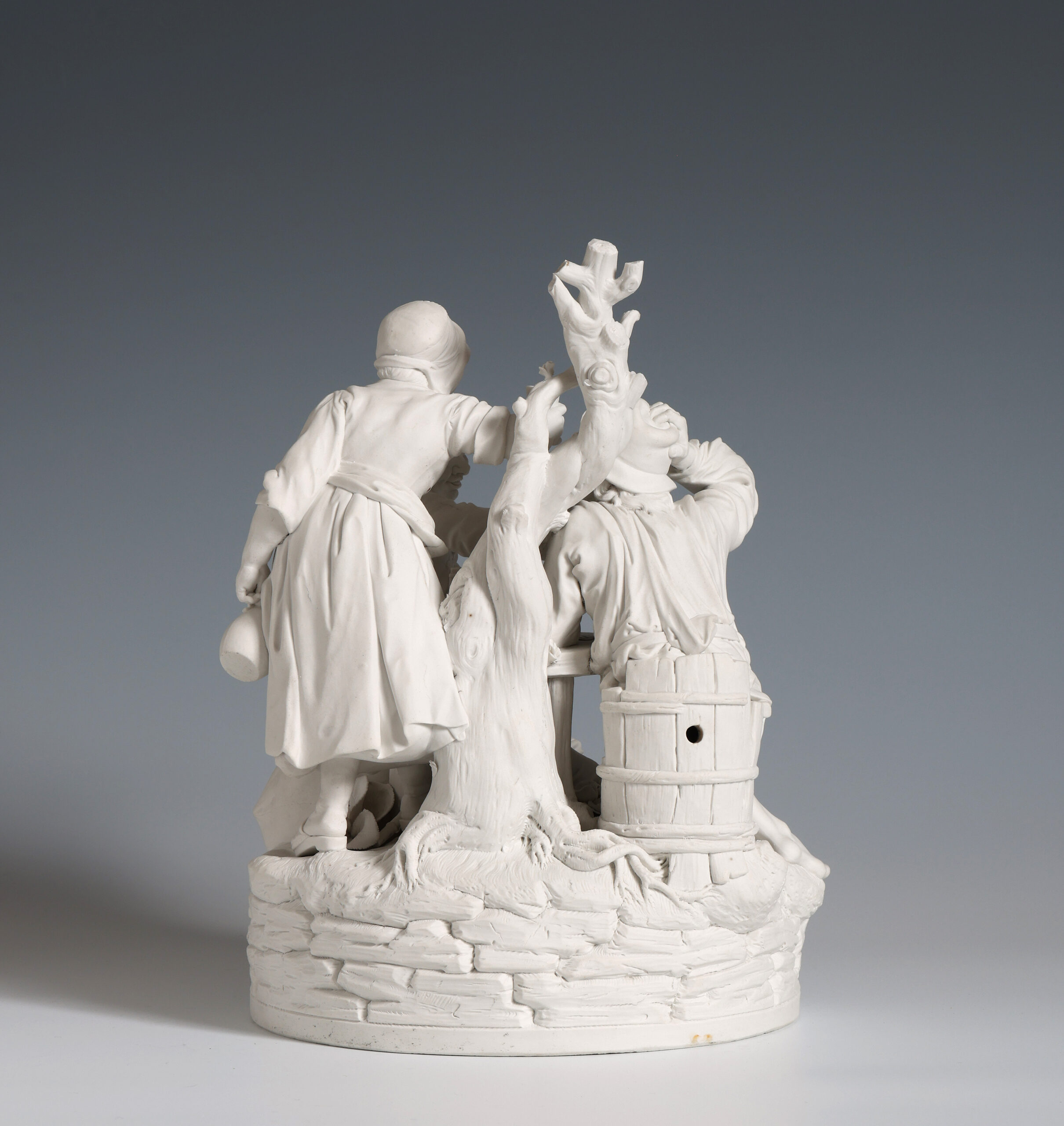

To date only four different large-scale models of these remarkably elaborate groups have been identified. Some are known in two or three versions (with small variants), making nine examples recorded in all so far. They are characterised by an extraordinary attention to detail and excellence of finish that is matched by no other producer of biscuit porcelain of the eighteenth century.
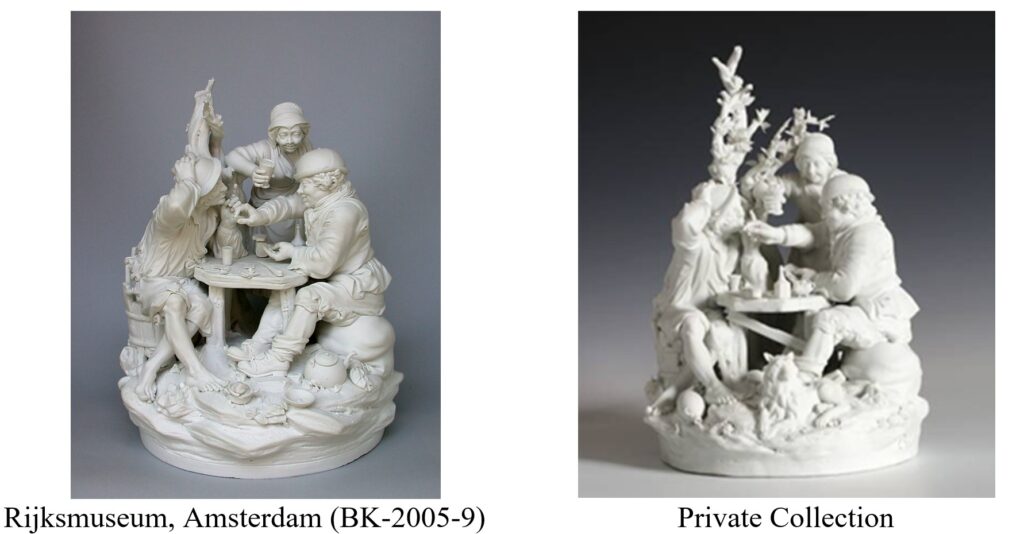
Our group is one of three recorded examples depicting a cardsharp, seated at a table, outwitting a simple peasant whilst his accomplice, a barmaid, plies him with a frothing glass of beer. On the table we see the cards, a tobacco box and pipes. Each of the three known versions have different details and bases.
The first recorded example of this group is the one that was acquired, from us, by the Rijksmuseum, Amsterdam, in 2005 and was published in the Rijksmuseum Bulletin in 2006.[i] Another example with a dog, a Keeshond, or Dutch Barge Dog, a symbol of the Patriot faction in the Netherlands during the unrest in the years before the French Revolution, is in a private collection.
The other examples of the related large groups are clearly by the same very skilled modeller. The features are bold, almost exaggerated, and often include dogs or, in the case of the Hollandse Maagd, a lion, another symbol of the Patriottentijd.[ii]

Allegorical group (Rijksmuseum R.B.K.16054)
The only one of the large groups that is marked is the allegorical group in the Rijksmuseum of a beggar woman and gentleman, perhaps a naval officer, having his shoes polished beside a bust of Diana on a pedestal. It is incised ‘MOL’ for Manufactuur Oude-Loosdrecht.[iii]
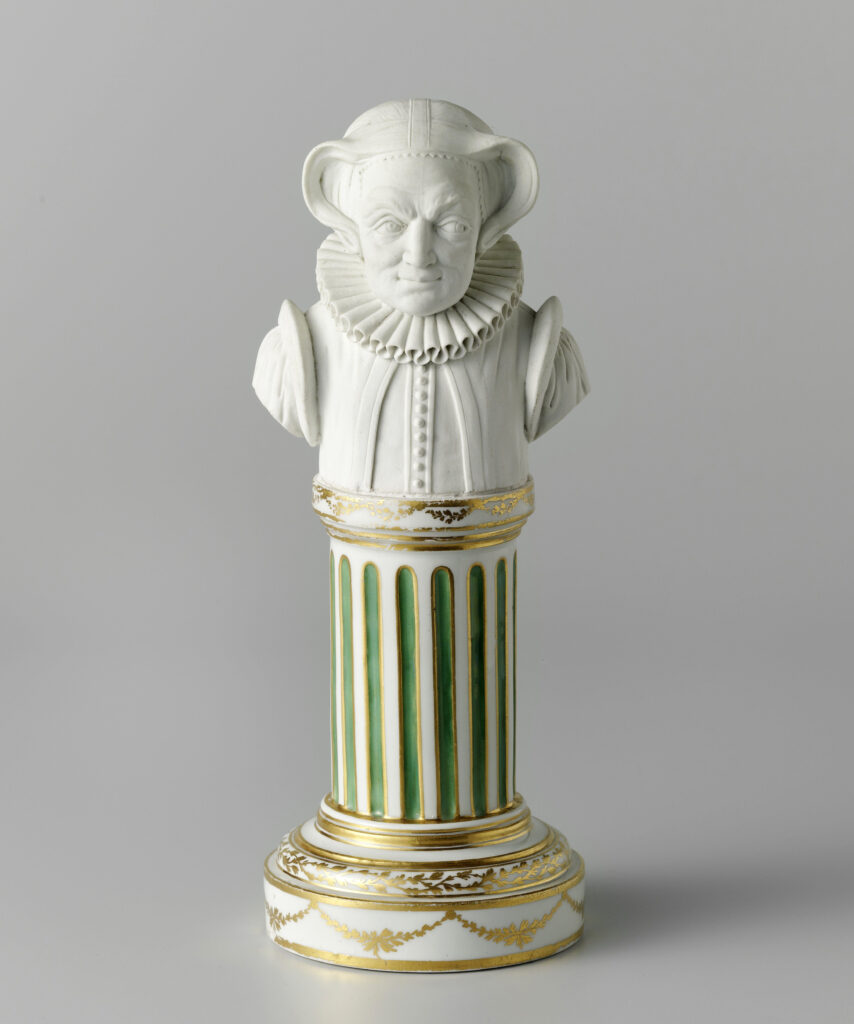
Maria van Utrecht (Rijksmuseum BK-NM-5845)
Numerous smaller busts of historic patriotic heroes exist with the same distinctive strong modelling and boldly defined features which appear on pedestals which are also marked MOL, for example Maria van Utrecht. Further smaller marked groups and figures include two fighting dogs in the Musée National de Céramique, Sèvres and the only glazed and enamelled Loosdrecht figure, a boy representing Autumn with a painted mark, now in a private collection. A number of fragments of figures, including elements of the fighting dogs, were found in the excavations of the factory site and published in De Loosdrechtse porseleinfabriek boven water, in 2007. [iv]

Fighting dogs (Sèvres – Cité de la Céramique, MNC 14085)
The identity of the highly accomplished sculptor of these figures and groups has not been established, but we do know that Joannes de Mol employed a skilled worker, Johan Christoph Jurgens who had spent his apprenticeship at the porcelain factory of Fürstenberg, where, as late as 1772, he was referred to as a Figurenformer. In 1778 Jurgens married Wilhelmina Davidson from Doesburg in Loosdrecht. He was presumably the mould maker and modeller rather than the actual sculptor.[v] Joseph Estié, of Salomon Stodel Antiques, makes the interesting suggestion that the production of biscuit sculpture at Loosdrecht coincides with the time that the great French sculptor and head of the modelling studio at Sèvres, Etienne Maurice Falconet (1716-1791), took refuge in The Hague when he was forced to leave Russia. Falconet gave lessons in sculpture at the Hague and was accompanied by his daughter-in-law Marie-Anne Collot who hoped to build a career as a portrait sculptor in the Netherlands, perhaps she was the author of these remarkable works.[vi]
Condition:
Toe restuck, losses
References:
Rijksmuseum 2006
Bulletin van Het Rijksmuseum, Jaargang 54/nummer 1, 2006, ‘Keuze uit de aanwinsten’
Trumpie & Bosmans 2007
Ank Trumpie & Sarah Bosmans, Pretty Dutch, 19th Century Dutch Porcelain, Exhibition catalogue, Princessehof Leeuwarden, 2007
Nieuwenhuizen 2007
Koos Nieuwenhuizen, De Loosdrechtse porseleinfabriek boven water: over gebouwen, porseleinproductie en ds De Mol, 1774-1784, (Historische Kring Loosdrecht, Loosdrecht 2007).
Zappey et al. 1988
W. M. Zappey, A. L. den Blaauwen, A. W. A. van der Goes, A. C. Pronk, Loosdrechts porselein, 1774-1784, (Waanders, 1988)
Estié 2009
Joseph Estié, Hollands Porselein, Collectie Willems, 150 jaar Salomon Stodel Antiquités, 2009
———————————————————————————————————————————————-
[i]Bulletin van Het Rijksmuseum, Jaargang 54, 2006 /nummer 1, no. 9, Groep van een kaartspelend gezelschap, pp. 82-83.
[ii] The two examples of the Hollandse Maagd are illustrated in Trumpie & Bosmans 2007, p.138 figs. 1 & 2.
[iii] Zappey 1988, pp. 298 & 299.
[iv] Nieuwenhuizen 2007, pp. 118, 119 & 120.
[v] Bulletin van Het Rijksmuseum, Jaargang 54, 2006/nummer 1, no. 9, pp. 82-83.
[vi] Estié 2009, pp. 84 & 85.
Price: £24,000

ADDENDUM
List of known Oude Loosdrecht Biscuit Porcelain Groups
Four different models of the larger groups are known to us. Some of are known in two or three versions (with small variants), making nine examples recorded in all so far.
- Allegorical group of a beggar woman and gentleman beside a bust of Diana on a pedestal.
Two versions known:
One in the Rijksmuseum, incised MOL (Rijksmuseum BK-16054)
Another (with some differences), Christie’s, Laren, 21 and 23 October 1980, lot 1216.
- ‘Hollandse Maagd’ – Group of the Maid of Holland seated by the Lion of the Dutch Republic holding the seven arrows of the provinces beside a child holding the fasces.
Two versions known:
-Museum Sypesteijn, Loosdrecht.
Exhibited at the Kunstmuseum Den Haag exhibition ‘Nederland Dineert. Vier eeuwen tafelcultuur’ in 2015.
Acquired in 2001from Dalva Brothers, New York, through Jacob Stodel.
-Another almost identical version now in a private collection. Sold by E & H Manners in 2002.
Both of these were exhibited in the Princessehof, Leeuwarden in 2007 and published in ‘Pretty Dutch, 19th Century Dutch Porcelain’, p. 138 figs. 1 & 2.
- Group of card players seated on a barrel and a sack around a table and being served drinks by a
Three versions known:
-Rijksmuseum (BK-2005-9). Sold by E & H Manners in April 2005.
Published in Bulletin Van Het Rijksmuseum, Jaargang 54/nummer 1, 2006, pp. 82, 83
-An example with E &H Manners in 2021, now in a private collection.
-Third example currently with E & H Manners.
- Group of revellers drinking and playing music
The fiddler with his dog at his side and a serving girl seated around a barrel. The girl handing a mug to a boy leaning over an arch.
Two versions known:
-One in the Museum Grand Curtius, Liège
-Another in the Rijksmuseum (BK-2017-39). Sold by E & H Manners in 2017
Figures and groups on a smaller scale include:
The only known glazed and coloured example of a figure is of a boy squeezing grapes into a glass, marked M.O.L with a star in underglaze blue (Private Collection, ex L’Argenterie Antique).
There is also an unmarked biscuit version of this figure in a private collection.
A group of two dogs fighting in the reserve collection of Sèvres – Cité de la Céramique. Incised mark: M:OL L48. (Published ‘Hollands Porselein, Collectie Willems’, 150 jaar Salomon Stodel Antiquités, 2009, pp. 84 & 85).
Fragmentary elements of figures and groups found in excavations at Loosdrecht.
Published in ‘De Loosdrechtse porseleinfabriek, boven water’, (Historische Kring Loosdrecht, Loosdrecht 2007) ,
A waster of the fighting dogs group, p. 118, figs. 239 and 240
A waster of a group of two putti around a dolphin on a socle of waves, p. 116, figs. 235, 236
Pieces of a head, a hat, wings and hands, pp. 119, 120
Beyond this there are numerous busts on columns of Dutch historical figures, these all have the same distinctive exaggerated features of the faces in the bigger groups.