

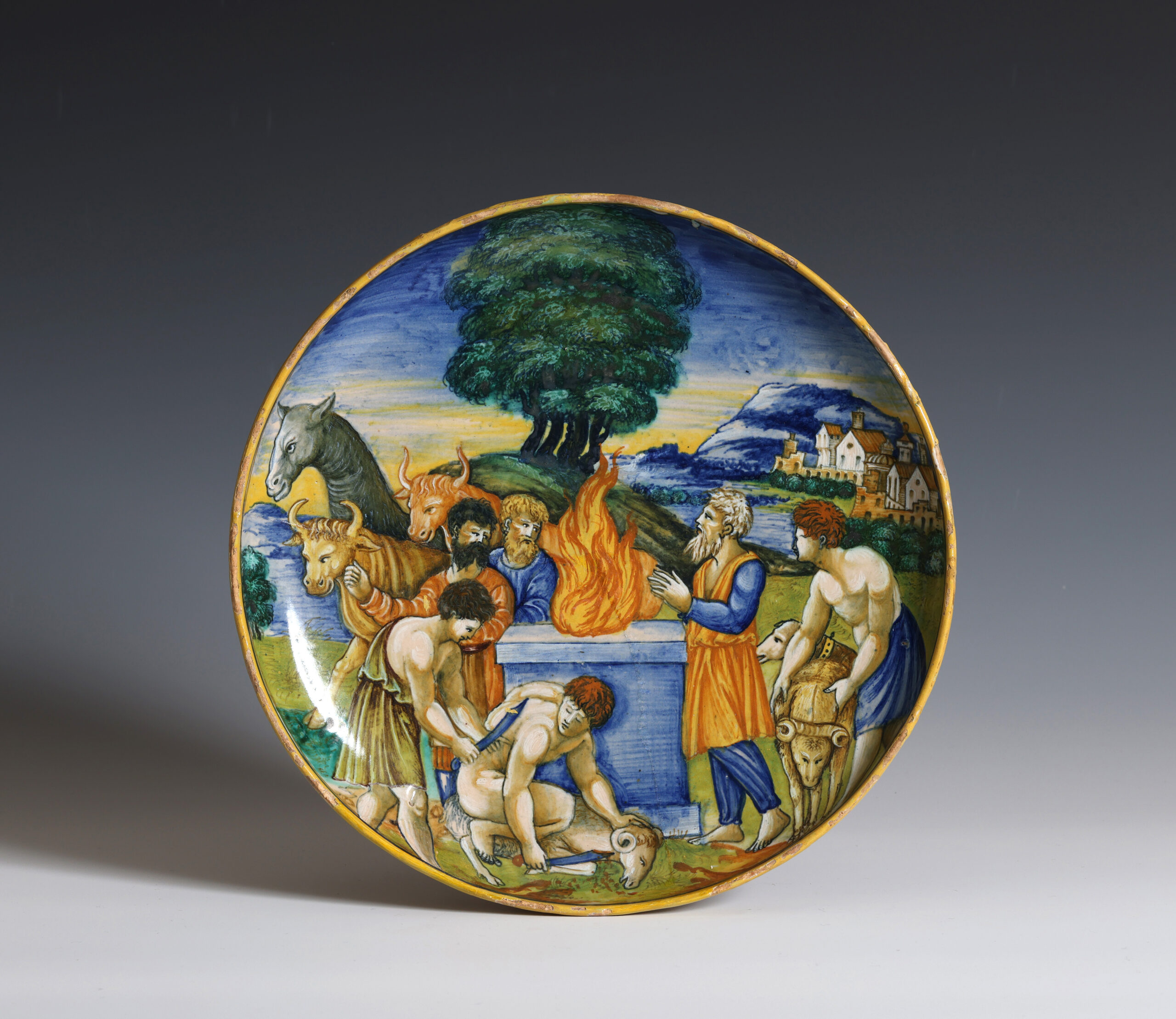
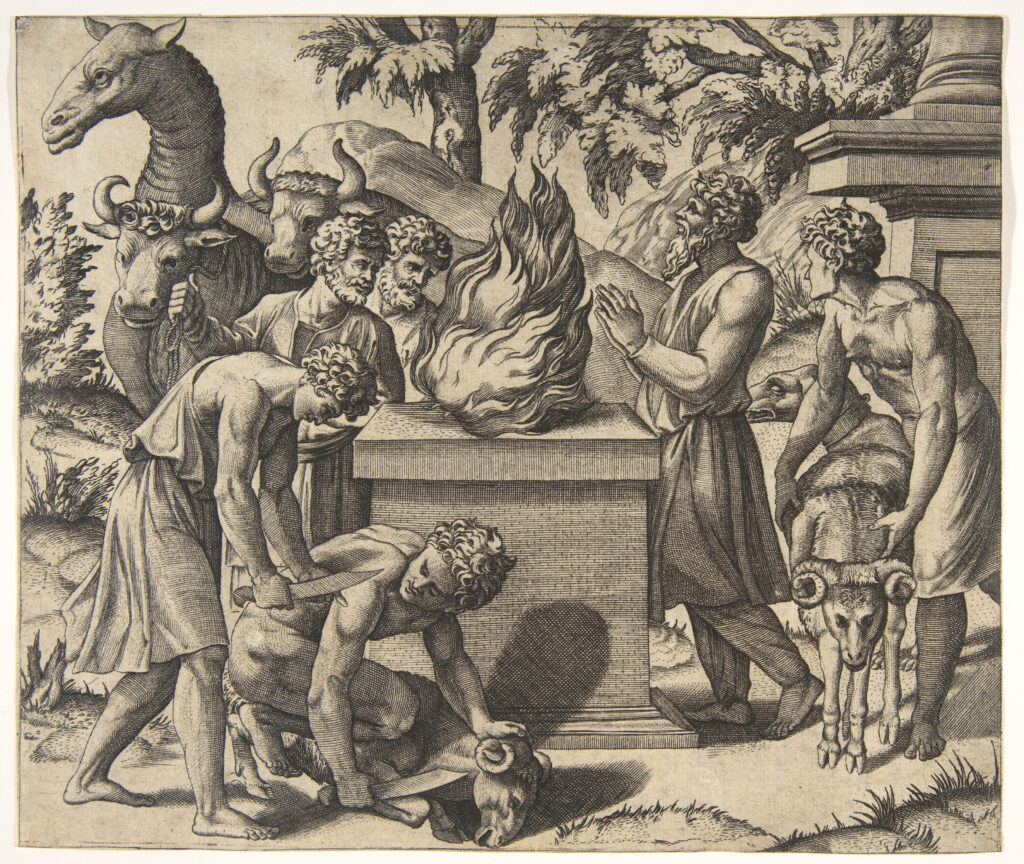
Depicting The Sacrifice of Noah, after an engraving (1515-27) by Marco Dente after Raphael’s design for the fresco of Noah’s Sacrifice in the Vatican Loggia. The Sacrifice of Noah refers to the biblical event where upon leaving the ark after The Great Flood, Noah made a burnt offering of every ‘clean’ animal to God. This act of worship pleased God, and He promised never to destroy the earth by a flood again. This promise is referred to as the Covenant of the Rainbow. The rainbow is said to be a reminder of this everlasting pledge.
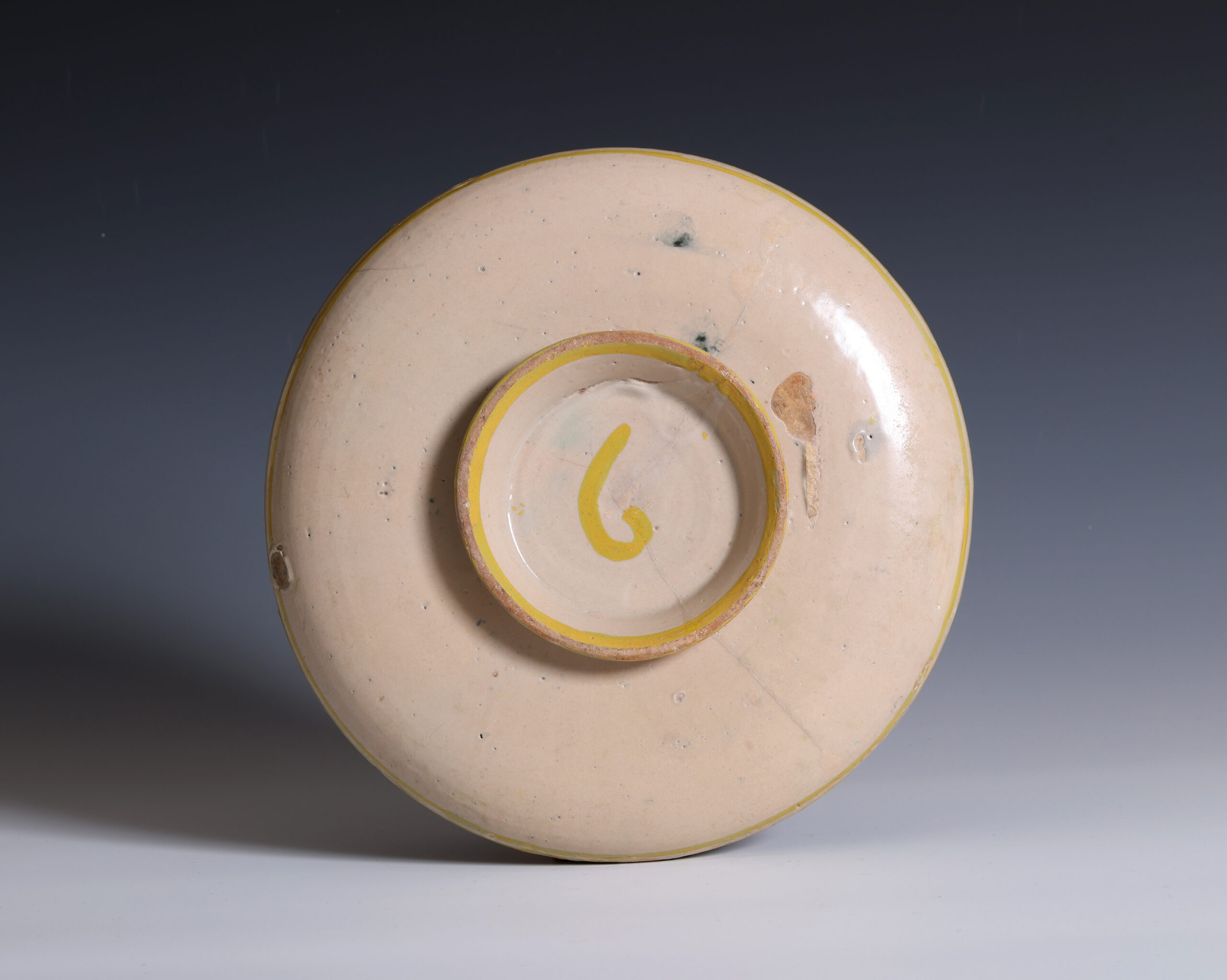
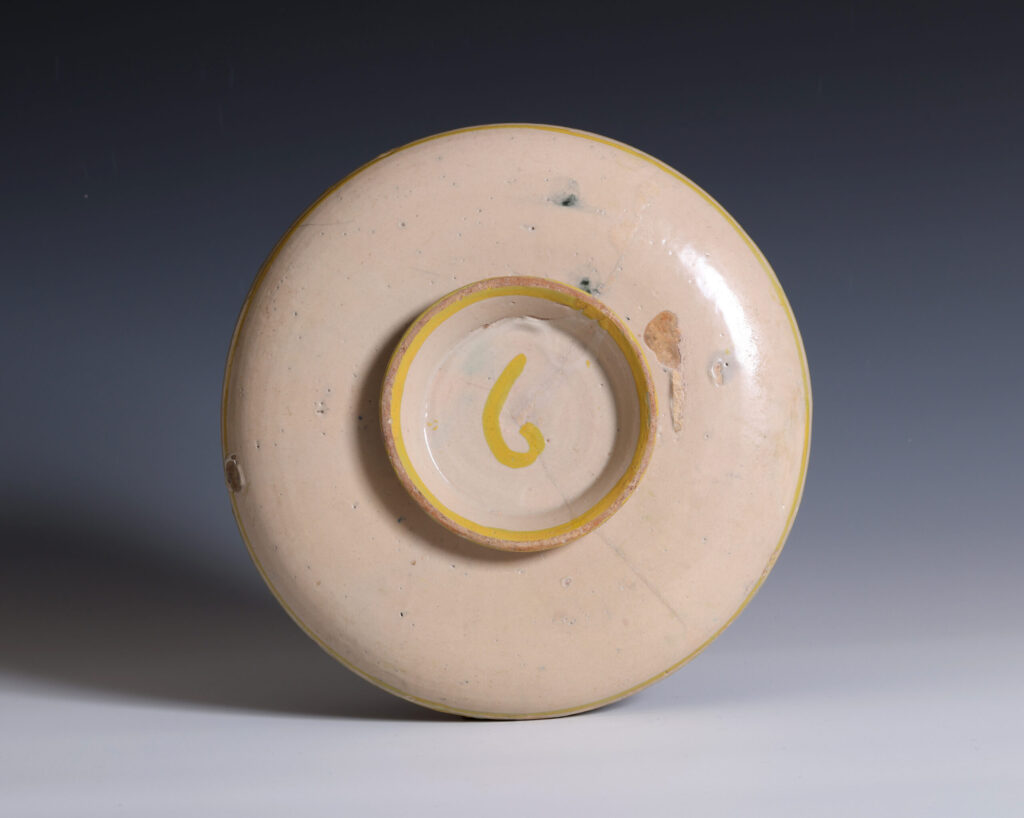
Our dish relates to small a group attributed to the ‘Argus painter’, named by John Mallet in an article of 1980 after a dish in the British Museum depicting the ‘all-seeing’ 100-eyed giant Argus.[i] The group coalesces around the fact that the ‘primary group’ of six low-footed dishes are inscribed on the reverse as having been ‘fato in pesaro’ [made in Pesaro] in the same script, and all-bar-one have the same blue foliate scroll around the foot ring. There are two further pieces that Mallet proposed as being by the same painter, including another dish in the Musée National de Céramique, Sèvres, with a monogram on the reverse that could be interpreted as either G.R? G.I.R? or G.F.R?. There is a further category that the group was extended to in a second article written in 1985 that bears a yellow mark to the reverse that could be interpreted as a ‘6’ or a ‘G’. When Mallet wrote his 1985 article[ii], there was only one piece in this category, since then another fragment has been identified and now with our dish it is a group of three. There may be other examples bearing this mark that I am not aware of.
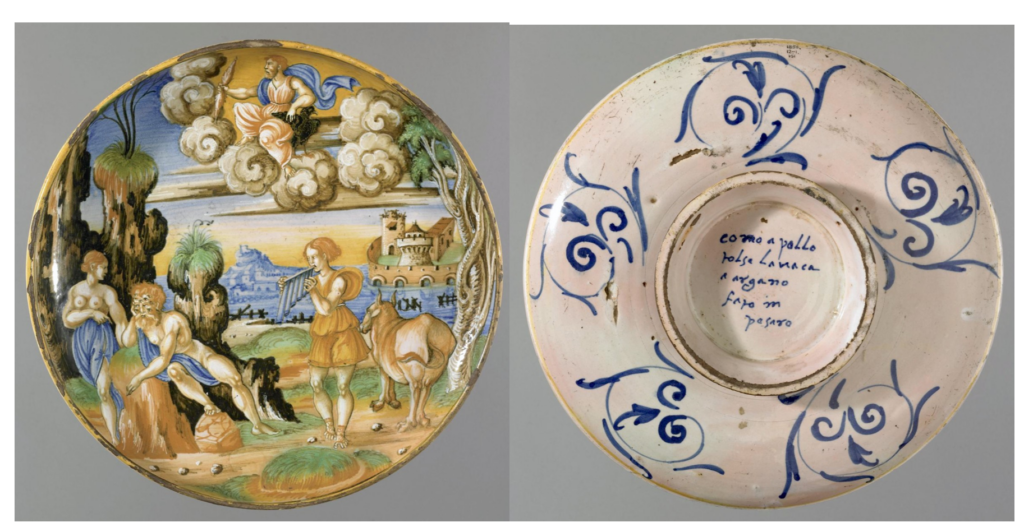
‘The Argus dish’ British Museum (1855,1201.101)[iii]
Although there are no dated pieces, given the stylistic links to Xanto and Nicola, Mallet suggested that the Argus painter was likely to have trained in Urbino and been working in Pesaro somewhere between 1535-1545. With the earliest dated pieces of Pesaro maiolica being dated to 1540, it is possible that he is the first of the Pesaro istoriato painters to be producing work in the Urbino manner. He seems to have produced all these pieces in a relatively short period. Mallet points out that the only bottega that we have marked pieces from at this time in Pesaro is Maestro Girolamo di Lanfranco dalle Gabbicce, and the G could be the mark of the workshop or that ‘it is just possible that the Argus painter is Girolamo [di Lanfranco dalle Gabicce] himself’. In the 15th century, Pesaro produced some of the highest quality istoriato of the period but seems to have stopped almost entirely at the beginning of the 16th century. This revival of istoriato painting in Pesaro coincides with Guidobaldo II becoming Duke of Urbino in 1538, and his preference for Pesaro as the seat of his court.
The dish that is discussed in Mallet’s 1985 article, which first introduced the ‘6’ or ‘G’ mark, depicts Hercules fighting the Centaurs, now in The Museo Internazionale delle Ceramiche in Faenza. Mallet pointed out that the print that the scene derives from ‘has only the most rudimentary landscape’, so the background on this dish is entirely of the painter’s creation and could lend itself to uncovering some characteristic features of his painting[iv].’ There are not many identifiable features in the landscape of our dish but there are a couple. At the elbow of the centaur drawing an arrow is a mountain of almost exactly the same form as one on our Sacrifice of Noah dish, and while not very prominent, it also contains a domed building in the background. The similarities in the backgrounds are limited but given that they also bear the same mark and have strongly outlined figures faithfully copied from contemporary engravings I find it compelling to think that they are painted by the same person, and very likely that they were made in the same workshop.
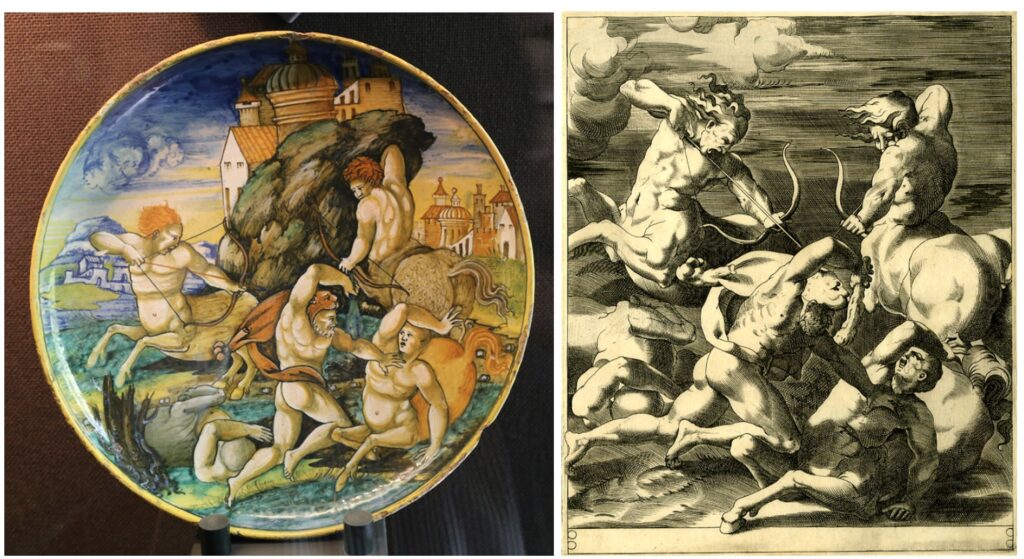
Hercules and the Centaurs, Museo Internazionale delle Ceramiche, Faenza
In 1985, when Mallet attributed the Hercules and the Centaurs dish from the Faenza museum [v] to the Argus painter, he pointed out the many similarities that it shares with the primary group of Argus painter dishes inscribed ‘fato in Pesaro’. He points to his tendency to feature ‘Bramantesque’ domed buildings in the background and compares the ‘rocky mound loaded with buildings to rise from the very centre of the dish’ to a similar feature in another dish of the original series in Braunschweig, that presents another, very different composition of Hercules fighting the centaurs. He also notes the similarity in ‘the manner of modelling and outlining the flesh; the method of painting profiles and other heads.’
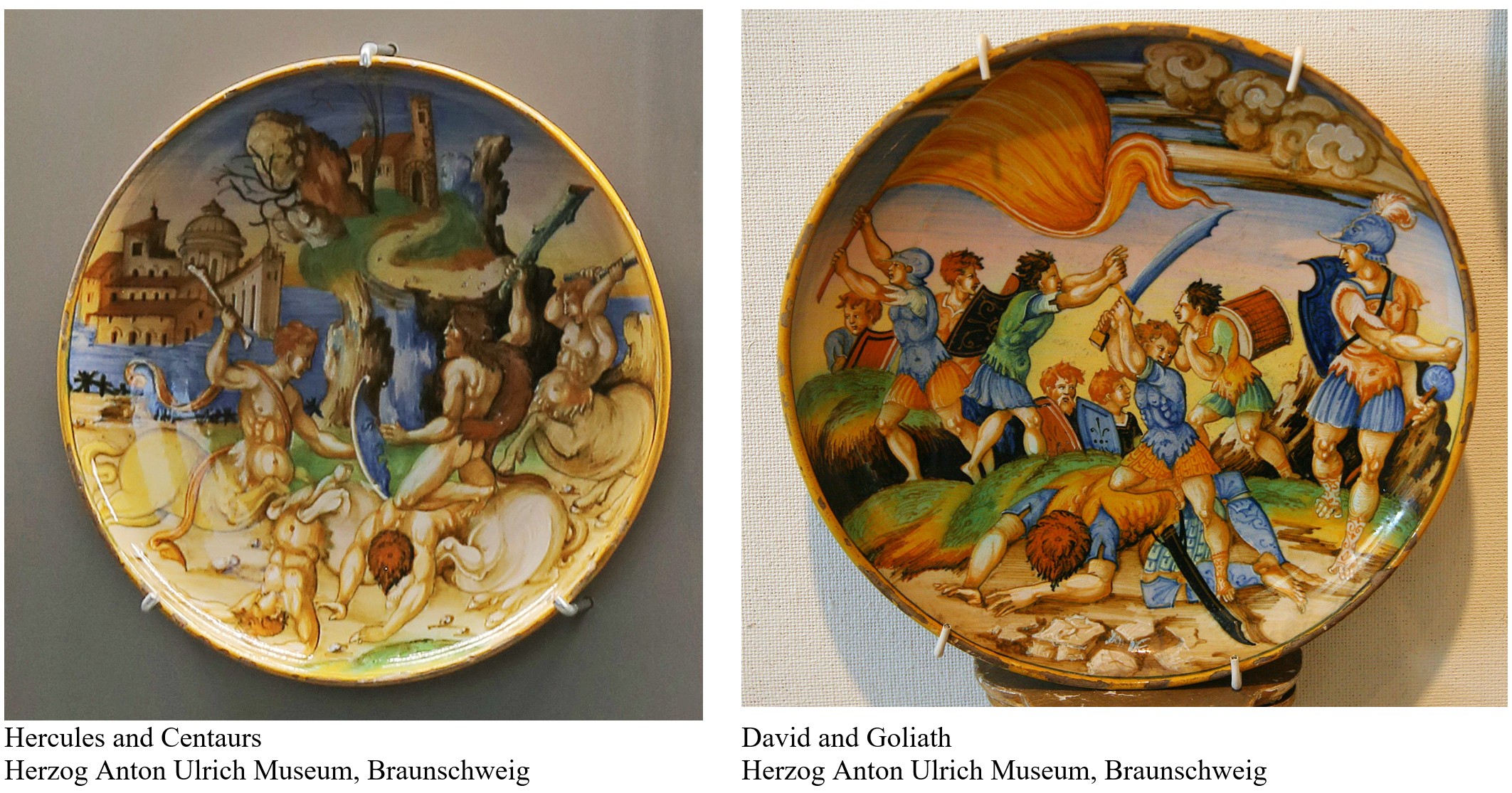
There is also a strong comparison between the Hercules and Centaurs dish marked with a ‘6’ and another from the primary group that depicts David defeating Goliath, also in the Herzog Anton Ulrich Museum in Braunschweig. See the distinct outlining of the bodies, and that Goliath takes the same form as the defeated centaur at the fore of Braunschweig’s Hercules and the Centaurs dish. Whereas both the Sacrifice of Noah dish and Hercules and the Centaurs dish in Faenza are diligent copies of prints, the two in Braunschweig are, as Mallet describes in his article of 1980, ‘freely adapted’ from their print, with the addition and adaptation of characters. This a feature of the Argus painter that is stressed as a feature of his style in Mallet’s original 1980 article. I am not sure whether there is much to infer from this observation, as many of the other scenes are drawn from much more primitive woodblock prints, which would require a larger degree of interpretation. I do not particularly doubt they were painted by the same hand, but it shows a different of approach to the painting the scenes on two of the three dishes marked with a ‘6’ or ‘g’ to some the wider group.
We should take a moment to look at the third fragmentary piece that bears a yellow spiral mark. The dish differs slightly from our Sacrifice of Noah dish and the Hercules battling the centaurs dish in Faenza, in that the mark is an inverted version of the one on the other two, and the draughtsmanship seems to be of a lesser quality. This type of mark is a very rare feature on maiolica so despite the difference, the pieces are overwhelmingly likely to be connected. There are also a number of features that link it to other pieces in both groups – heavily outlined figures, a deity amongst clouds, a central rocky outcrop, distinctive fence motifs and tabletop mountains in the background – that it fits into the wider ‘fato in Pesaro’ group. Given all these joining dots, it seems likely to have been painted by the same painter too.
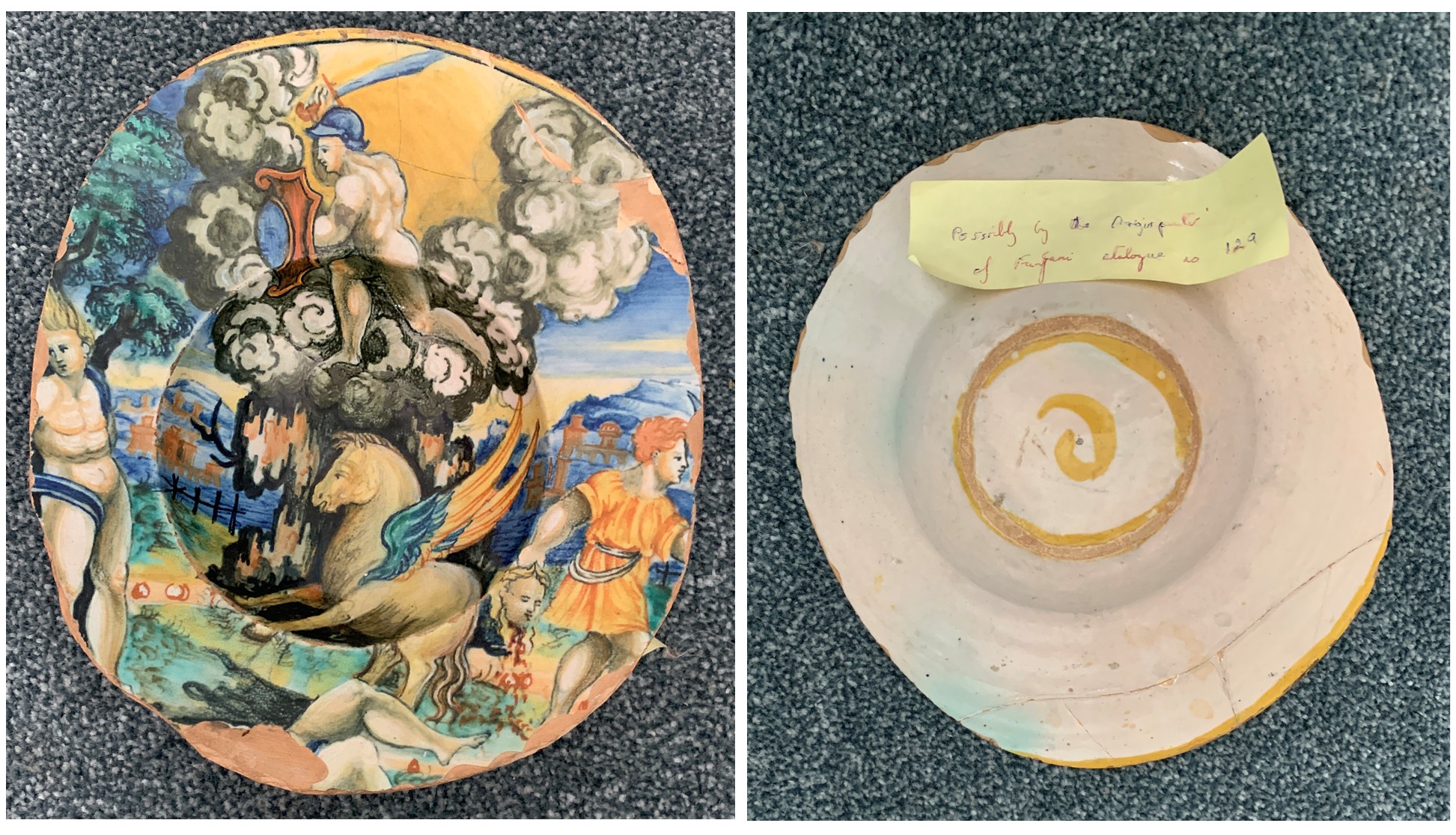
Private collection
Below, I list the other dishes from the original group, all bearing inscriptions in the same hand, stating that they were ‘fato in Pesaro’. Both the Gaio ed Ottavio and the Influence of Mercury dishes have the same distinctive foliate scroll pattern to the reverse, while Picus and Circe is plain around the footrim. In this description I have made an effort to link our Sacrifice of Noah dish to the rest of the group using the dishes I consider to relate most strongly to it.
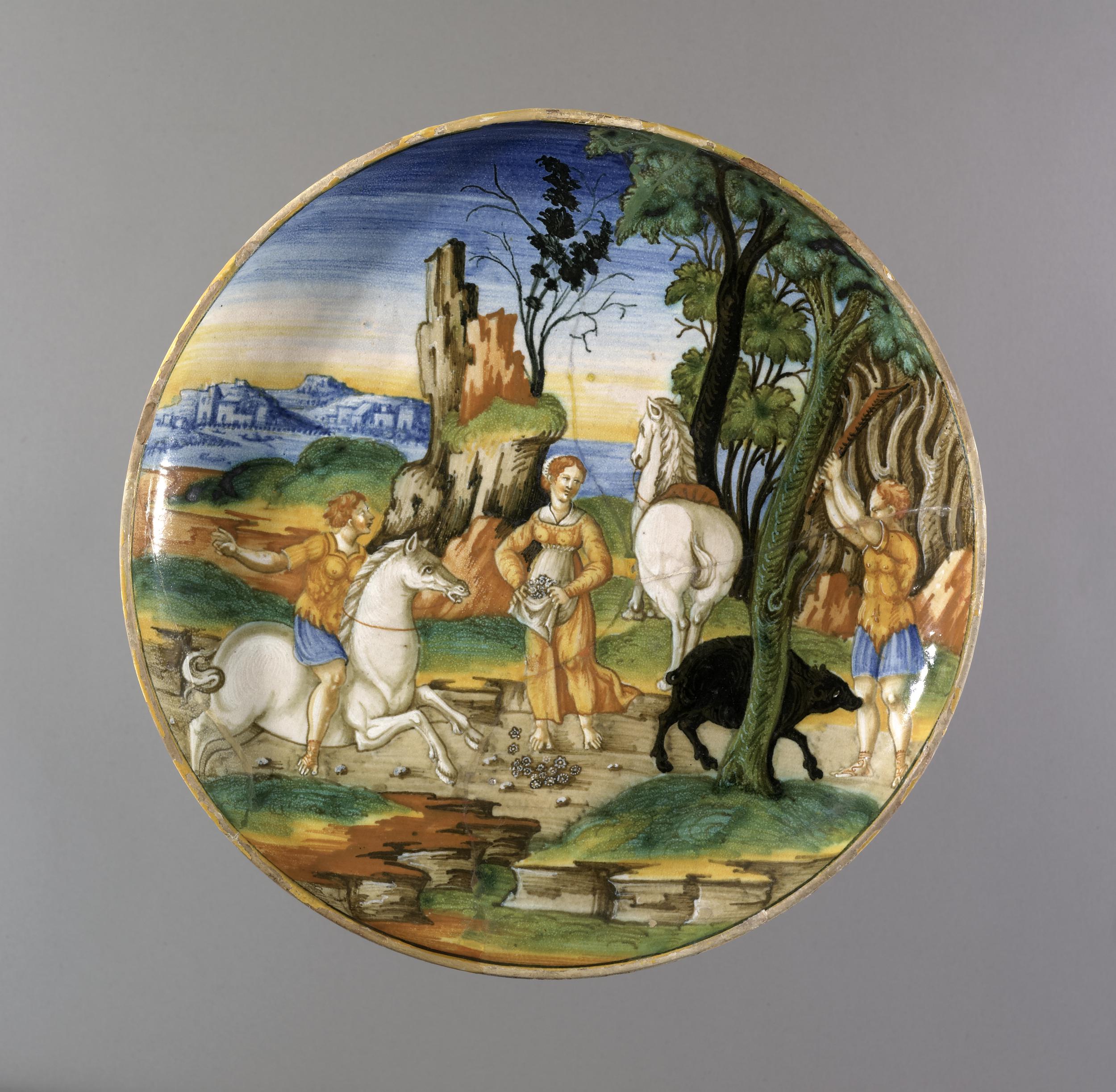
Picus and Circe, British Museum
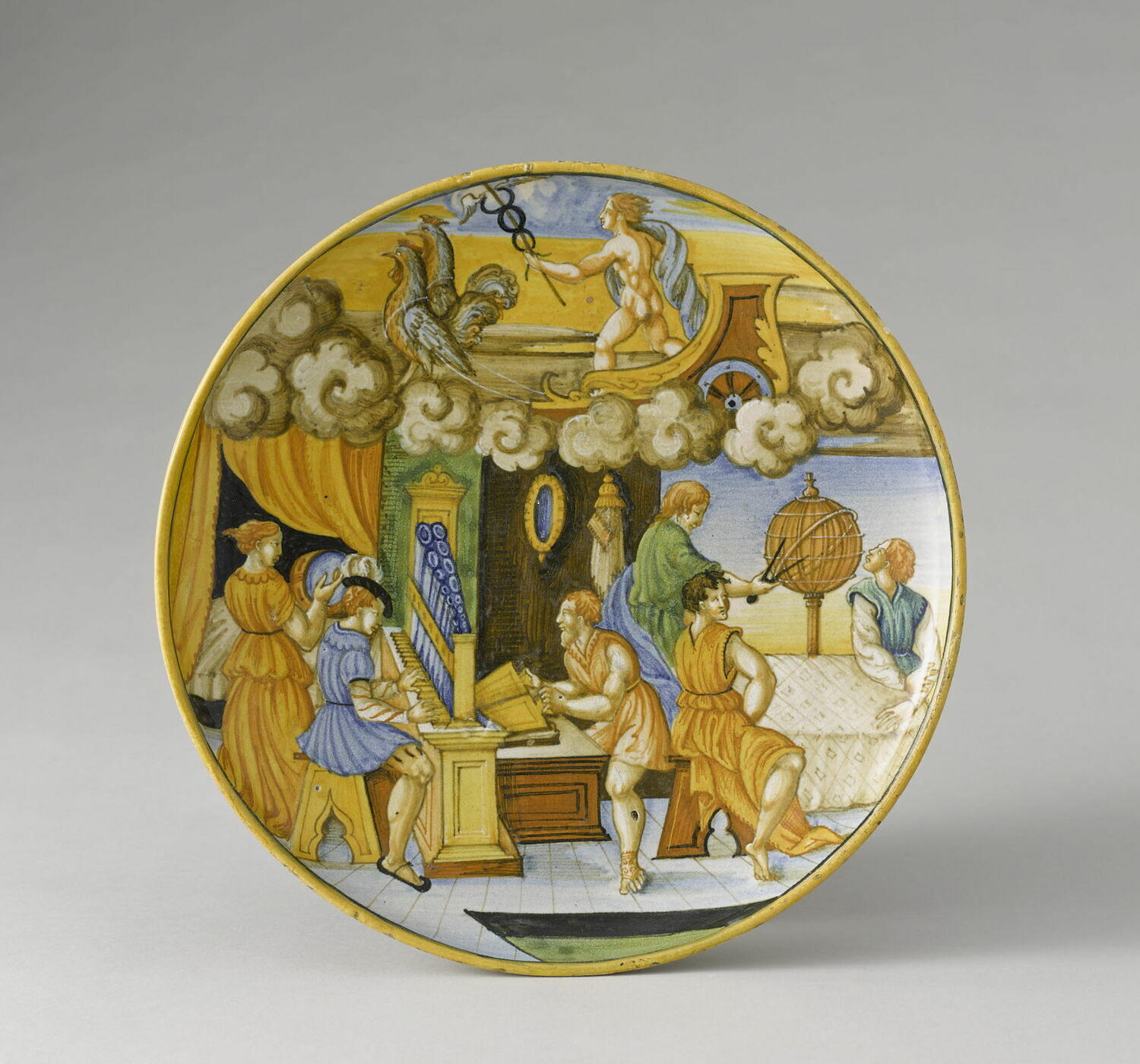
Influence of Mercury, The Louvre
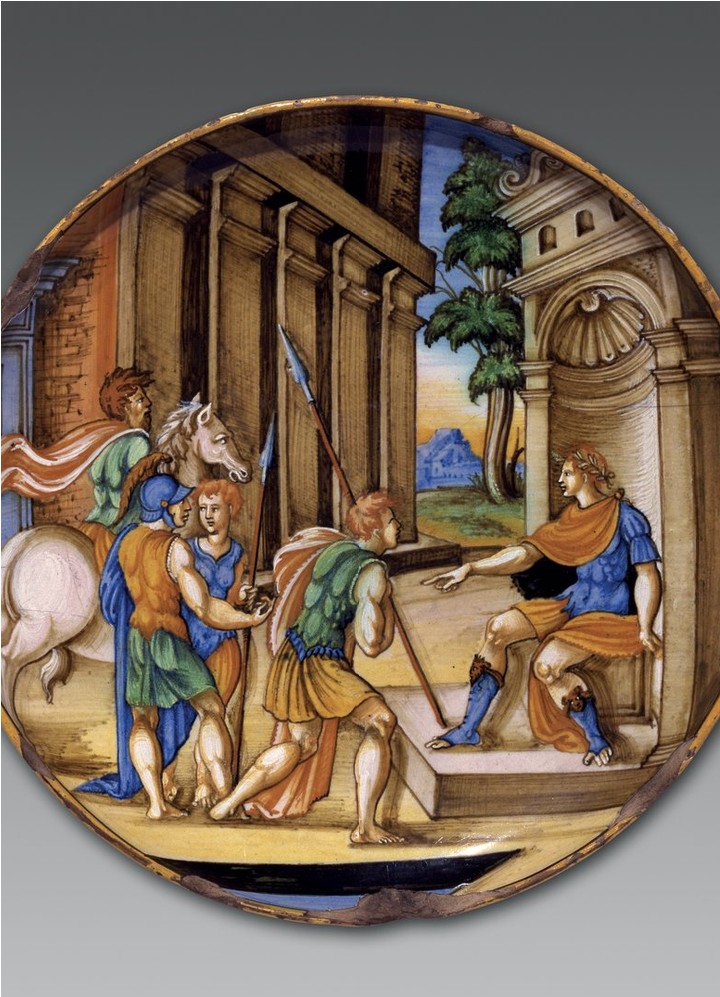
Gaio ed Ottavio, Historisches Museum Basel
I thank John Mallet, Timothy Wilson and Elisa Sani for their assistance in identifying and with the description of this piece.
Condition:
A large section restuck along a line from 9 o’clock to 6 o’clock, with restoration to the rim at 6 o’clock. Old rivets filled.
Provenance:
Robert Compton Jones Collection
References:
Lessmann 1979
Johanna Lessmann, Italienische Majolika: Katalog der Sammlung Herzog Anton Ulich-Museum Braunscweig, (Braunschweig 1979)
Mallet 1980
John Mallet, ‘Istoriato painting at Pesaro’, written for Faenza, Anno LXVI, no. 1-6, 1980, pp. 153-164
Mallet 1985
John Mallet, ‘Istoriato painting at Pesaro. II. An additional work by the Argus Painter’, written for Faenza, Anno LXXI (Vol. 71), no. 4-6, 1985, pp. 293-295
Guidotti 1990
Carmen Ravanelli Guidotti, La Donazione Angiolo Fanfani Ceramiche dal Medioevo al XX Secolo, (Edit Faenza, 1990)
Thornton Wilson (2009)
Dora Thornton and Timothy Wilson, Italian Renaissance Ceramics: A Catalogue of the British Museum Collection, Vol 1, No. 64
Price: £24,000

[i] John Mallet introduced the Argus painter in an article “Istoriato painting at Pesaro”, written for Faenza, Anno LXVI, no. 1-6, 1980, pp. 153-164. He lists six low footed dishes of the same form and size that all have inscriptions on the reverse that sign of as having been made in Pesaro. He also suggests two other pieces as candidates for having been painted by the Argus Painter. One of particular interest that bears a monogram to the reverse that could be interpreted as G.R; G.I.R. (for Girolamo?); G.F.R
[ii] See Istoriato painting at Pesaro. II. An additional work by the Argus Painter, written for Faenza, Anno LXXI (Vol. 71), no. 4-6, 1985, pp. 293-295 this article introduces the dish of Hercules and the Centaurs with the Mark of a 6 of a G to the reverse.
[iii] Tim Wilson and Dora Thornton, in their catalogue of the Maiolica of the British Museum in 2009, write descriptions of the Argus dish, and also of another ‘Argus painter’ dish of Picus and Circe. They broadly agree with the conclusions of John Mallet’s article that he was one of, if not the earliest Istoriato painters to be working in Pesaro, and may well have been working in the workshop of Girolamo di Lanfranco.
[iv] While agreeing with the attribution of this dish to the Argus Painter, Guidotti disagrees that the fantasy background Mallet refers to is very helpful to deciphering the style of the Argus painter, describing the background as having been painted in ‘conventional way, [with] routine elements of the istoriato of the time’.
[v] This dish, and the next ‘David and Goliath’ dish are written up and illustrated in the catalogue of the Herzog Anton Ulrich museum by Joanna Lessmann. pp330-331, catalogue numbers 461 & 462. At this point John Mallet had already presented a talk on the Argus Painter, and the pieces in Braunschweig were attributed as such, but he had not yet written the 1980 article.