
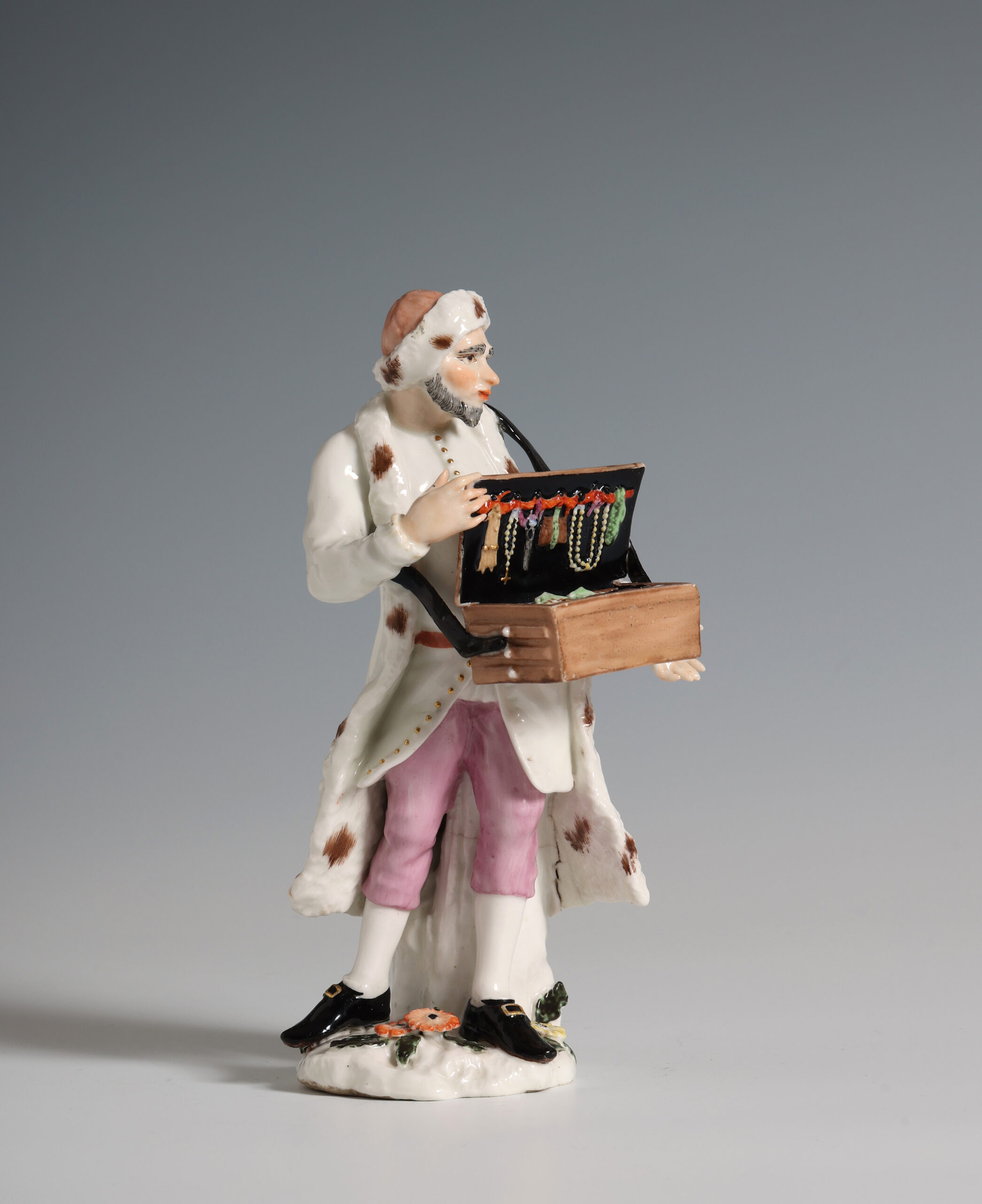
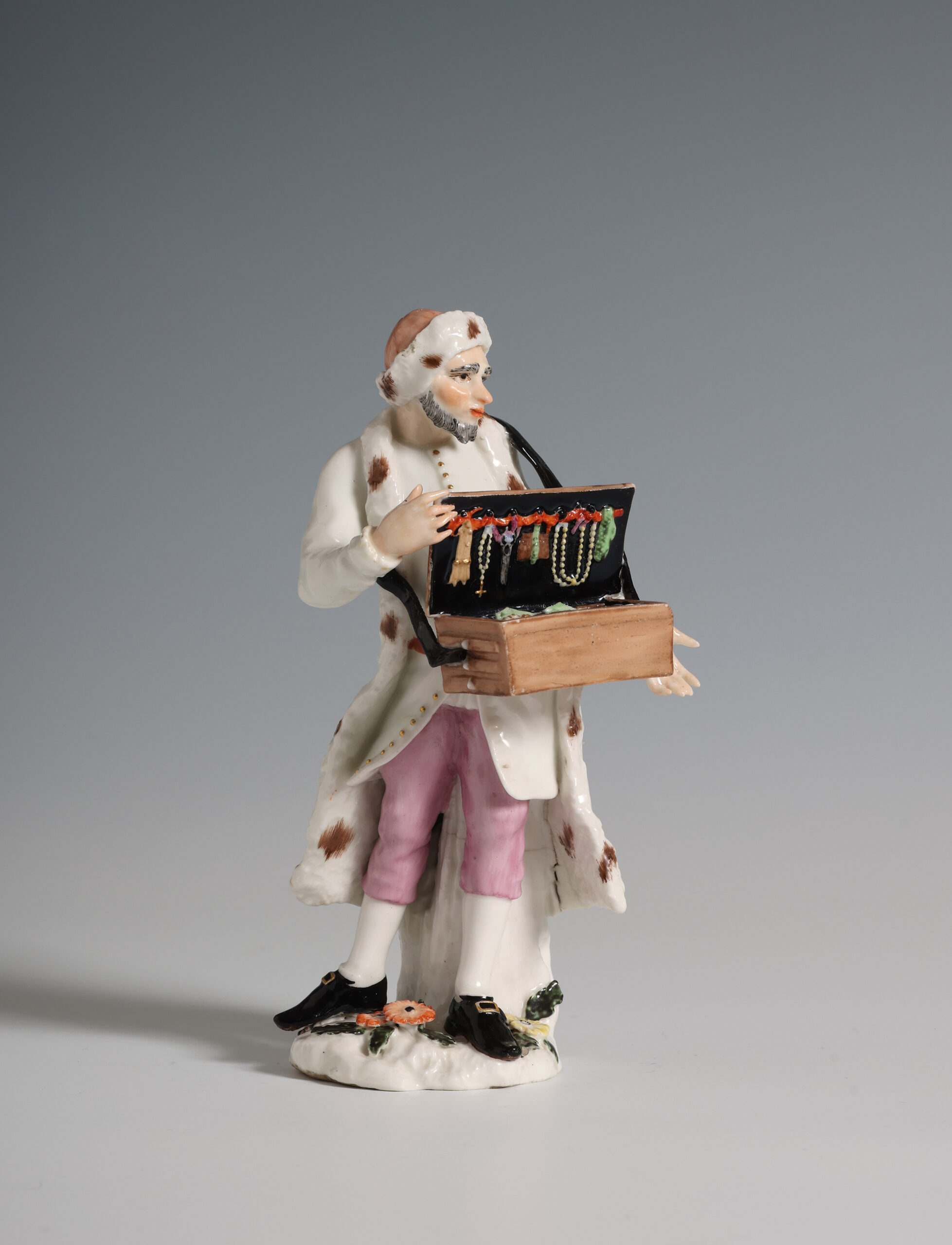
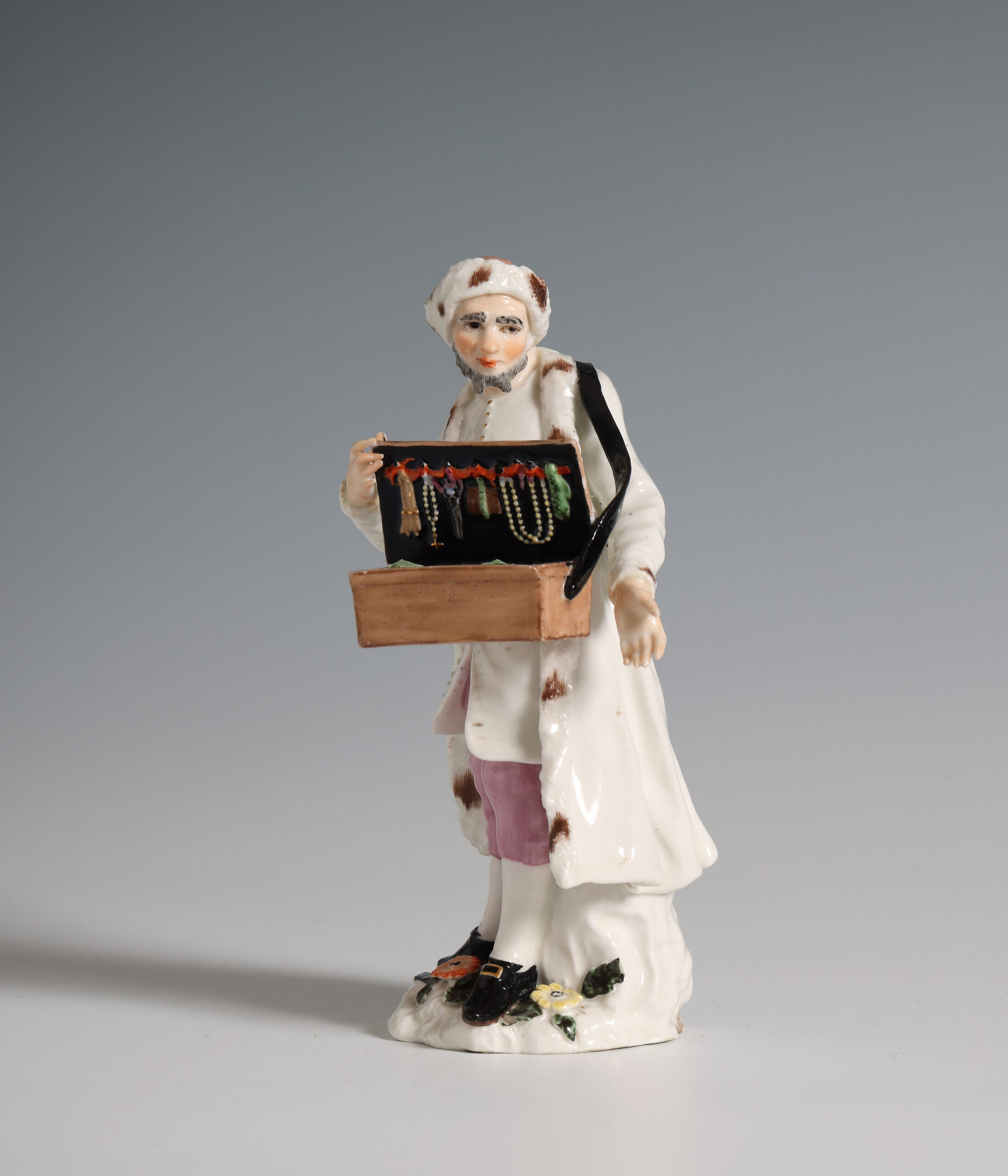
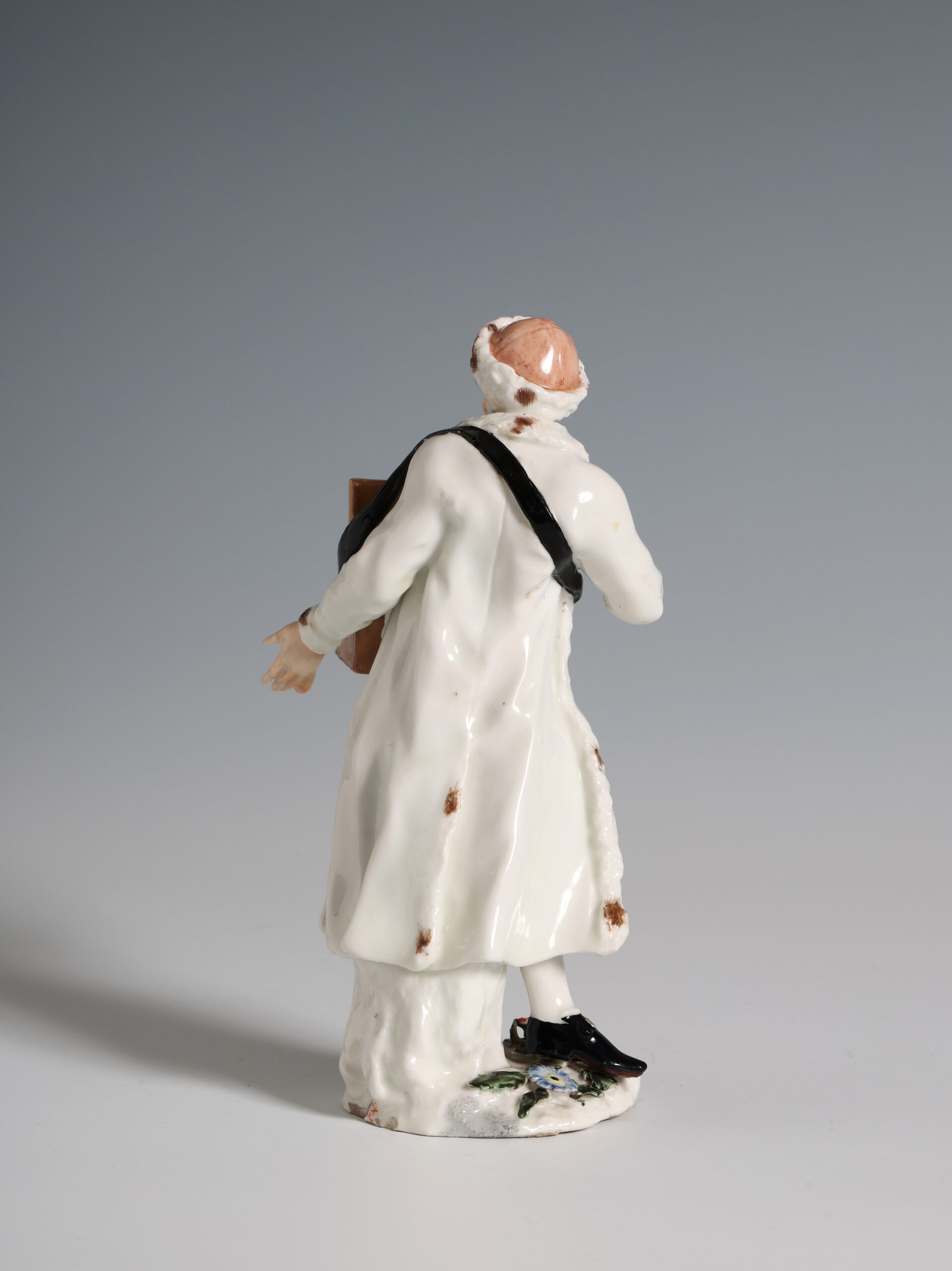
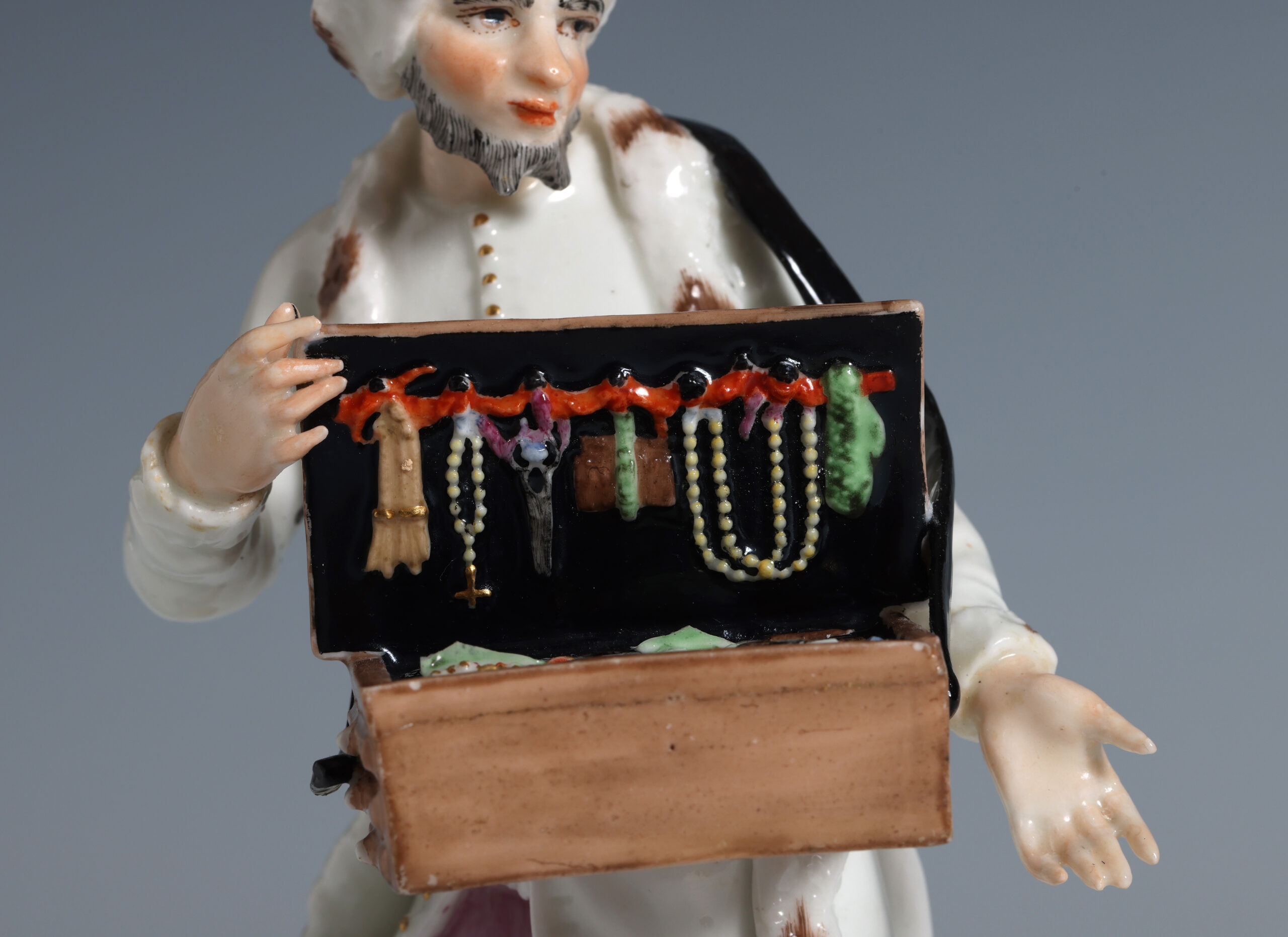
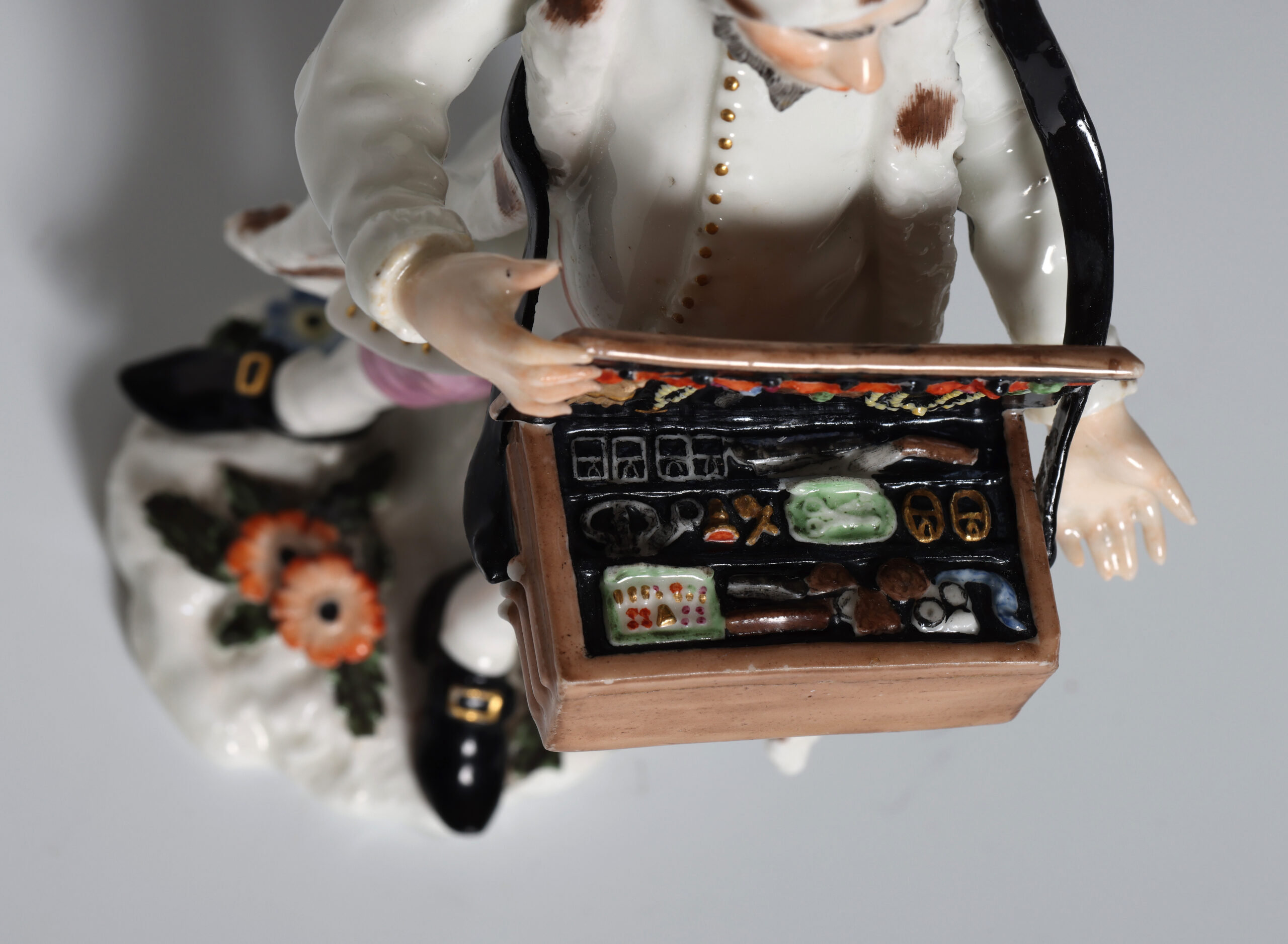
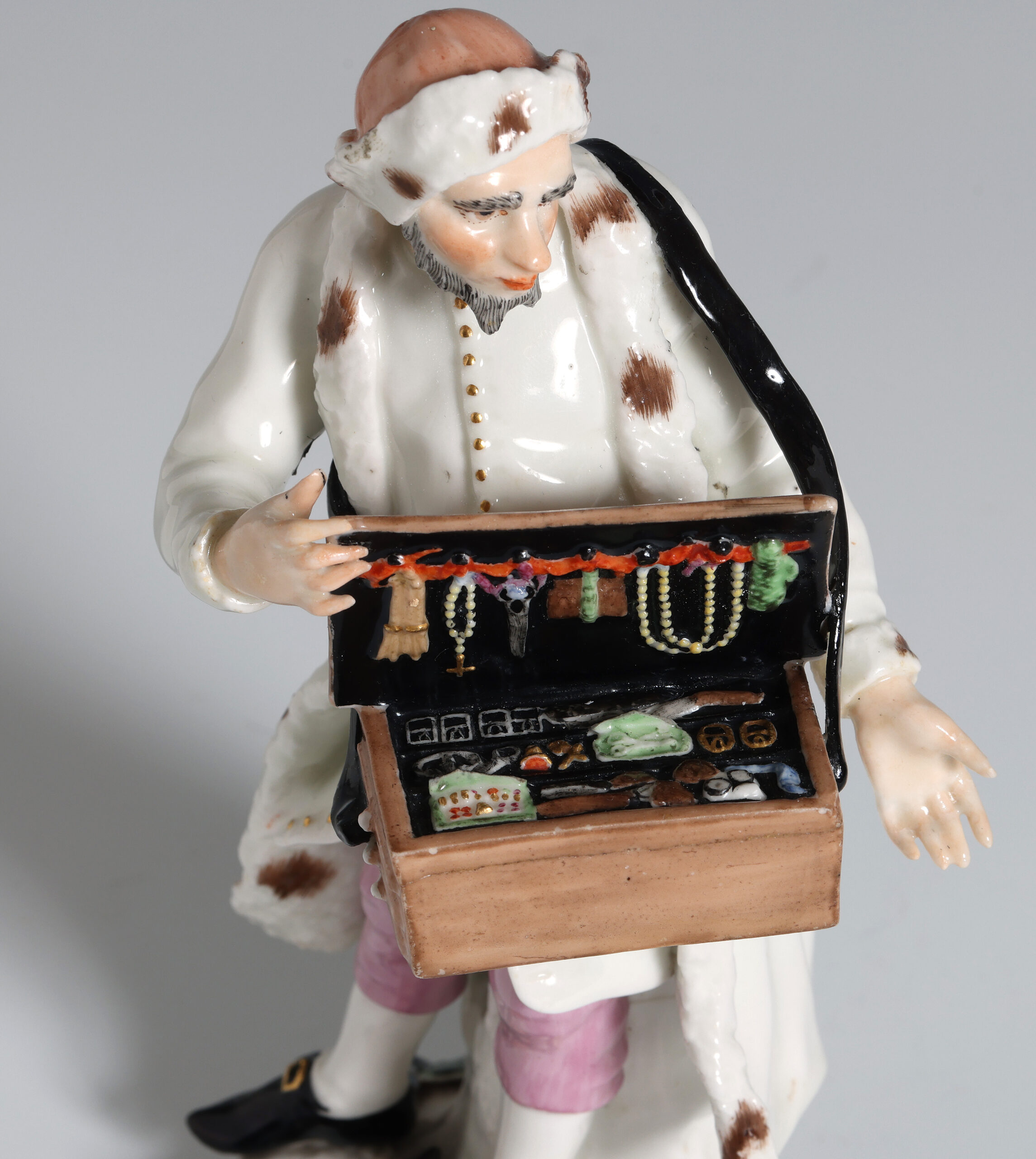
Dressed in a fur-lined coat and hat, and sporting a beard which identifies this figure as a Jewish pedlar. Beards were rarely worn by anyone other than Jews (or visiting Russians) in England in the 18th century. Jewish pedlars of Ashkenazi origin were a familiar feature of London and the countryside particularly around 1740-1760. They fulfilled a useful function since few smaller towns had shops selling the small, manufactured items that were their stock-in-trade.
V.D. Lipman notes that:
‘It was as pedlars that Jews first penetrated the English countryside. From 1720 to 1735, a pedlar named Moses Emanuel, “a Jew of uncommon learning” was familiar in the Leicestershire countryside and used to discuss theological questions with the Vicar of Hinckley. By the end of the 18th century, the Jewish pedlar had become a familiar figure in the English countryside, depicted by Rowlandson and other artists, fulfilling a useful function, as did the more numerous non-Jewish pedlars in the rural distribution of cheap jewellery, trinkets, ribbons, laces, watches and so on.’
This is an original model by the Flemish-born sculptor Joseph Willems (1715-1766) who was the chief modeller at Chelsea, but clearly, he must have been aware of the Meissen figure of the Trinket Seller by Pieter Reinicke from the first Cris de Paris series. Willems was never a slavish copyist but has reinterpreted it to represent an increasingly familiar sight in England.

The Meissen Trinket Seller by Pieter Reinicke 1747-1750
The only other coloured example of this rare model that we have found is in the Musée Ariana, Geneva, (N° inventaire AR 1999-091), one further white example was sold as part of the Dr Peter Bradshaw Collection at Bonhams in 2007.
The Derby porcelain factory in around 1765 adapted the model further, keeping the poise and dress of the pedlar, but much reducing the box of items for sale. They added a companion, after a Meissen model, which does not seem to exist in Chelsea porcelain.[i]
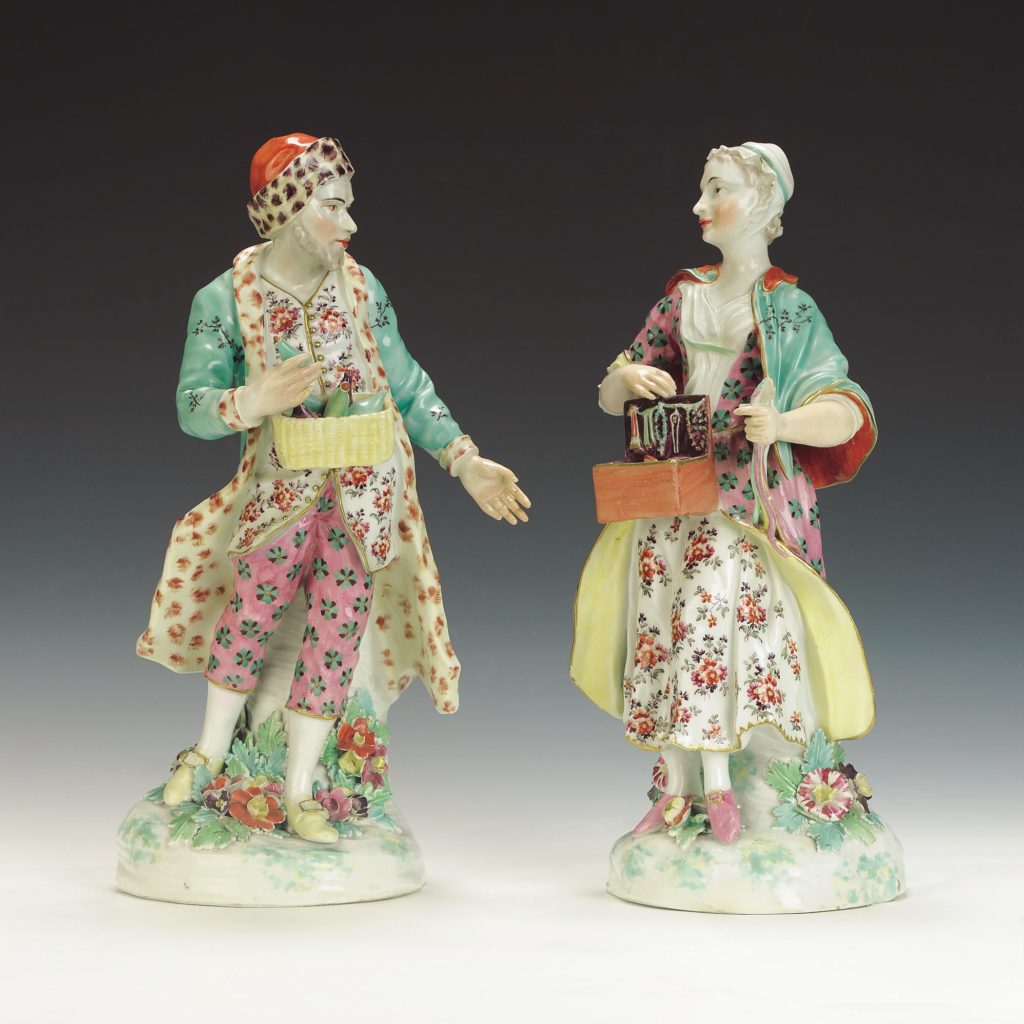
Derby Porcelain Jewish Pedlars, c. 1765
The Jewish Museum London (JM 693a)
Condition:
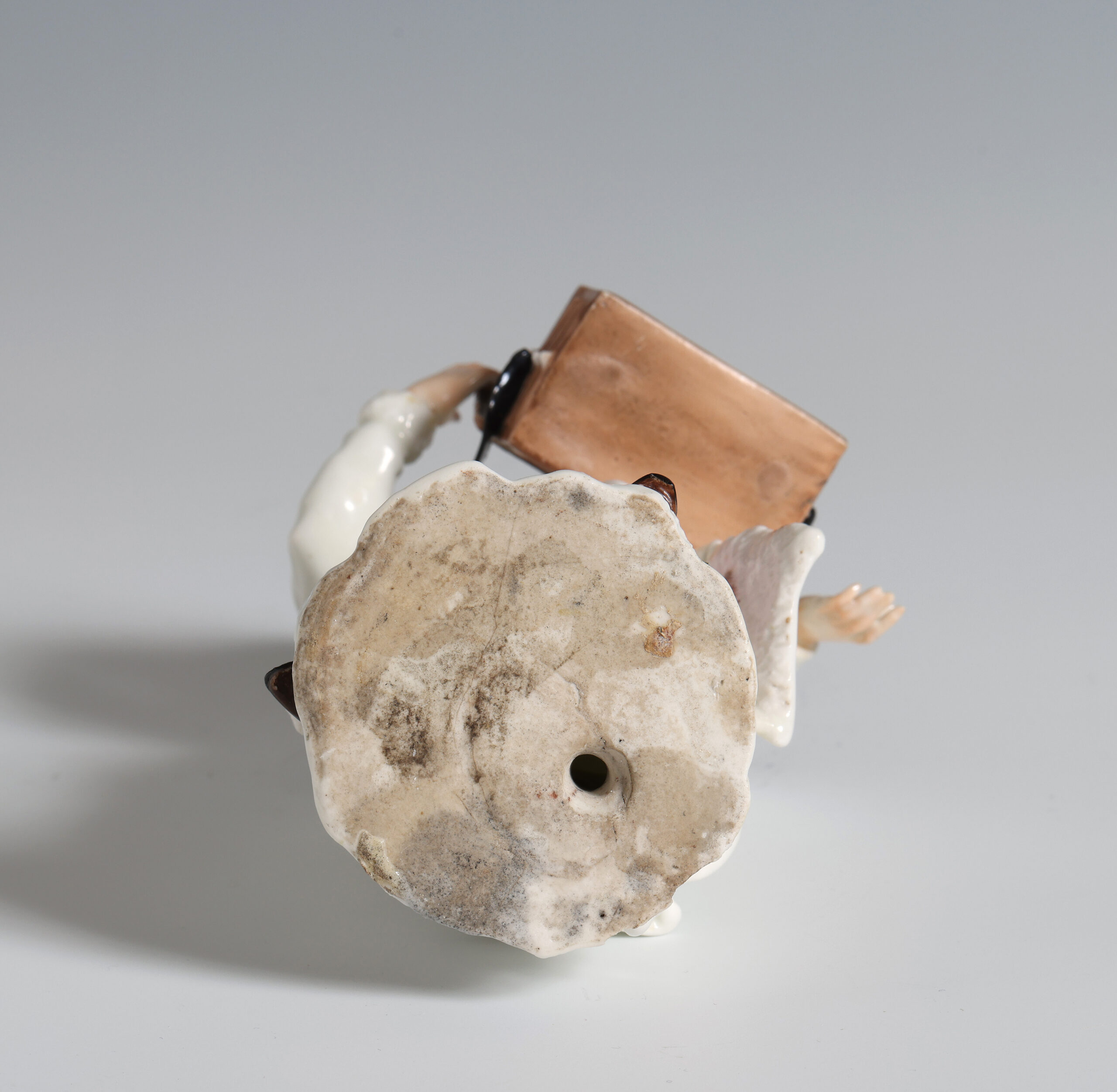
Restoration to strap on left side; left hand: thumb and fingers; right hand: index finger
Provenance:
Private Collection Australia
Christie’s, London 7 June 1994, lot 35
References:
V.D. Lipman, The Origins of Provincial Anglo-Jewry, The Newman Papers, JHSE Conference, University College London, 6 July 1975.
https://www.jewishgen.org/jcr-uk/Newman_papers/Provincial_Jewry_Victorian/origins-vic.htm?utm_source=chatgpt.com
Literature:
Legge 1984
Margaret Legge and J.V.G. Mallet, ‘Flowers and Fables: A survey of Chelsea porcelain, 1745-69’, (National Gallery of Victoria, Melbourne, 1984), p. 36, no. 62
Exhibited:
Margaret Legge and J.V.G. Mallet, ‘Flowers and Fables: A survey of Chelsea porcelain, 1745-69’, (National Gallery of Victoria, Melbourne, 1984)
Price: £16,500

[i] Peter Bradshaw mentions a Chelsea companion to the Jewish pedlar, in the Untermeyer Collection, but this is in fact a Derby version of the model. Another example of the Derby pair is in the V&A in the Lady Charlottle Schreiber Collection, bought originally as a Chelsea (Sch. I 294).