
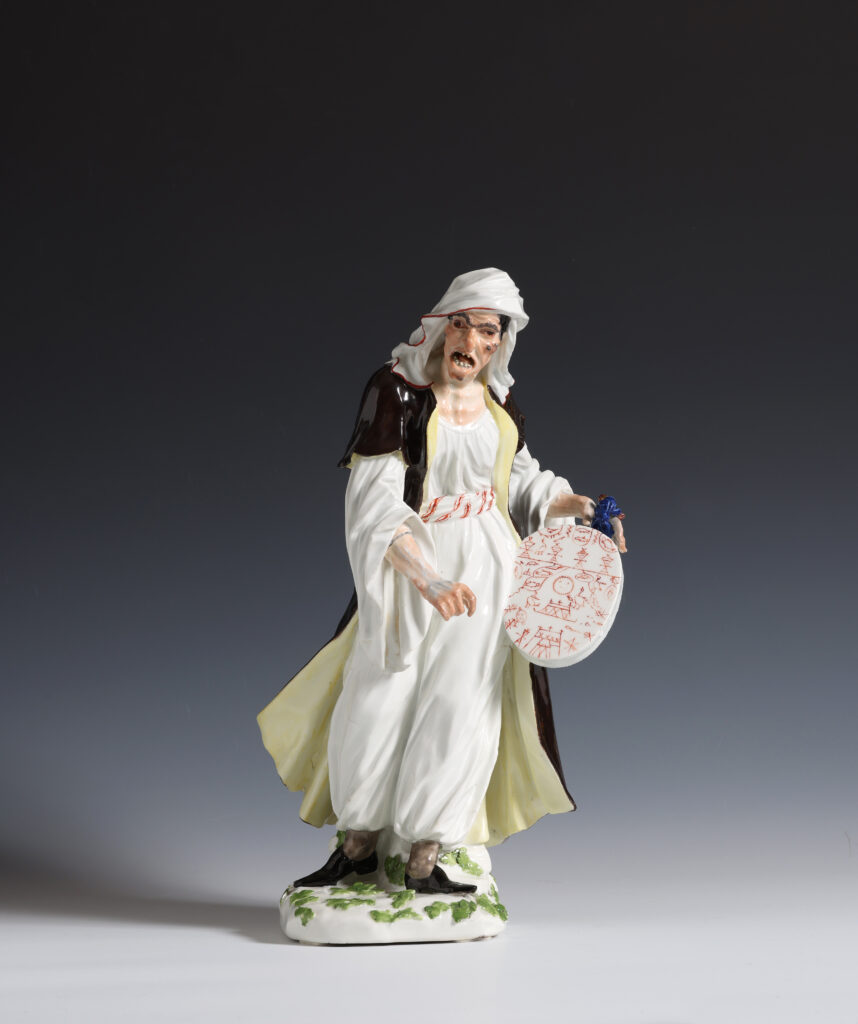
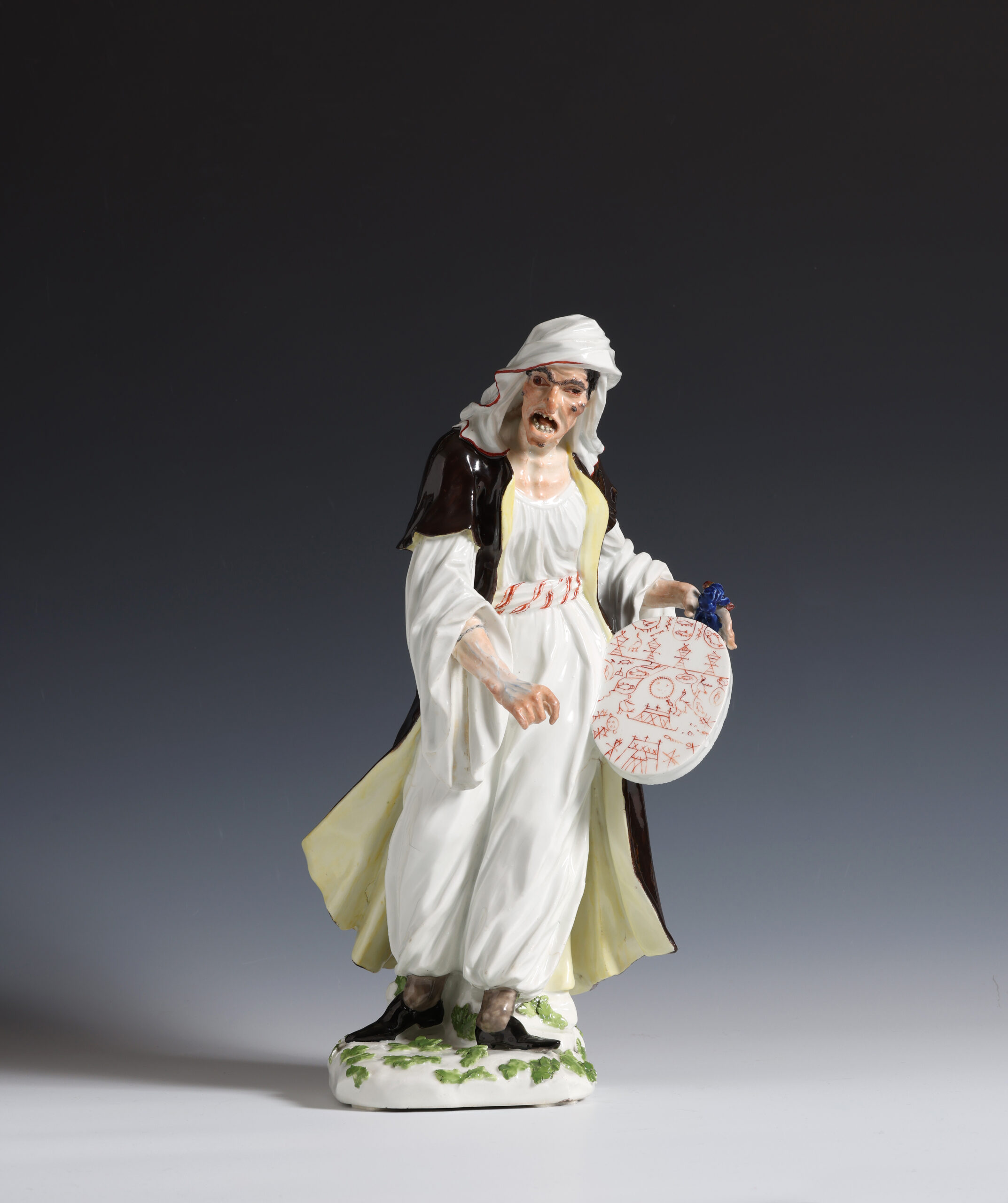
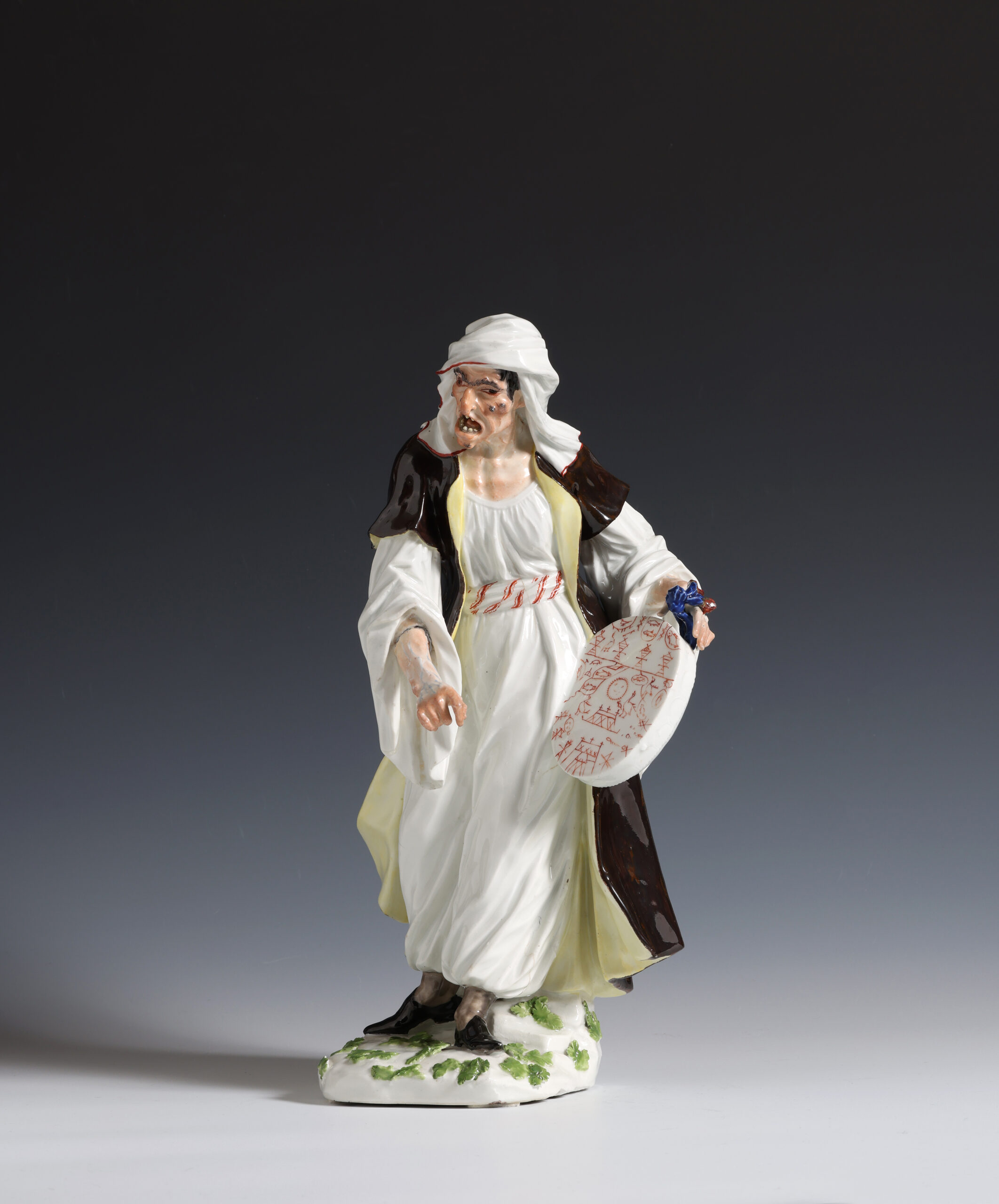
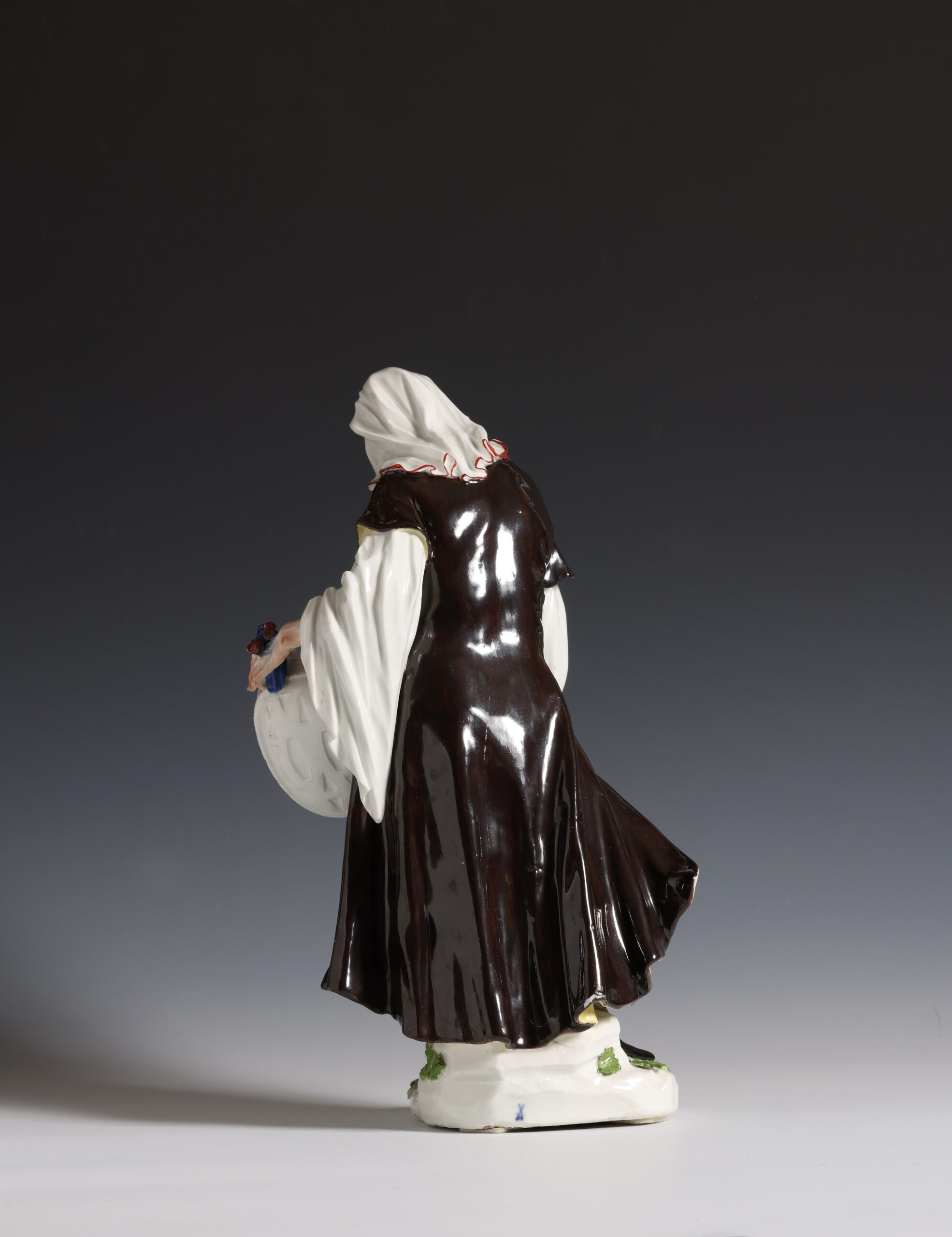
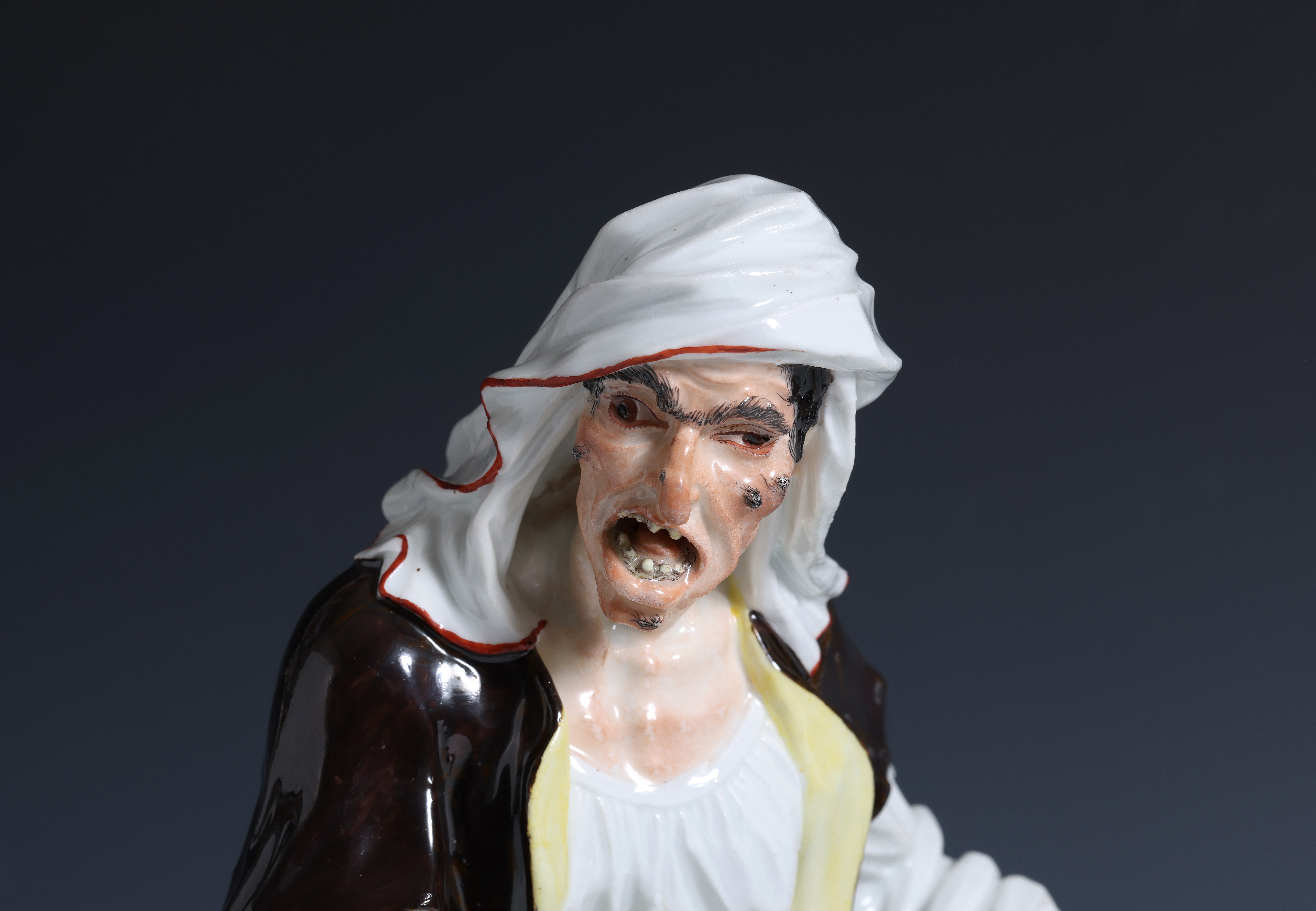
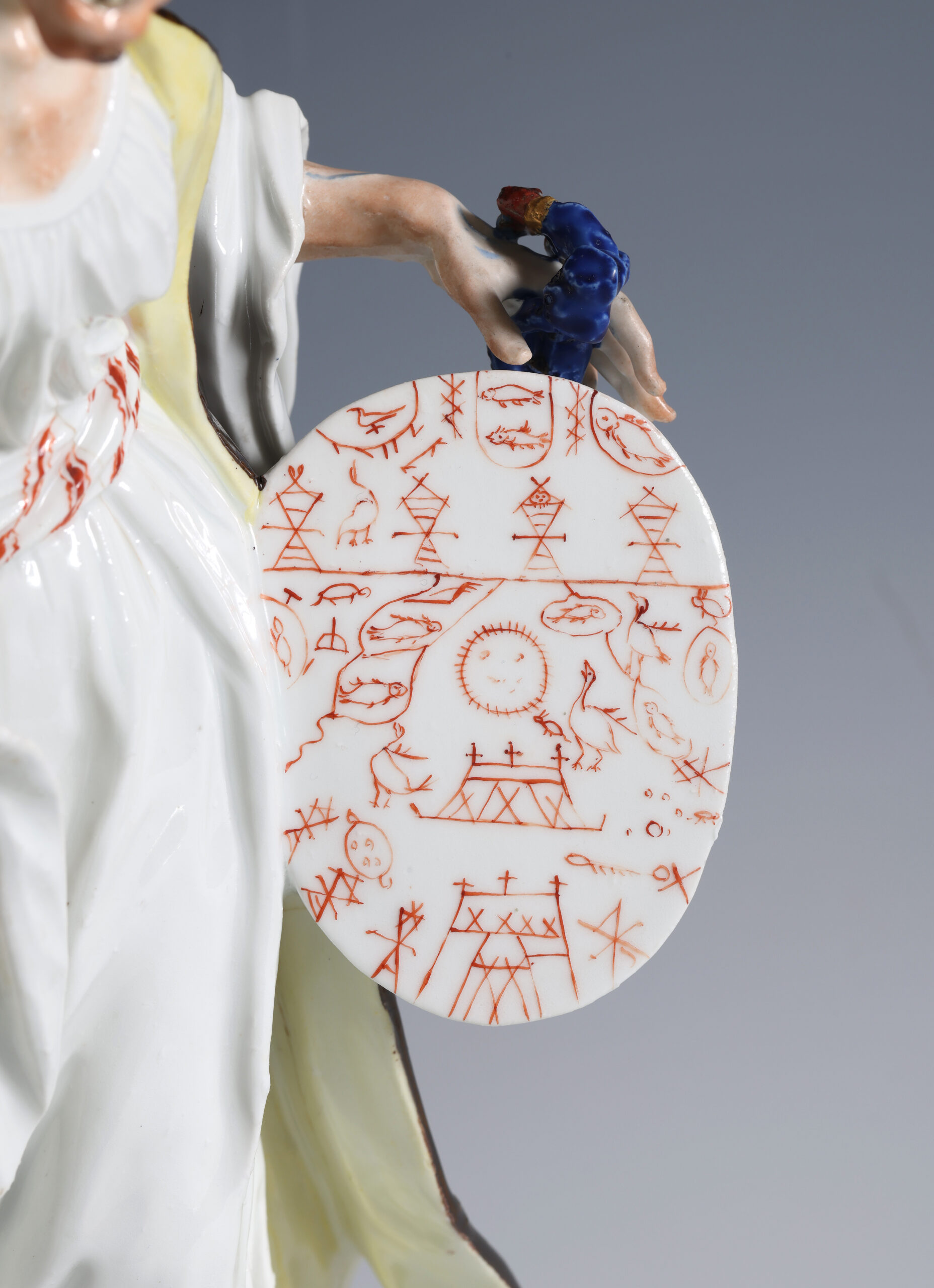
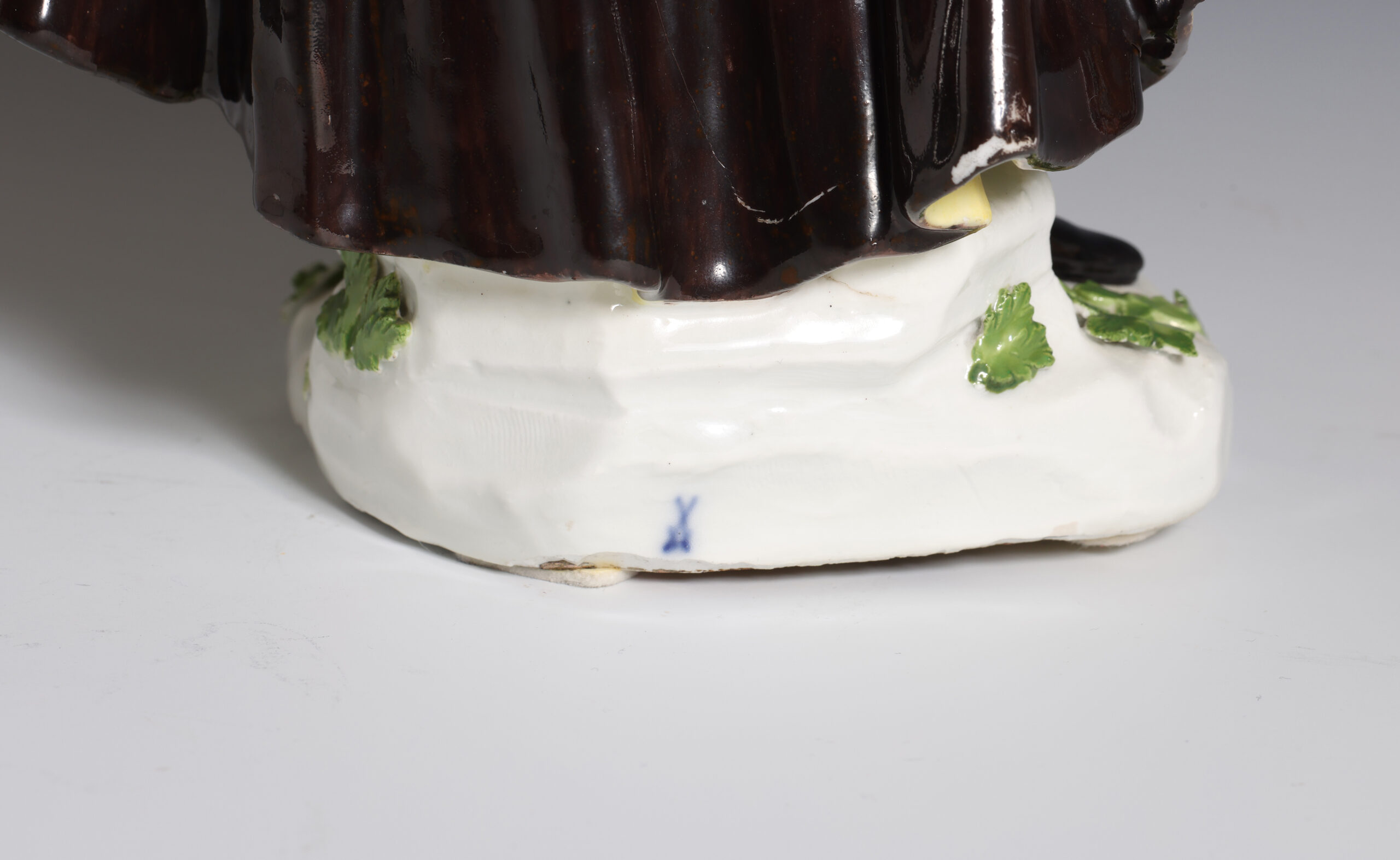
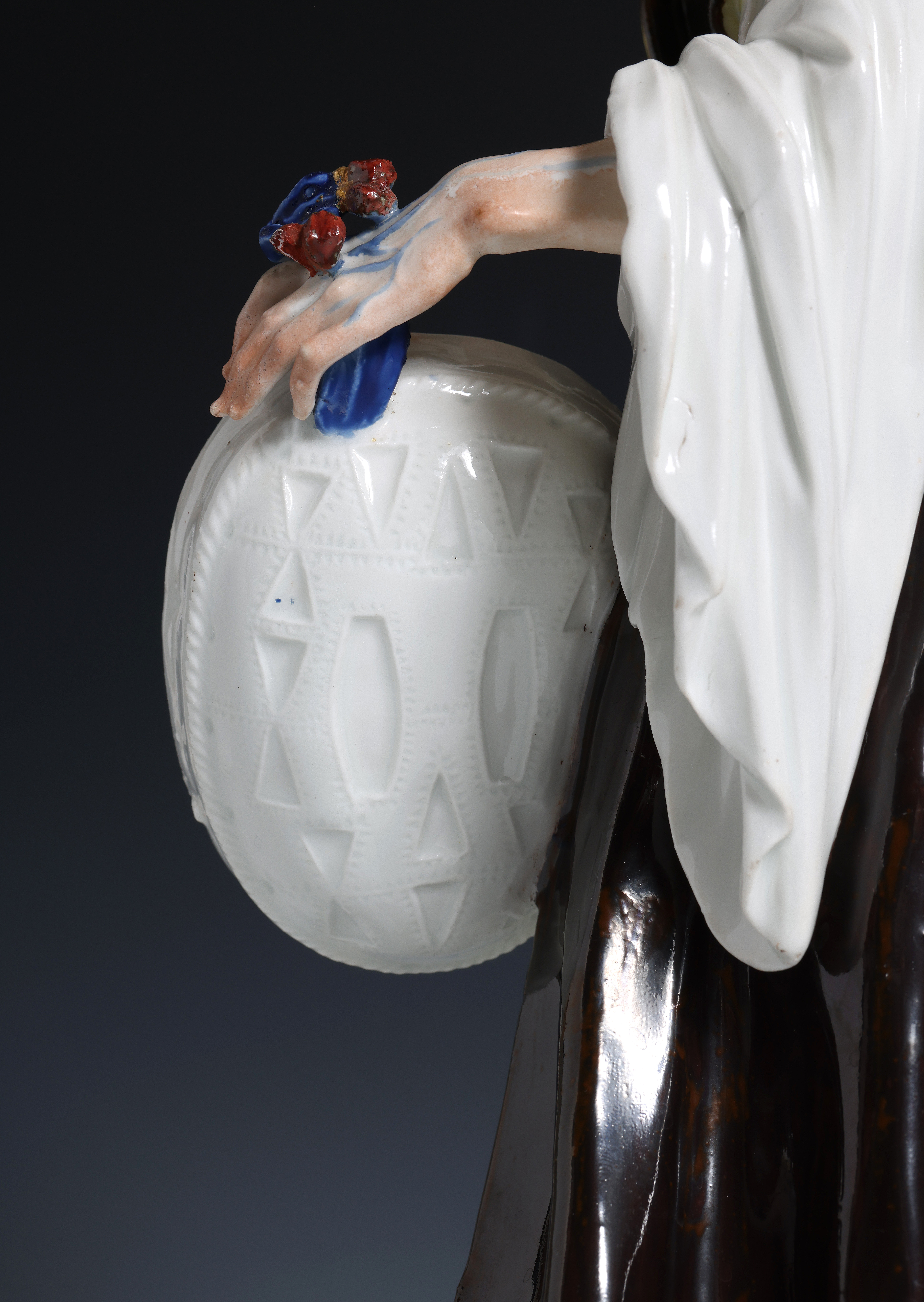
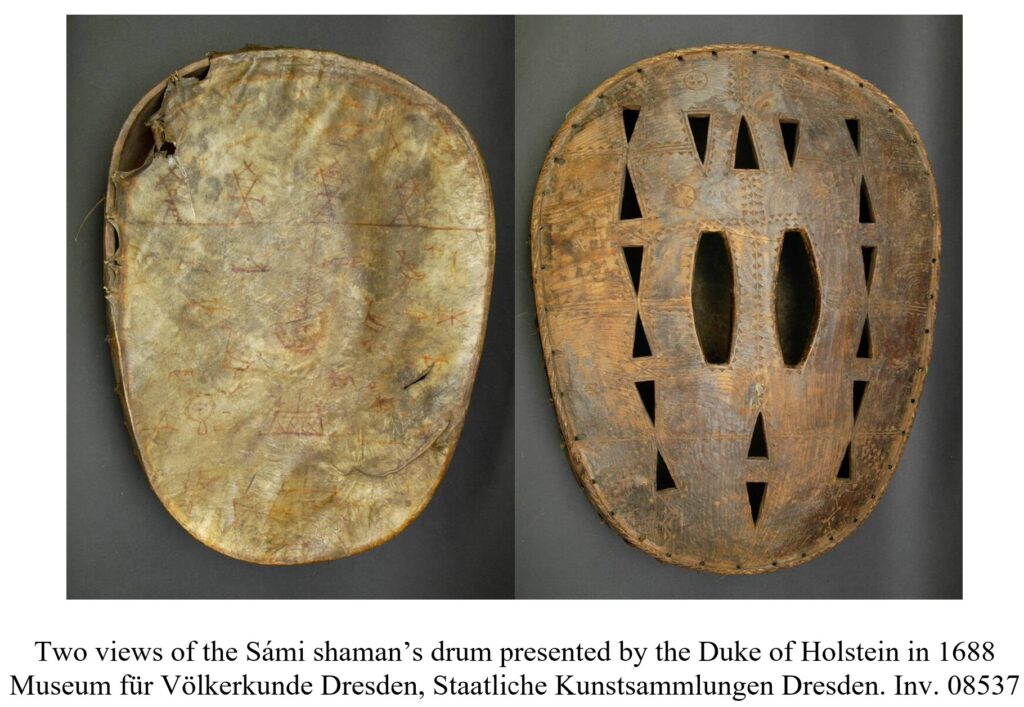
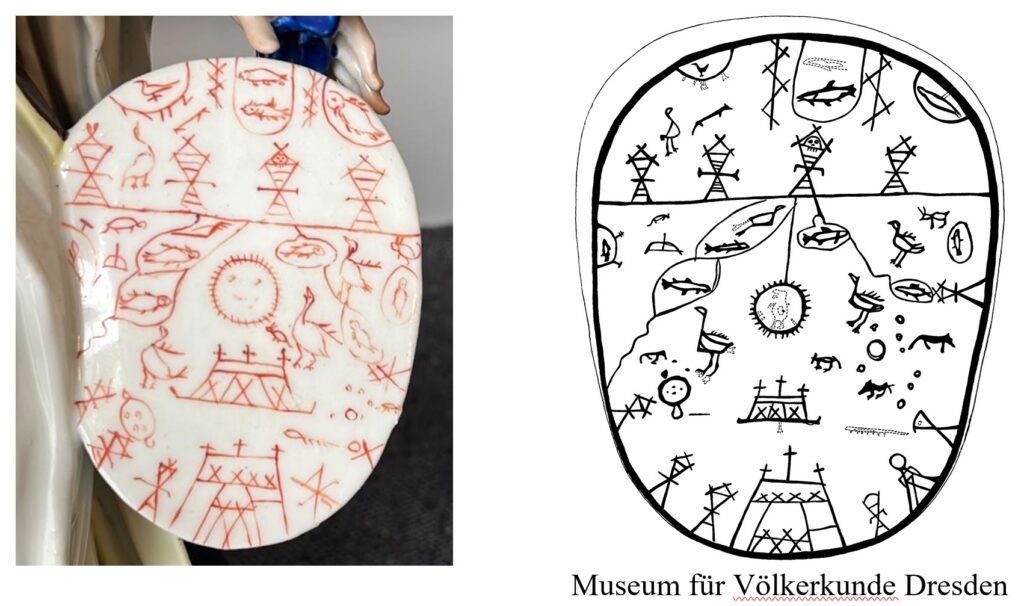
In this unique and unusually large figure Kaendler has modelled a grotesque and haggard sorceress holding a drum which is a precise copy of the Sámi shaman’s drum that was presented to the Elector of Saxony, Johann Georg II, on 28th March 1668 by Kristian Albrekt, Duke of Holstein (1641-1695). The drum survives and is now held in the Museum für Völkerkunde Dresden.[1] The drawing on the reindeer skin and the pierced structure of the wooden bowl are copied almost exactly indicating that both Kaendler and the painter of the figure had access to the original drum. The reason for this model being made is not recorded, it was clearly not for commercial production but for some purpose within the court of Dresden.[2]
The Sámi people of Northern Scandinavia and their drums held a particular fascination at the time as they were amongst the last pagans of Europe to resist conversion to Christianity. Furthermore, it was rumoured that the Swedes had won their battles in the Thirty Years’ War (1618-48) with the aid of Sámi witchcraft.[3]
The Dresden drum was most likely one of those confiscated by missionaries seeking to covert the Sámi to Christianity in the early 17th century. A number were brought to Copenhagen for the royal Kunstkammer and the missionary college.[4] It was presented to the Elector along with a two-part painting titled “Dis sint de sitten von Laplant” [These are the customs of Lapland]. The drum (and painting) are recorded in the inventories of the “Indianische Cammer” in 1684, 1710, 1716, 1783 (by which time the bone clapper had been lost) and 1821. In 1838, it was recorded (without the painting) in the inventory of the “Türkenzelt” [Turkish Tent]; in 1838 it became part of the Historical Museum of the royal collections, and in 1979 it was transferred to the Zoologische und Anthropologisch-Ethnographische Museum in Dresden, now known as the Museum für Völkerkunde.[5]
According to Mrs Alpermann, of the Völkerkundemuseum, The electoral collections were divided into various areas. The “Indianische Cammer” was part of the Rüstkammer [the Armoury] which was held in the upper floors of the Johanneum until 1772. Parts of the Rüstkammer however (for example, the “Türckische Cammer”) were moved – as far as is known – in 1722 to the „Geheime Kriegskanzlei“ [Privy War Chancelry]. It can be assumed, therefore, that in the mid-18th century the drum was either in the Johanneum or the „Türckische Cammer“ in the “Geheime Kriegskanzlei”.[6]
Sebastian Kuhn only recently identified that this was a Sámi drum and the very one preserved in Dresden, its origins had quickly been forgotten even at Meissen. Kaendler’s mould was used, as far as is known, only one other time in the 18th century when it was re-issued a few years later with a conventional cylinder drum.[7] The moulds were used again in the early 20th century when a figure was produced with the Sámi drum without the skin covering and with pierced apertures on the reverse. They had forgotten what the actual drum looked like or signified and now described her as an “ägyptische Zauberin” [or Gypsy sorceress in the English edition].[8]
The sorceress herself is a fanciful creation of Kaendler based on the prevailing cruel iconography of witches and sorceresses. In fact, the Sámi shaman or Noaidi were usually depicted, at that time, as men who used these drums to enter a trance-like state in which their ‘free spirit’ was said to leave the body and visit the Spirit world where the future could be glimpsed, however Sámi women were also known to perform this role. The iconography of each drum is different and personal to the owner, the symbols on the Dresden drum indicate that it belonged to someone who was more of a hunter than reindeer herder.
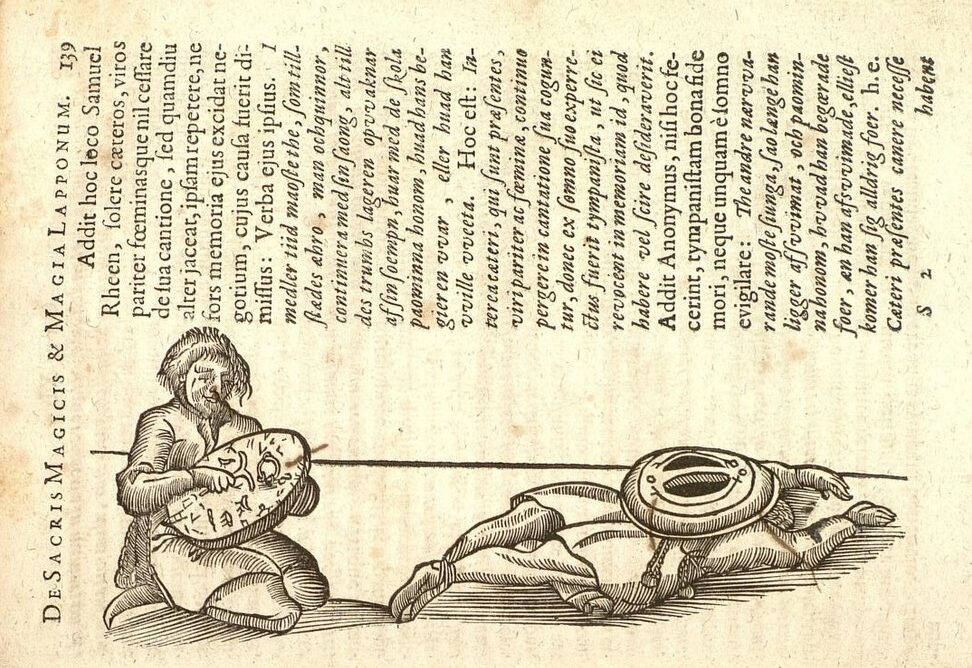
A Shaman or Noaidi beating his drum and entering a trance from Johannes Scheffers description of Lappland, digitized 2017 by the Royal Library in Stockholm
Johannes Schefferus (1621-1679), a professor at Uppsala University published his study of Lapland, Argentoratensis Lapponia, in 1673 which became popular around Europe and was translated into English as ‘The history of Lapland’ in 1674.[9]
I am grateful to Sebastian Kuhn for sharing his thoughts on the origins of this figure
Provenance:
Anon. sale, Sotheby’s London, 4 June 1996, lot 100
Hadrian Merkle
The Merkle Collection: Part III, Bonhams Cornette de Saint Cyr, Paris, 29 October 2025, lot 36
Exhibited:
Hohenberg an der Eger, Porzellanikon – Staatliches Museum für Porzellan, 2018-2023
References:
Adams 1987
Len and Yvonne Adams, Meissen Portrait Figures, (Barrie & Jenkins, 1987), p. 56
Berling 1910
K. Berling, Festive Publication to commemorate the 200th Jubilee of Meissen, 1910
Gundestrup 1991
Bente Gundestrup, Det kongelige danske Kunstkammer 1737, The Royal Danish Kunstkammer 1737, (Nationalmuseet, 1991)
Meier 2005
Gudrun Meier, Zaubertrommeln’ und anderes Sámi-Objekte in Sachsen und Thüringen – Zur Geschichte musealen Sammelns, in Abhandlungen und Berichte der Staatlichen Ethnographischen Sammlungen Sachsen, vol. 52 (2005): 189-208.
Newman 1977
Michael Newman, Die deutschen Porzellan-Manufakturen,(1977), Band 1,
Scheffer 1674
John Scheffer, The History of Lapland, Wherein are shewed the Original, Manners, Habits, Marriages, Conjurations, &c. of that People, (At the Theatre, Oxford 1674)
Westman and Utsi 1998
Anna Westman and John E. Utsi. Trumtid, om samernas trummor och religion = Gáriid áigi: Sámiid dološ gáriid ja oskku birra. (Ájtte and Nordiska museet, 1998), p. 32. (according to https://en.wikipedia.org/wiki/S%C3%A1mi_drum#cite_note-AWJEU-16 )
———————————————————————————————————————————————————————————————————————————————————————————————————
[1] https://skd-online-collection.skd.museum/Details/Index/1635525
[2] Another example of a large figure being made by Kaendler for court rather than commercial purposes is the figure of the huntsman Johann Georg Wenzel ordered Maria Anna daughter of Augustus III (and later Electress of Bavaria) in 1744; Wenzel was her favourite huntsman and rumoured lover. Dresden, State Art Collections, Porcelain Collection, Inv. No. P.E. 256.
[3] Anna Westman and John E. Utsi. Trumtid, om samernas trummor och religion = Gáriid áigi: Sámiid dološ gáriid ja oskku birra. (Ájtte and Nordiska museet, 1998), p. 32. (according to https://en.wikipedia.org/wiki/S%C3%A1mi_drum#cite_note-AWJEU-16 )
[4] Further drums remain in the Royal Danish kunstkammer and are published in Gunderstrup 1991, pp. 27 & 28.
[5] Taken from Sebastian Kuhn’s Bonhams entry. Also see Meier 2005, pp.198-208.
[6] I am grateful to Sebastian Kuhn for sharing his correspondence with Mrs Alpermann with me.
[7] Newman 1977, Band 1, illustrated fig. 169, p. 171. Newmann describes it as ‘ein Meisterwerk des spezifisch Kaendlerschen Genies‘ and Adams 1987 p. 56.
[8] Berling 1910, fig. 38. I am grateful to Professor Dror Wahrman for pointing out another 20th century example recently on the art market.
[9] I am grateful to Matthew Martin for pointing me to the link to the English edition at: https://www.gutenberg.org/files/59695/59695-h/59695-h.htm
ACQUIRED BY THE BRITISH MUSEUM 2026
https://www.britishmuseum.org/collection/object/H_2025-8029-1