
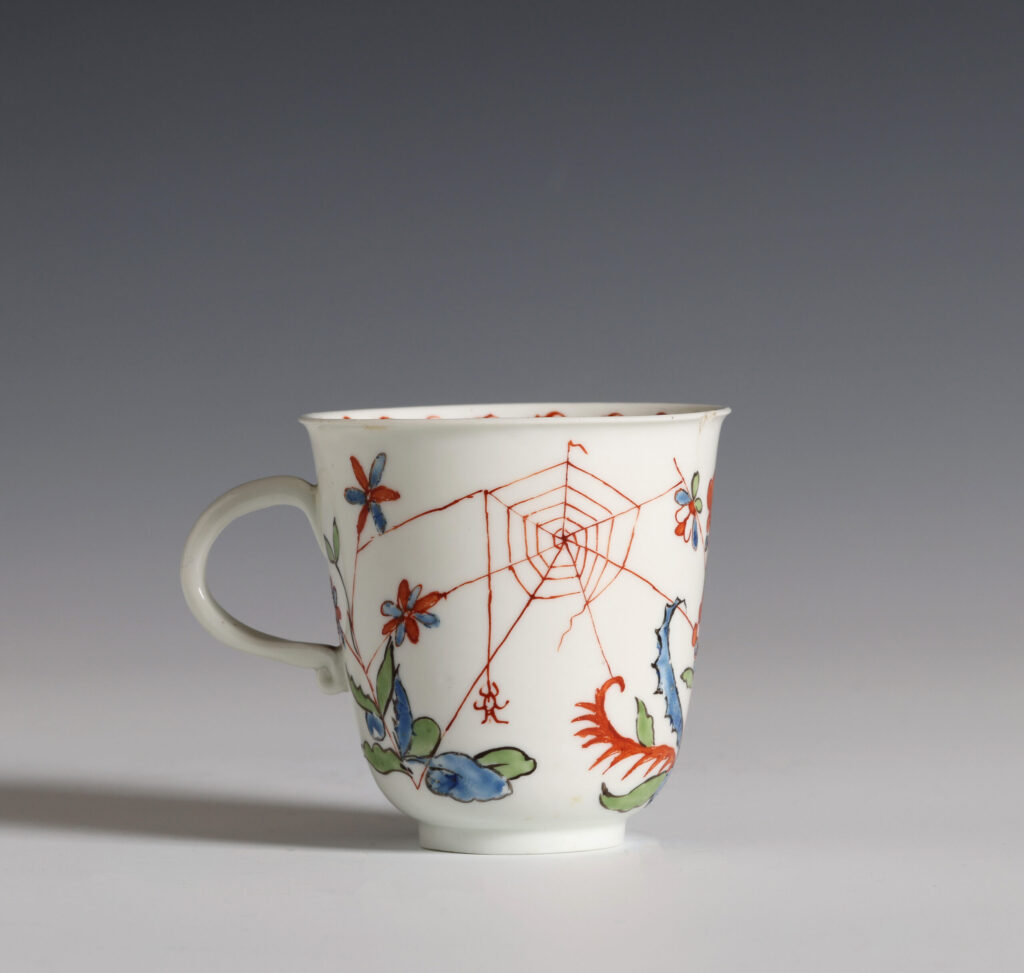
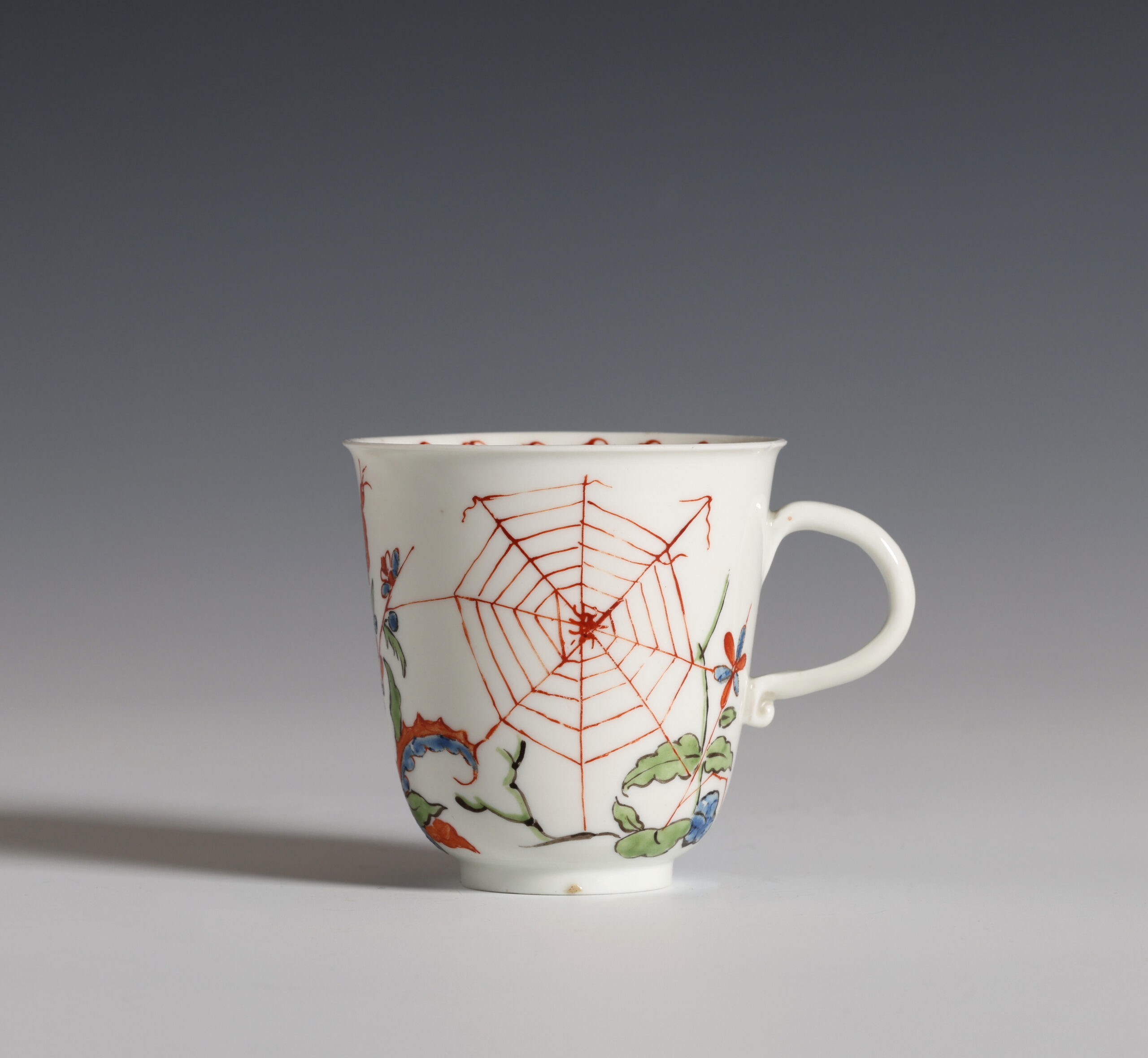
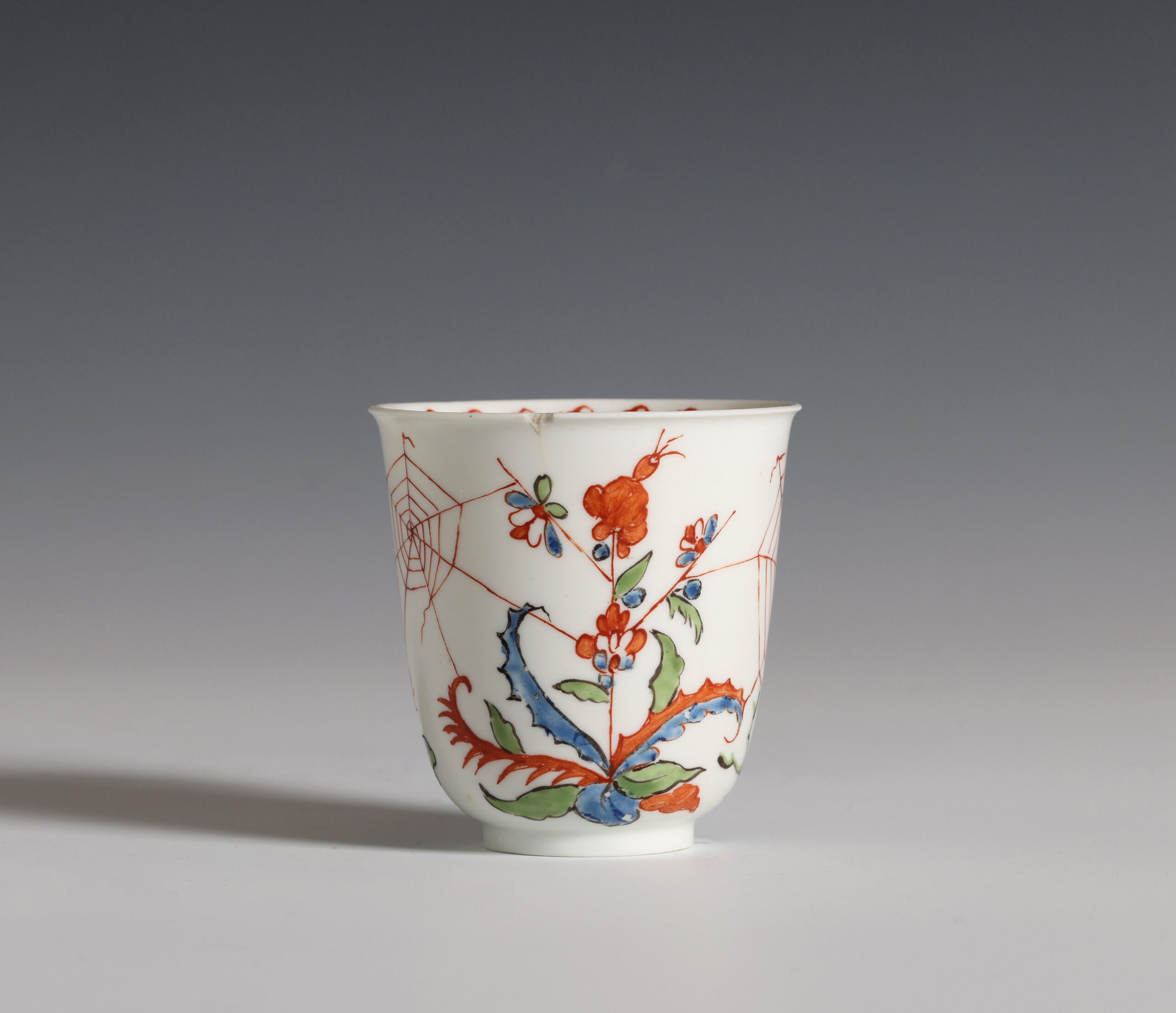
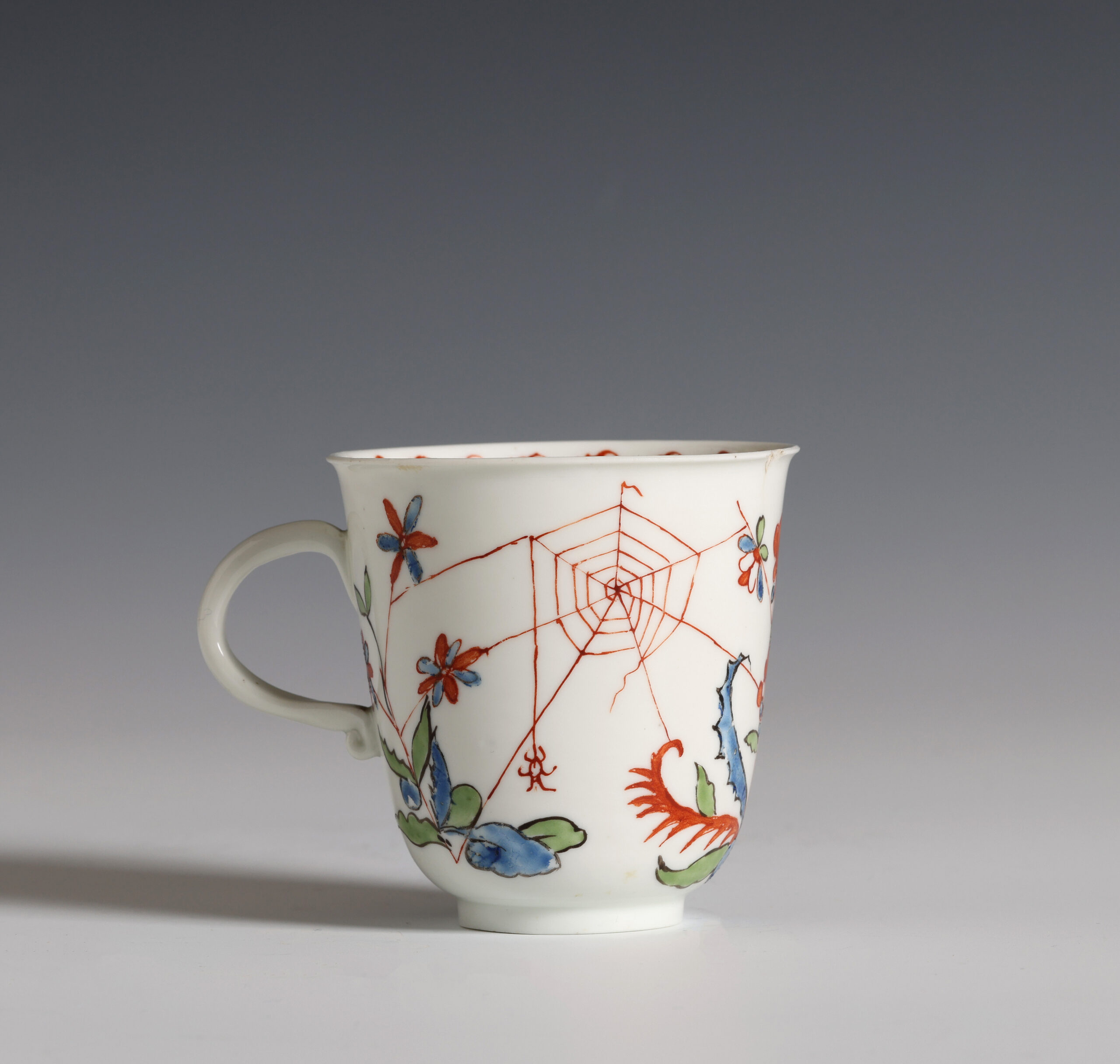
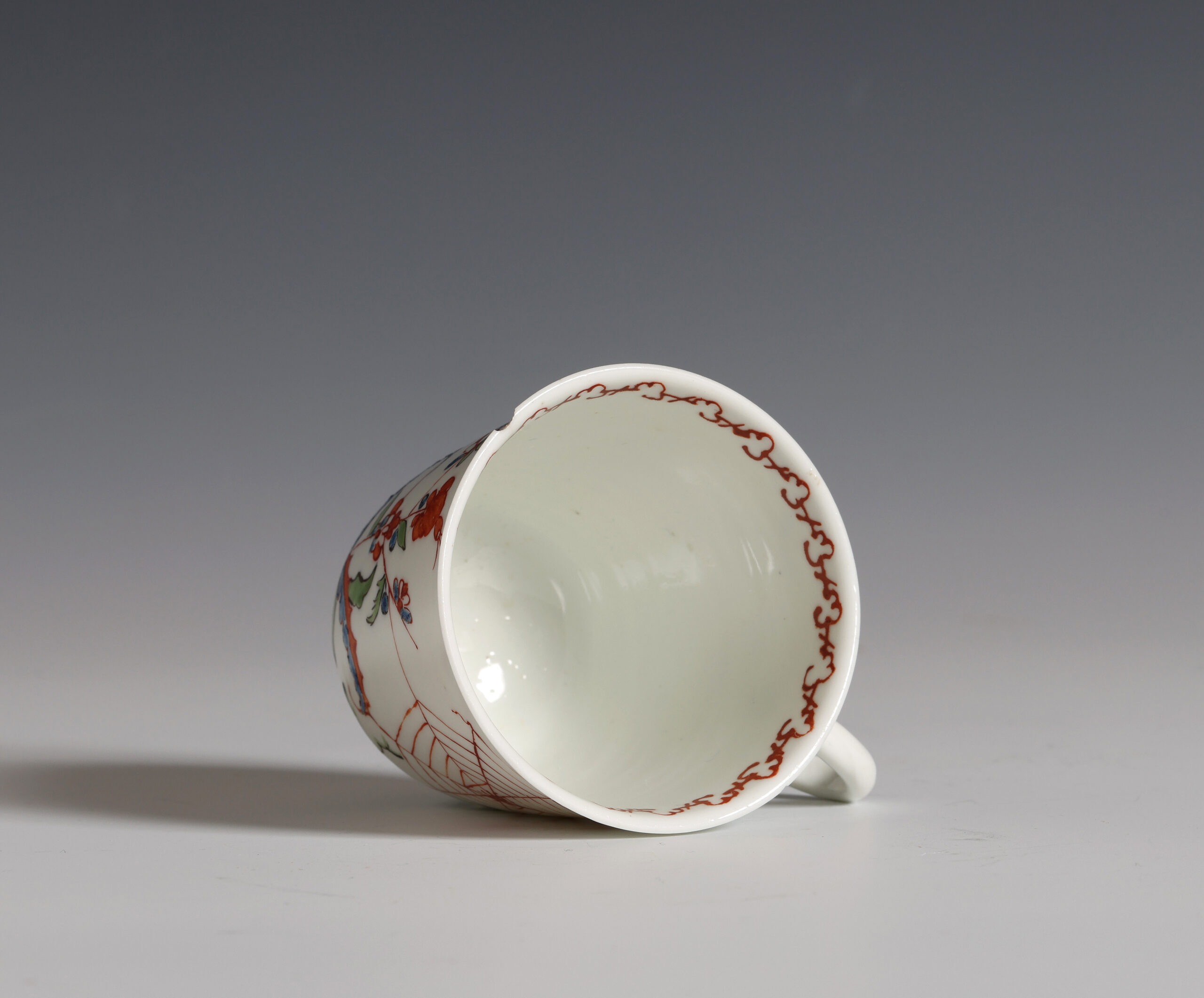
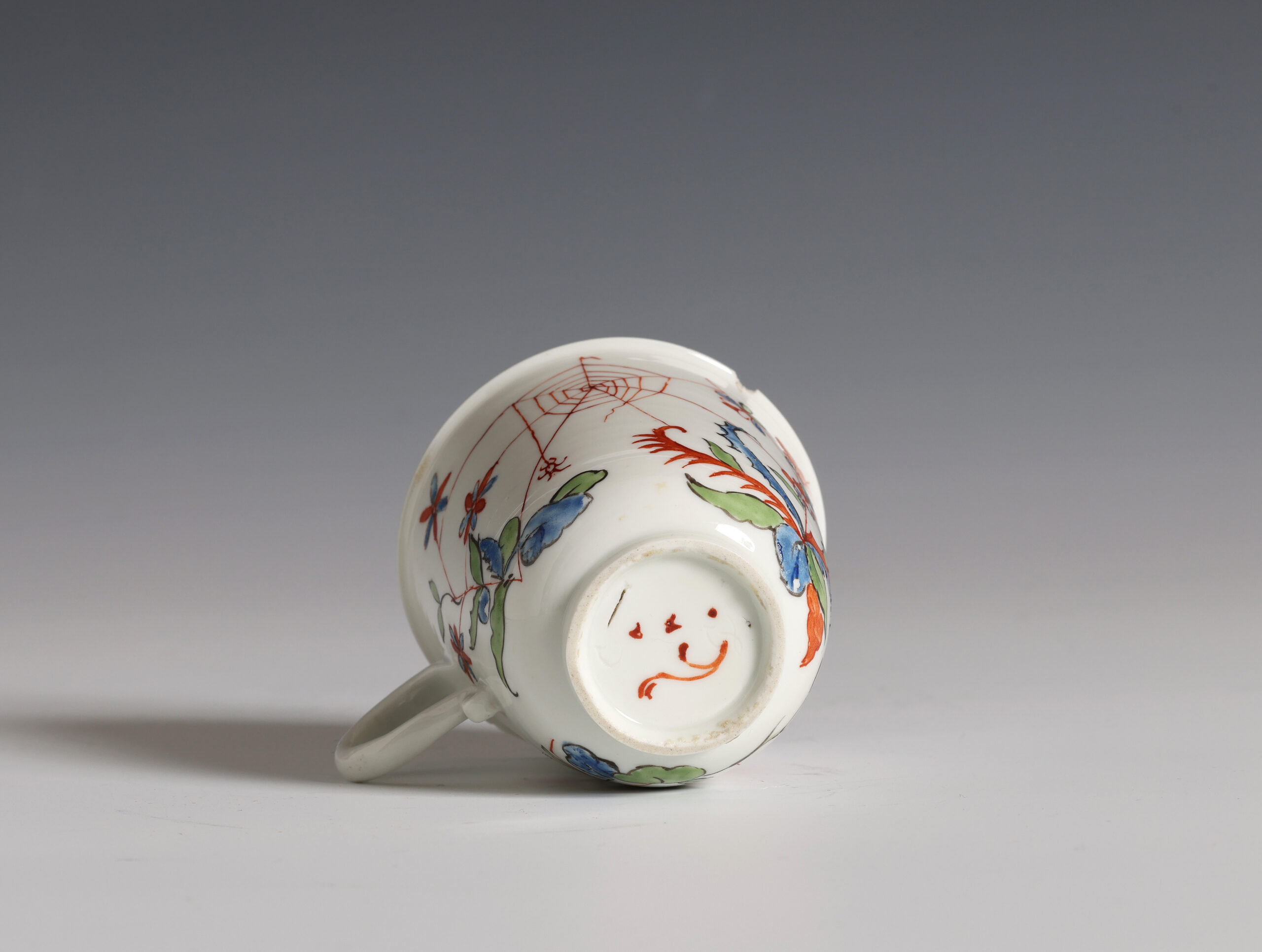
Painted with two spider’s webs suspended from thistles in a simple palette of iron-red, green and blue with black outlines, the interior with an iron-red scroll border.
Three examples of this striking design are recorded, which perhaps suggests that they originally formed part of a tea service. Luca Melegati has published the example in the collection of the Villa Cagnola in Lombardy and notes that another had been on the art market.[i]
Giovanni Vezzi established this first Italian hard-paste porcelain factory on the Giudecca in Venice in 1720 with a financial guarantee from his father Francesco a successful goldsmith. It was remarkable in being the first European factory to have been started by merchants intent on establishing a business rather than by a Prince.
The technical skills of porcelain manufacture were supplied by the itinerant arcanist Christoph Konrad Hunger who had been persuaded to flee Meissen in 1717 by Graf von Virmont, representative of the Austrian court at Dresden and establish the factory of Claudius Innocentius Dupaquier in Vienna, his stay there was brief before moving on to Venice. The clay used initially at Vezzi was the same as that used by Meissen and was smuggled from Aue in Saxony. Hunger quarrelled with Giovanni Vezzi and left in 1724 and the factory struggled to survive, finally being forced to close and dismantle the kilns in 1727.
After the demolition of the kilns a quantity of undecorated porcelain remained which Giovanni Vezzi and his collaborators continued to decorate until at least 1735, and so it is always difficult to date the decoration of Vezzi porcelain precisely.
There are several reasons for thinking that the decoration of our cup is relatively early. Similar serrated leaves can be found on examples of Vezzi porcelain decorated in underglaze blue which can only be done before the firing of the porcelain which stopped by 1727. Such leaves can be seen on a pair of underglaze blue and gold decorated covered vases published in Brittle Beauty.[ii]
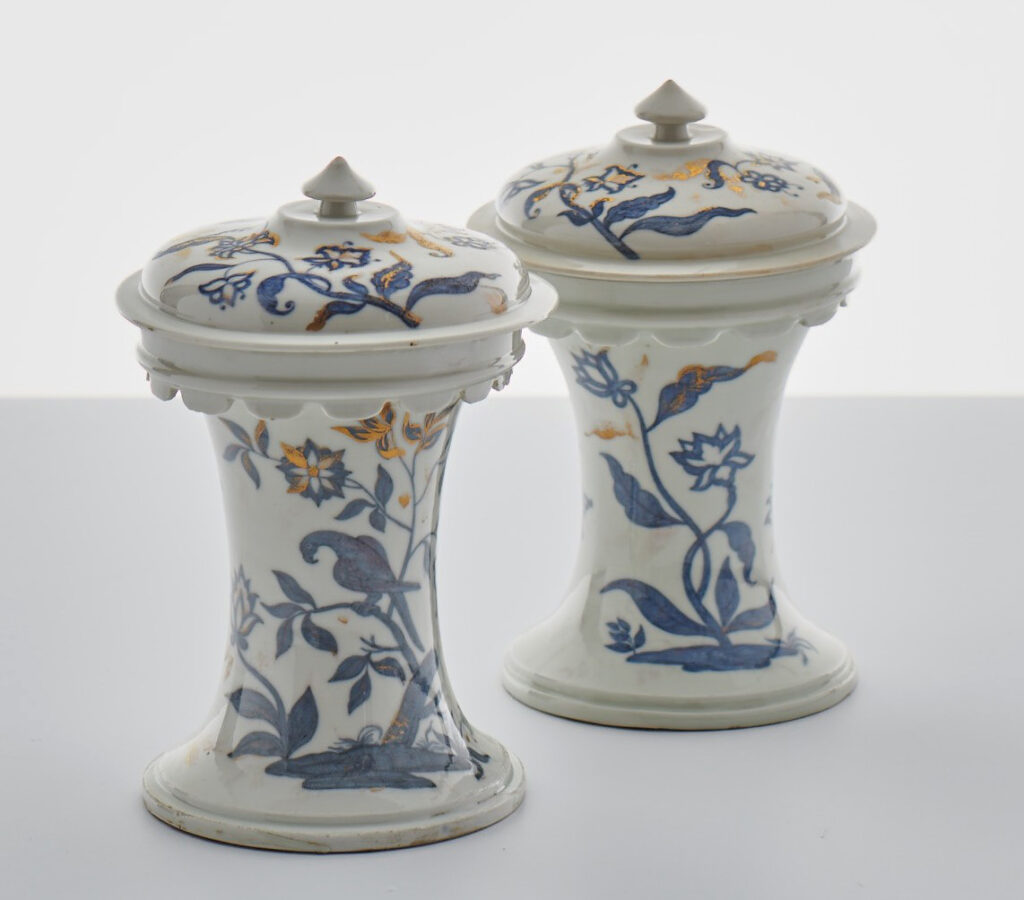
Vezzi, pair of vases, 1720 – 1727, Private Collection (Photo: Sylvain Deleu)
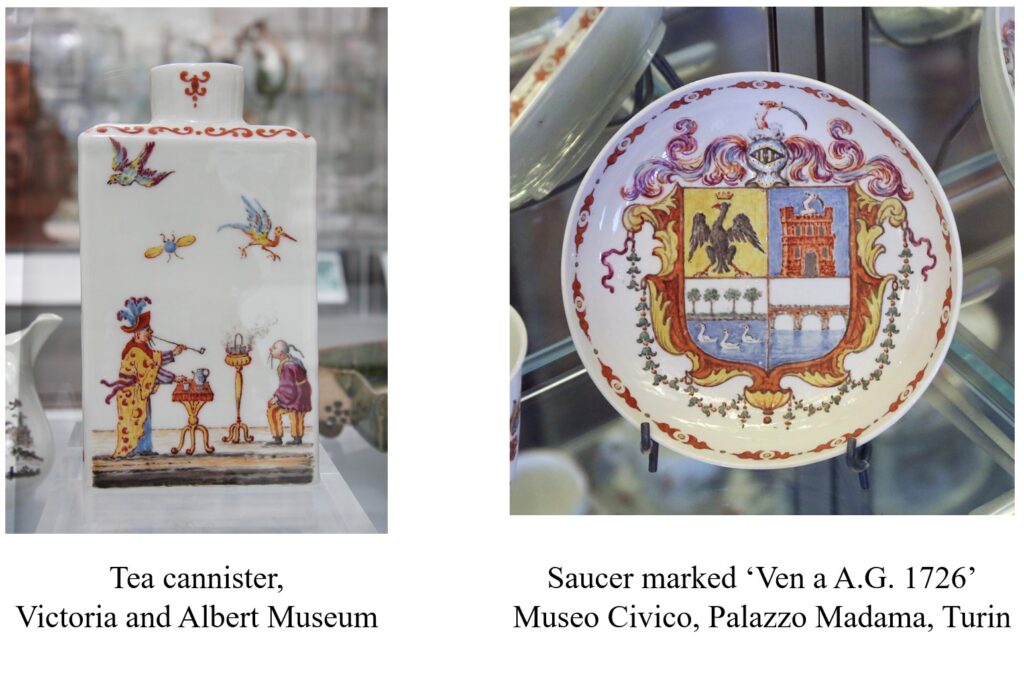
Perhaps only one dated piece of Vezzi porcelain exists, an armorial saucer in the Museo Civico in Turin inscribed ‘Ven a A.G. 1726’. The palette of this can be matched closely to the tea cannister in the Victoria and Albert Museum with chinoiserie decoration after an engraving of Martin Englebrecht which has an iron-red border around the neck rather similar to the border on the inner rim of our cup.[iii]
Condition:
Chip and associated short crack on rim
Provenance:
Gianni Fedeli Collection, Milan (by 1976)
Literature:
Molfino 1977
Alessandra Mottola Molfino, L’arte della porcellana in Italia, Vol. 1, Il Veneto e La Toscana, (Bramante Editrice, 1977), nos. 40/41
References:
Brittle Beauty 2023
D’Agliano, Lehner-Jobst, Manners, Savill, Schwartz and Munger, Brittle Beauty: Reflections on 18th-Century European Porcelain, (Ad Ilissvm, 2023)
Cagnola 1999
Guido Ceriotti (ed.), La Collezione Cagnola. II. Le arti decortive. Arazzi – Sculture – Mobili – Ceramiche, (Nomos Edizioni, Busto Arsizio, 1999)
Melegati 1998
Luca Melegati, Giovanni Vezzi e le sue porcellane, Milan 1998
——————————————————————————————————————————————————————————-
[i] Melegati 1998, p. 186, no. 67 & Cagnola 1999, p. 276, no. 202.
[ii] Brittle Beauty 2023, p. 156, no. 21.
[iii] Melegati 1998, p. 19, figs. 4 & 5.
SOLD