
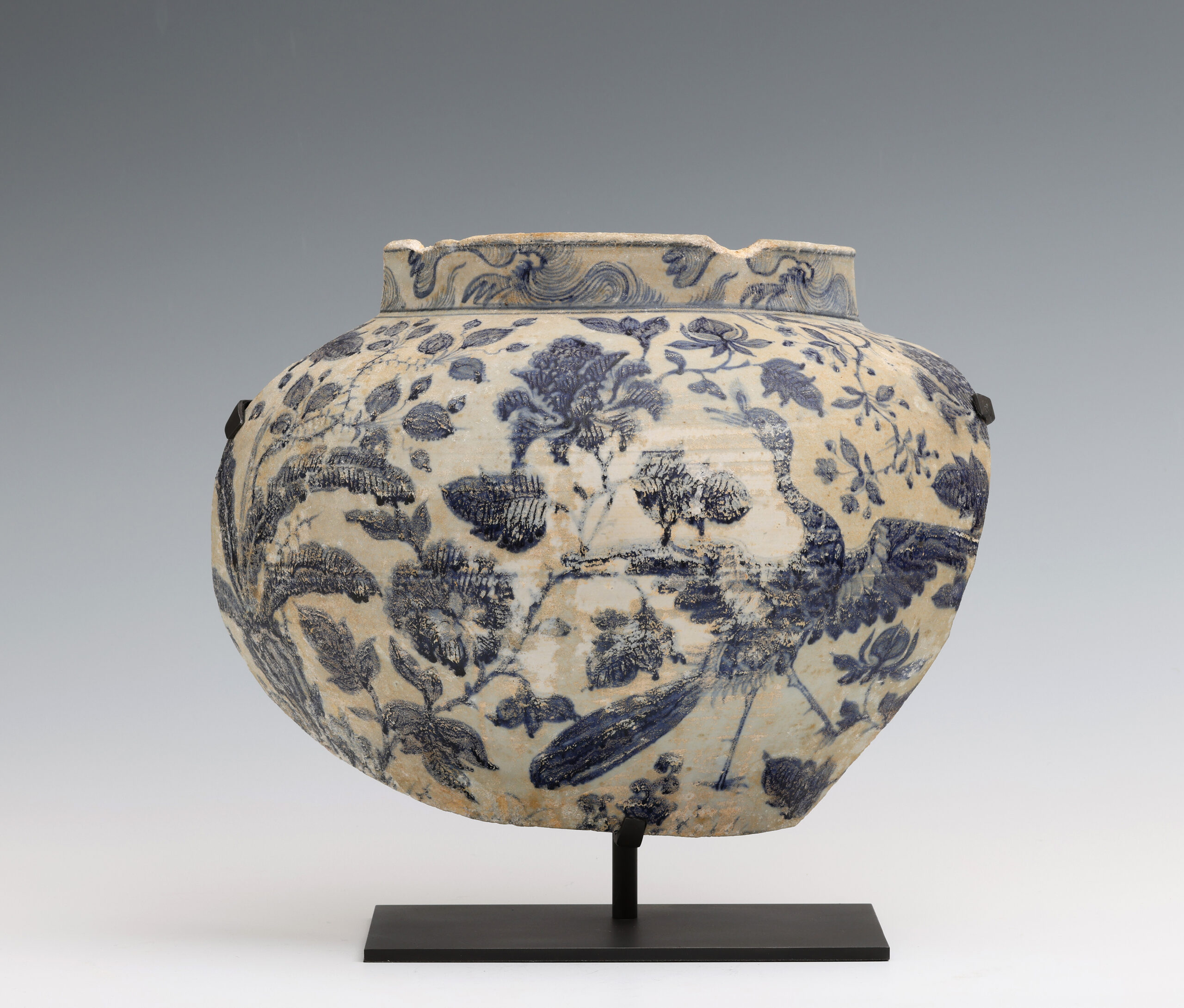
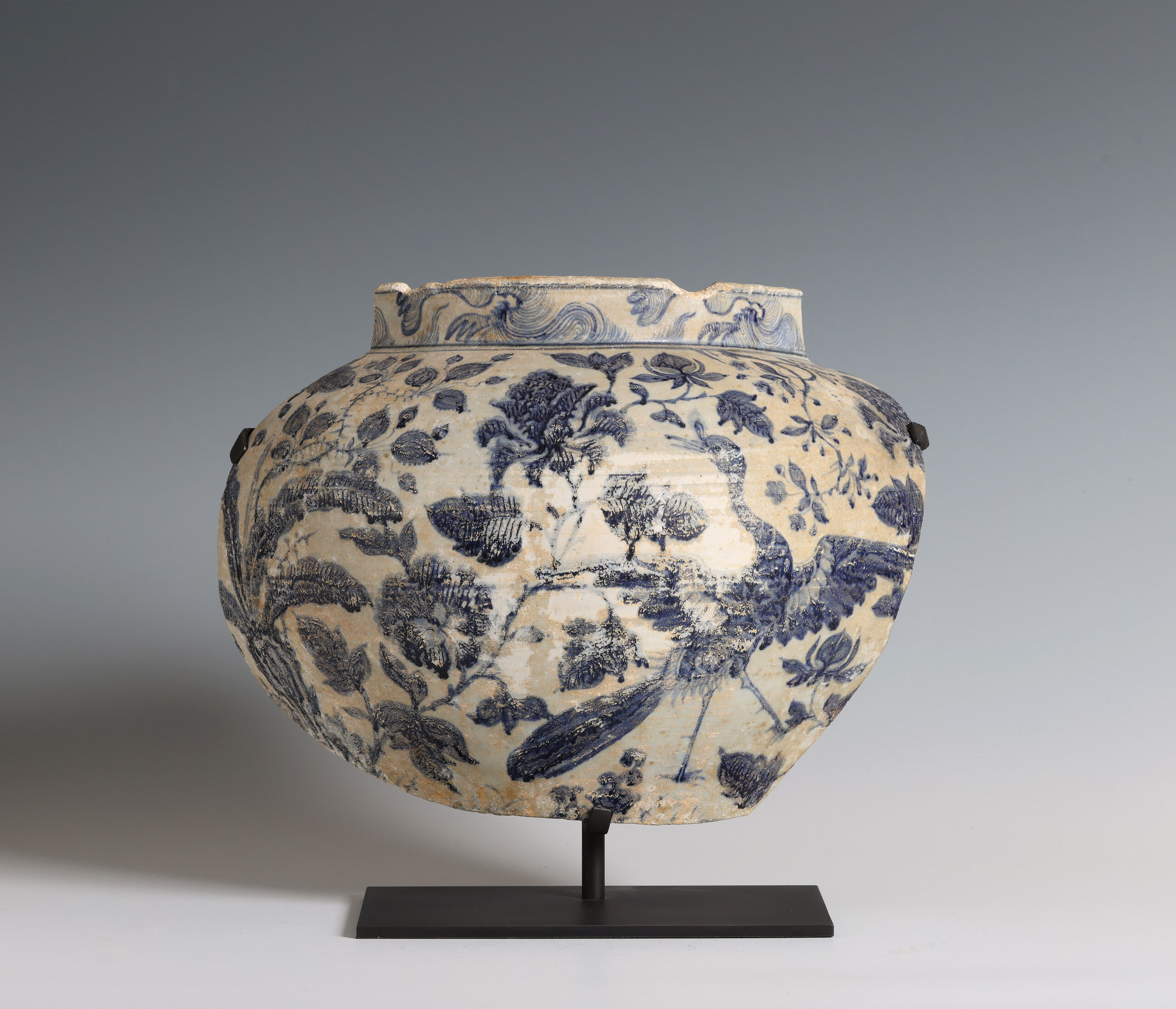
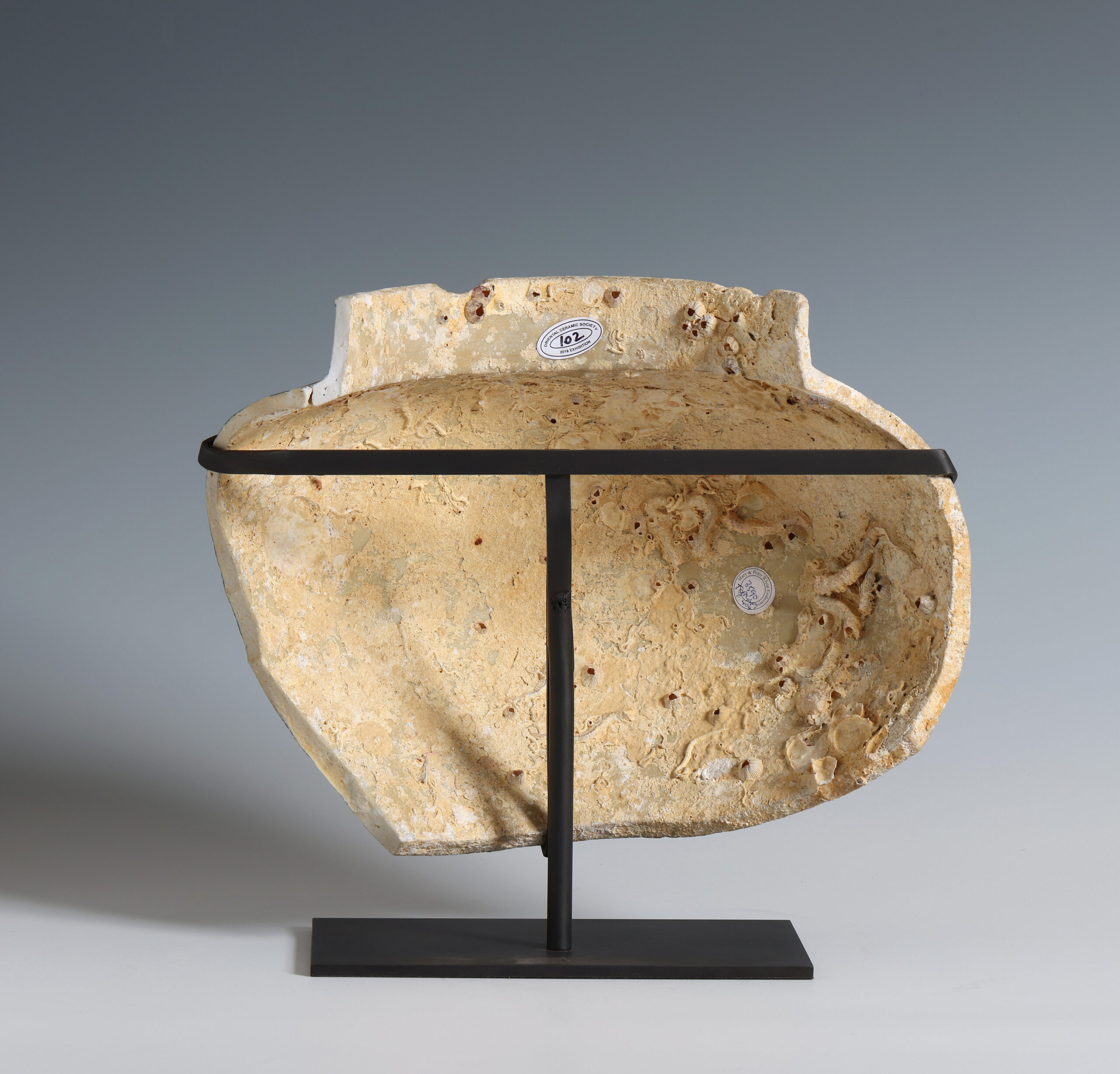
This is a section of a globular jar or guan, including a section of the short neck, and a crane with its wings spread dancing amongst plantain and blooming flowers on the exterior.
This piece comes from a group of 57 sherds of high-quality Yuan blue and white porcelain made in China for the Islamic market which were recovered from the Red Sea along the western coast of Yemen in the late 1990s[i]. This discovery was of great importance in confirming the significant role of the maritime trade routes in the importation of such pieces to the Middle East which had previously been rather overlooked.
The two great remaining historic collections of Yuan and Ming porcelain in the Islamic World, are the Ardebil Shrine and the Topkapi Saray in Istanbul. Many of the pieces in the Ardebil Shrine would have travelled via the overland Silk Routes in the form of tribute or trade. The collections of the Topkapi were assembled piecemeal over 500 years by successive Ottoman sultans. In their detailed study of the Topkapi archives Dr Julian Raby and Dr Yücel surprisingly only found one record of a piece being purchased, all the rest were acquired through the system of muhallefat which literally translates as inheritance but became a form of taxation or confiscation and developed into a form of arbitrary death duty on the Sultan’s subjects.[ii] In this way many of the collections that once must have existed in the great cultural centres of Cairo, Damascus and Aleppo were absorbed into the Topkapi.
Examples of jars of the same form with similar decoration to the necks are in the Topkapi Saray (Krahl 1986 p. 404, no. 579) and the Ardebil Shrine (Pope 1956, plate 27). Professor Carswell illustrates two sections of a guan from the same shipwreck, apparently from the same vessel (Carswell 2000, p.176 b & c, section drawing p.189)
Provenance:
Acquired from R & G McPherson Antiques, London, in June 2010
Peter and Mary White Collection
Literature:
Oriental Ceramic Society 2016
The Oriental Ceramic Society, China Without Dragons: Rare Pieces from Oriental Ceramic Society Members, London, 2016, pp.168-171, no.102, p. 171 top left (part of a larger group)
White 2020
Mary White, Beasts at the Whites’ House: A selection of ceramics from the Whites’ House collection, vol. 2020, p. 160
References:
Carswell 2000
John Carswell, Blue & White: Chinese Porcelain Around the World, (The British Museum Press, London 2000)
Krahl 1986
Regina Krahl, Nurdan Erbahar, Ünsal Yücel John Ayers and Julian Raby, Chinese Ceramics in the Topkapi Saray Museum Istanbul. A Complete Catalogue. 3 volumes. (Sotheby`s Publications, 1986)
Pope 1956
John Alexander Pope, Chinese Porcelains from The Ardebil Shrine, (Freer Gallery of Art, Washington., 1956)
Price: £4,200

[i] There was also one Longquan celadon bowl, see Oriental Ceramic Society 2016, p. 160 no. 97.
[ii] Krahl 1986, p.15.