
‘Witness the tea-pots now made at the potters in Poultry in Cheapside which not only for Art but for beautiful colour too, are far beyond any we have from China. These are made of the English Haemites in Staffordshire, as I take it, by two Dutch men incomparable artists’, Martin Lister 1693
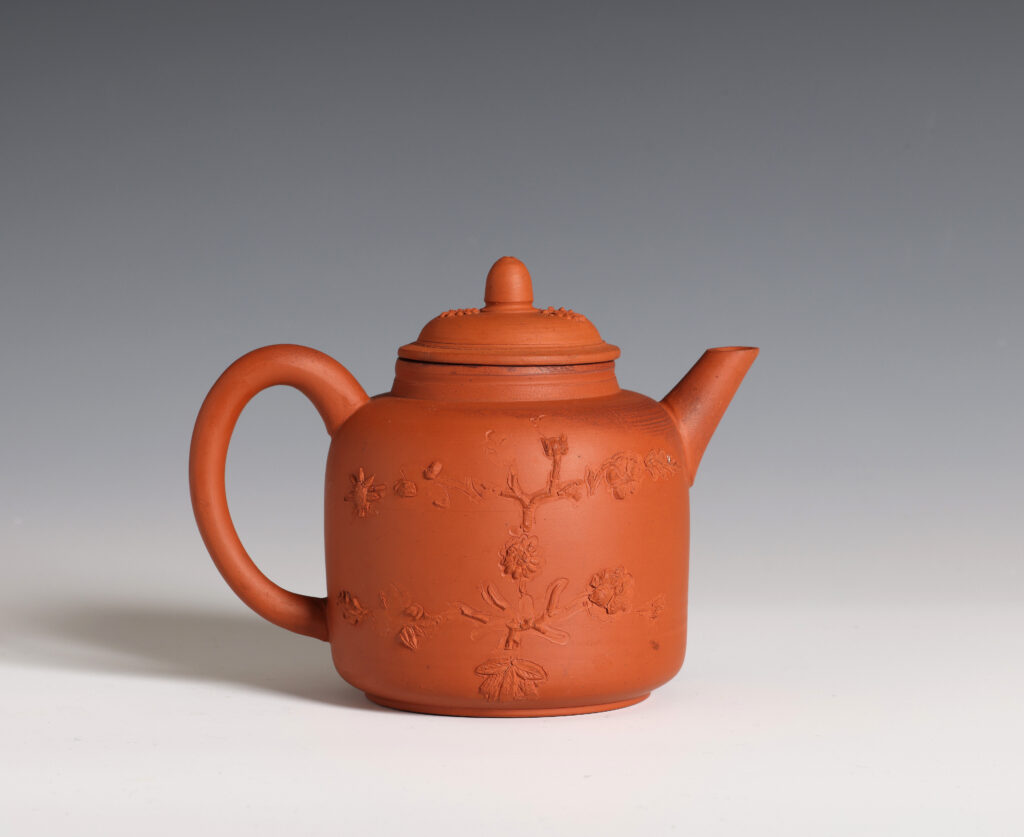
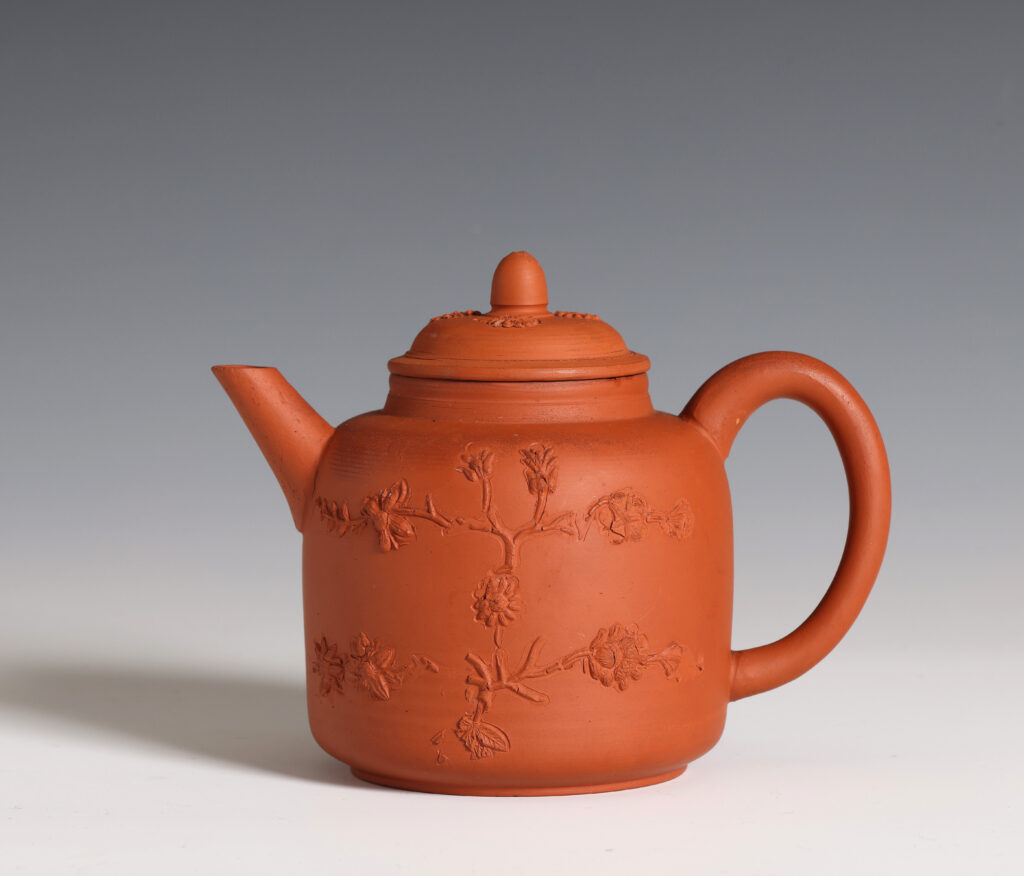
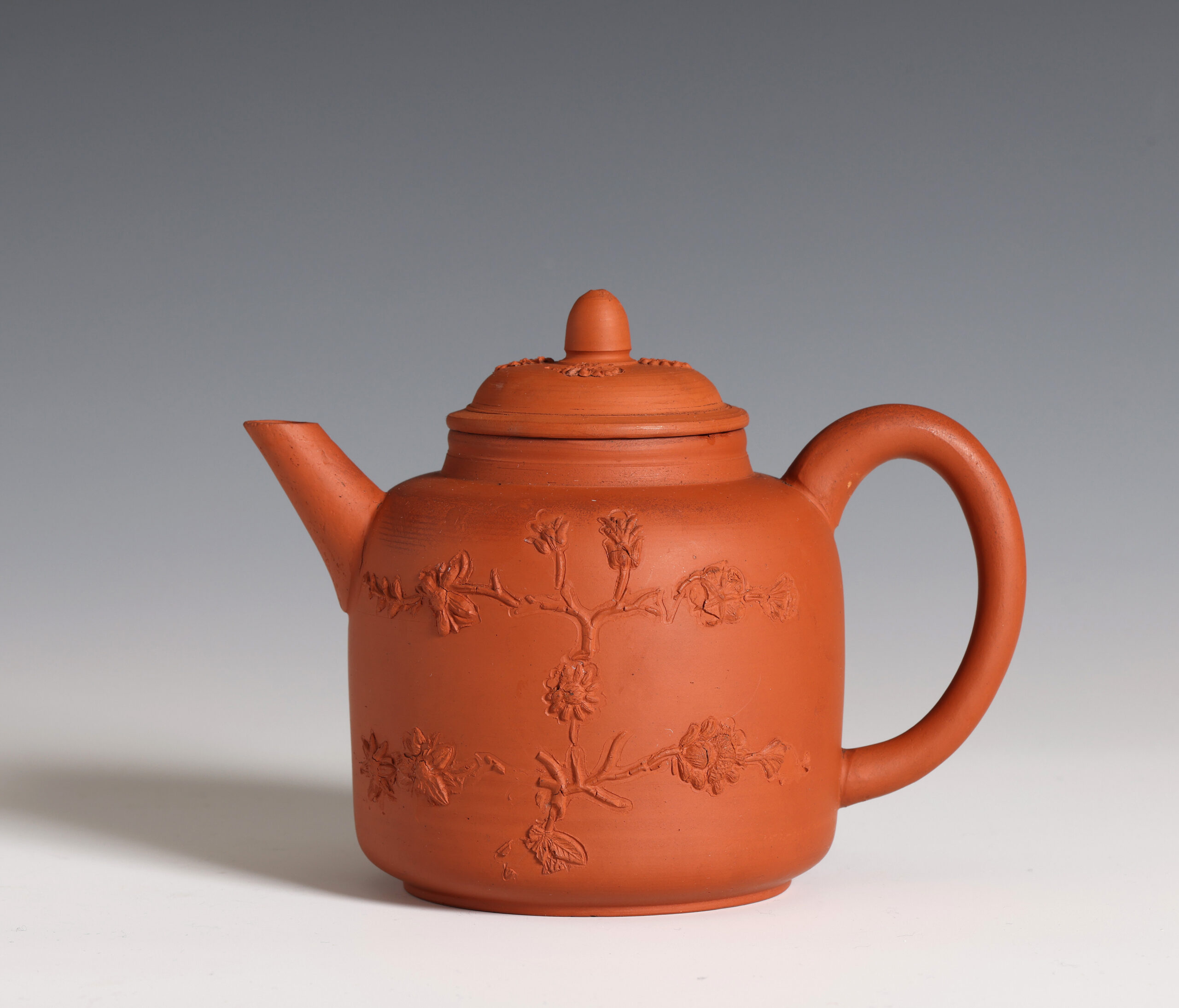
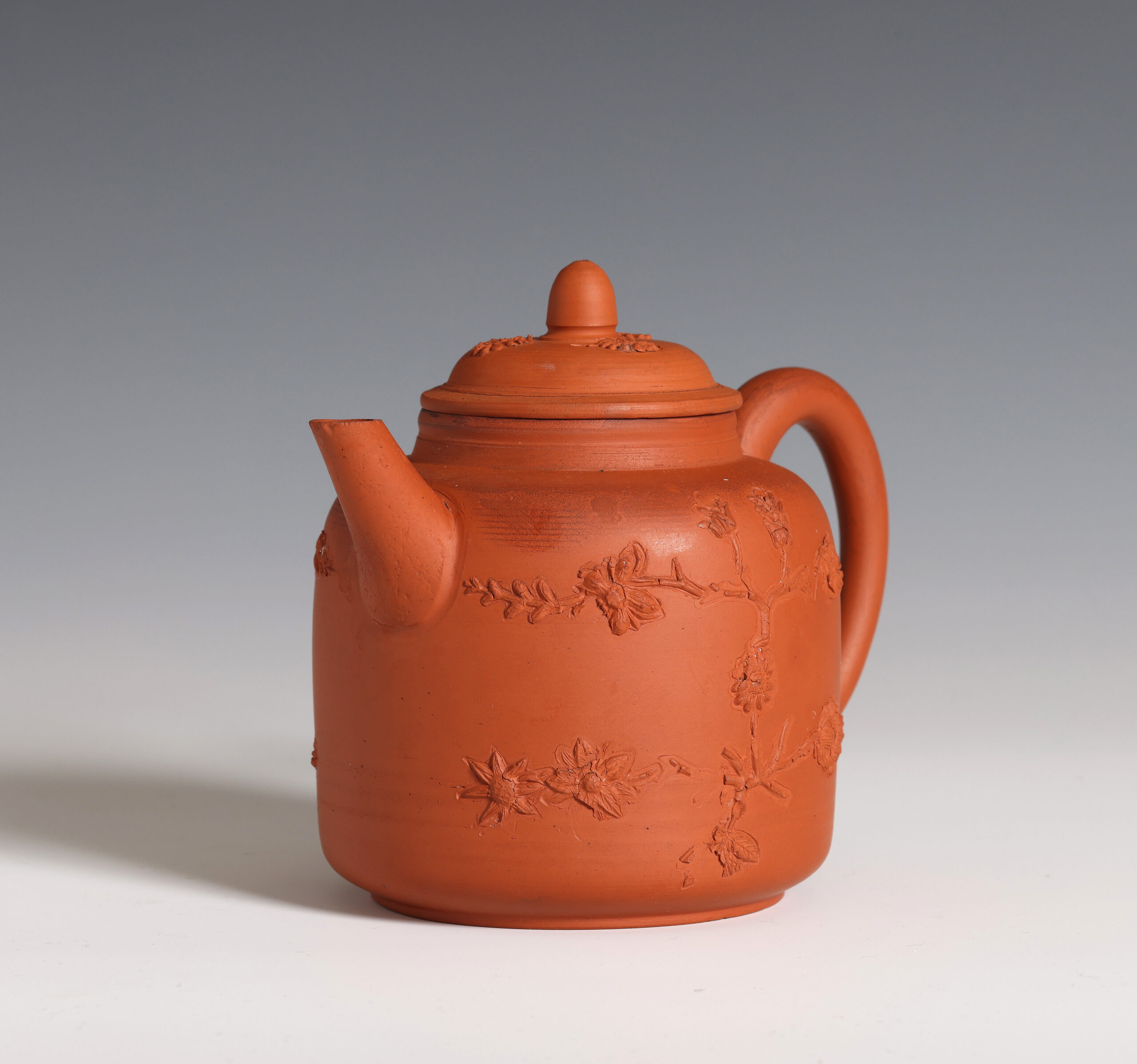
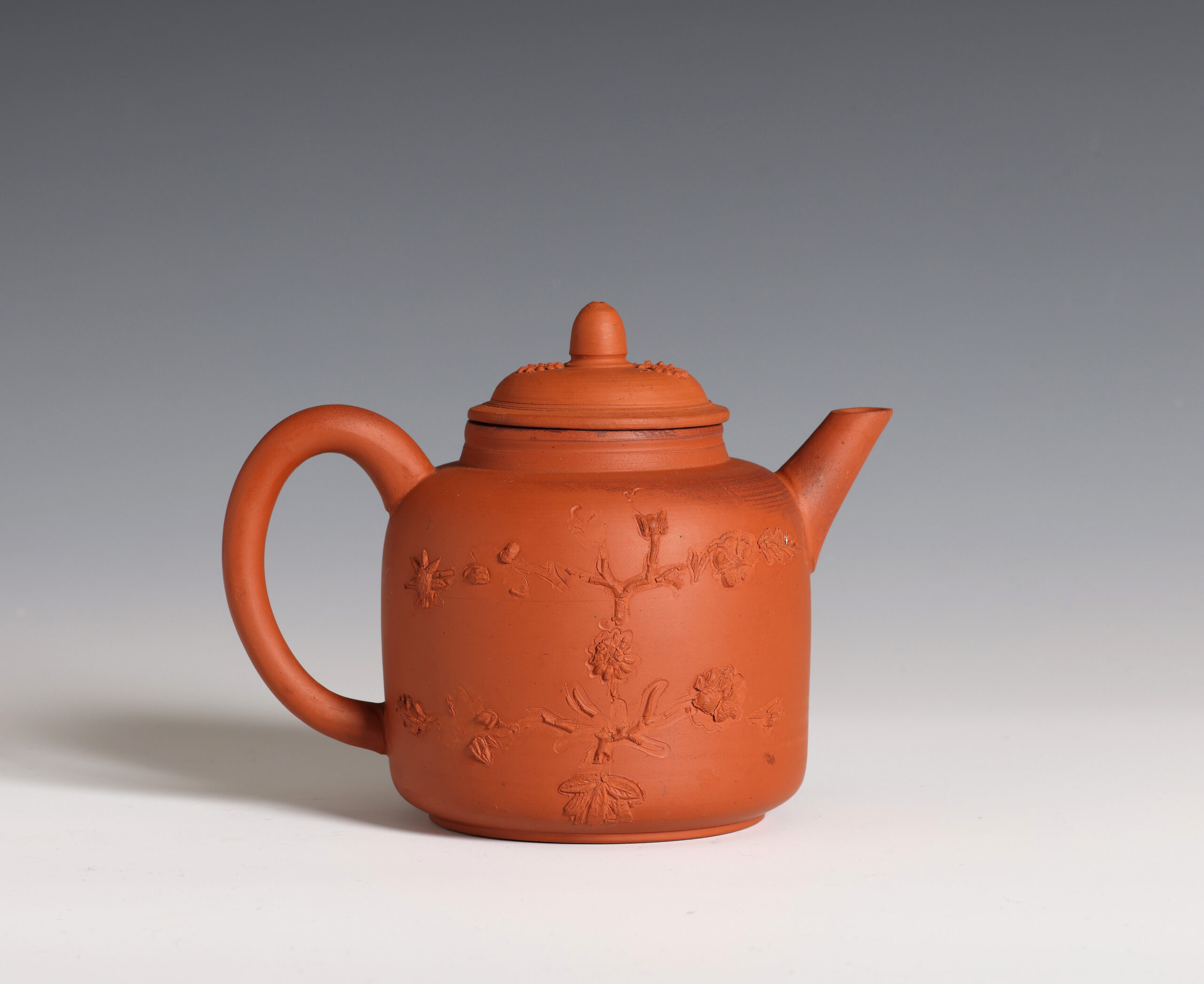
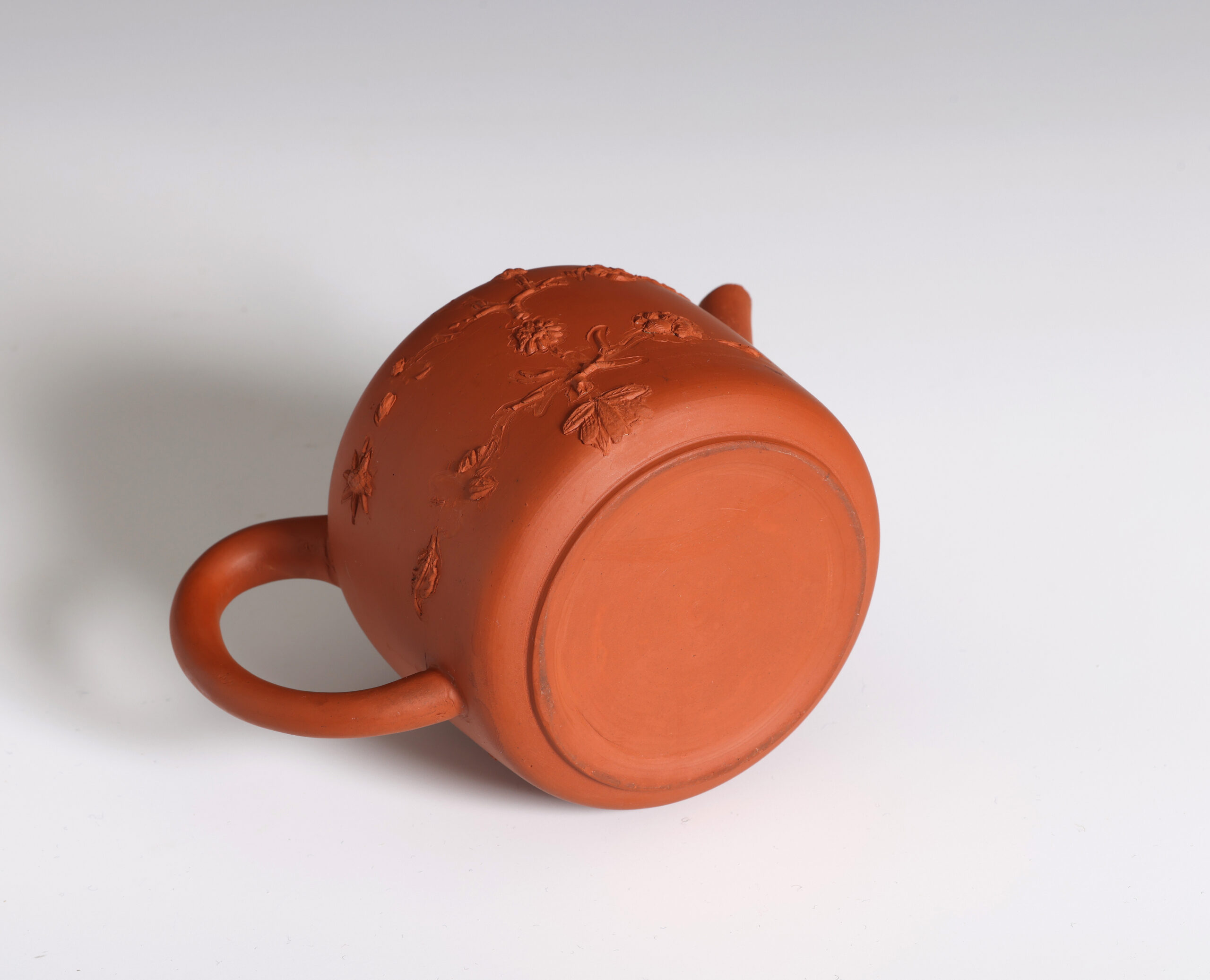
Slip-cast and lathe finished, of cylindrical form with decorative sprigging applied, the finial is cast in the form of an acorn.
John Philip and David Elers were Dutch silversmiths who produced high quality red stoneware at Bradwell Wood in Staffordshire for a brief period between circa 1690 and 1698, their establishment being last recorded in 1697. Their distinctive wares were cast in plaster moulds and the exteriors neatly turned on a lathe.
A letter of 1777 from Josiah Wegwood to Thomas Bentley details the innovations brought to English pottery by the Elers Brothers. [i] He writes:
‘The improvements Mr Elers made in our manufactory were precisely these – glazing our common clays with salt [and …] refining our common red clay by sifting and making tea and coffee ware in imitation of the Chinese Red Porcelain, by casting it in plaster moulds, and turning it on the outside upon Lathes, and ornamenting it with the tea branch in relief, in imitation of the Chinese manner of ornamenting this ware- for these improvements, and very great ones they were for the time, we are indebted to the very ingenious Messrs. Elers..’
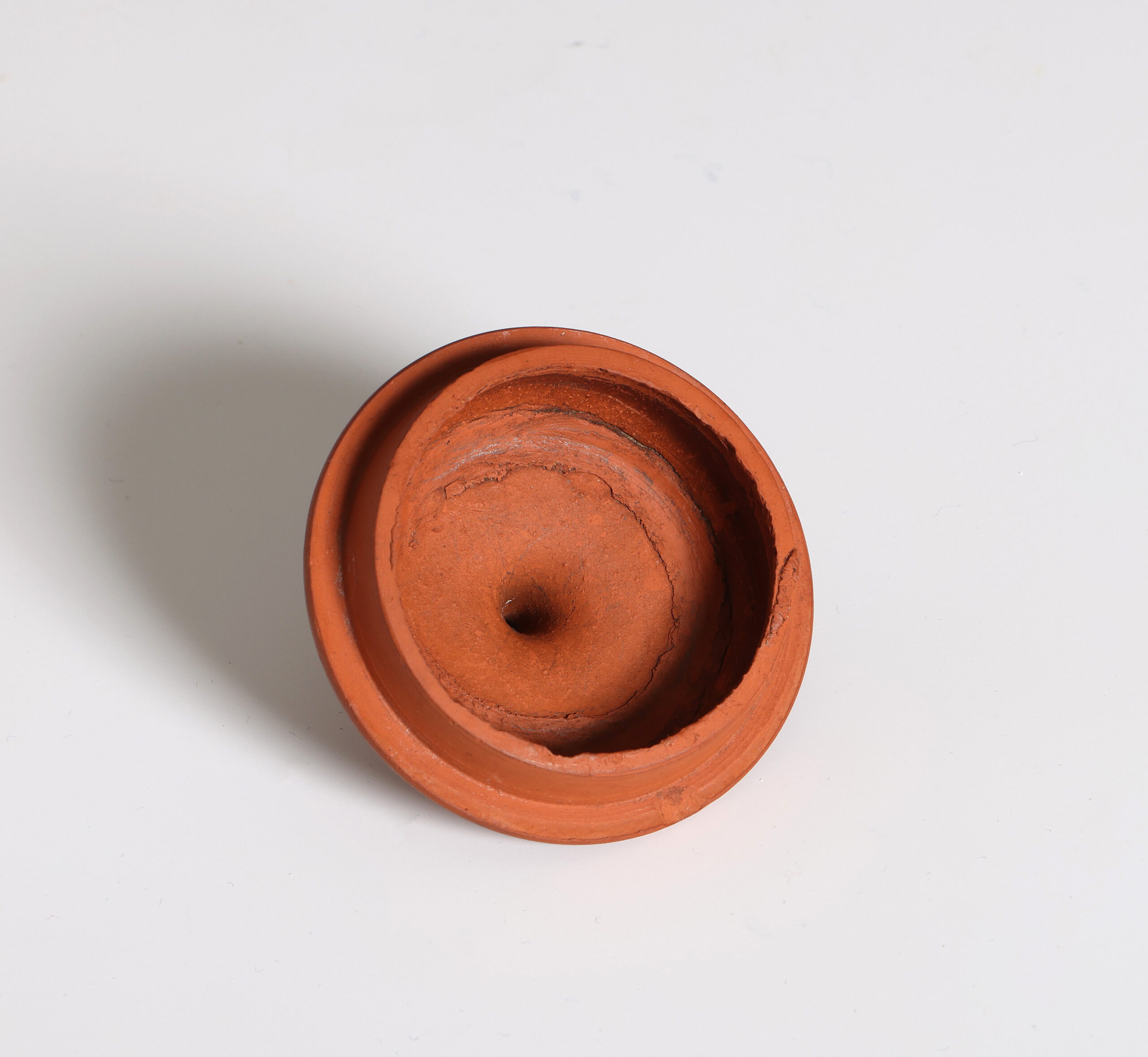
In the turning of a vessel on a lathe, a cone of either wood or clay is needed to hold the piece while it is spun, and the irregular circular impression to the centre of the base inside this teapot is consistent with this. The crispness of the moulded decoration on this teapot is attributable to the Elers’ use of metal dies, as indicated by the slight roughness surrounding these reliefs. An Elers coffee pot with strikingly similar decoration and a comparable acorn finial to the cover was sold by Bonhams on 1 May 2013, lot 2. A lidded jug with similar floral sprigged decoration and an acorn finial is illustrated by Elliott (1998), colour plate 4. Another Elers jug with comparable decoration is illustrated by Jan Daniël van Dam, European Redwares, British Ceramic Design 1600-2002 (2003), p.36, pl.8.
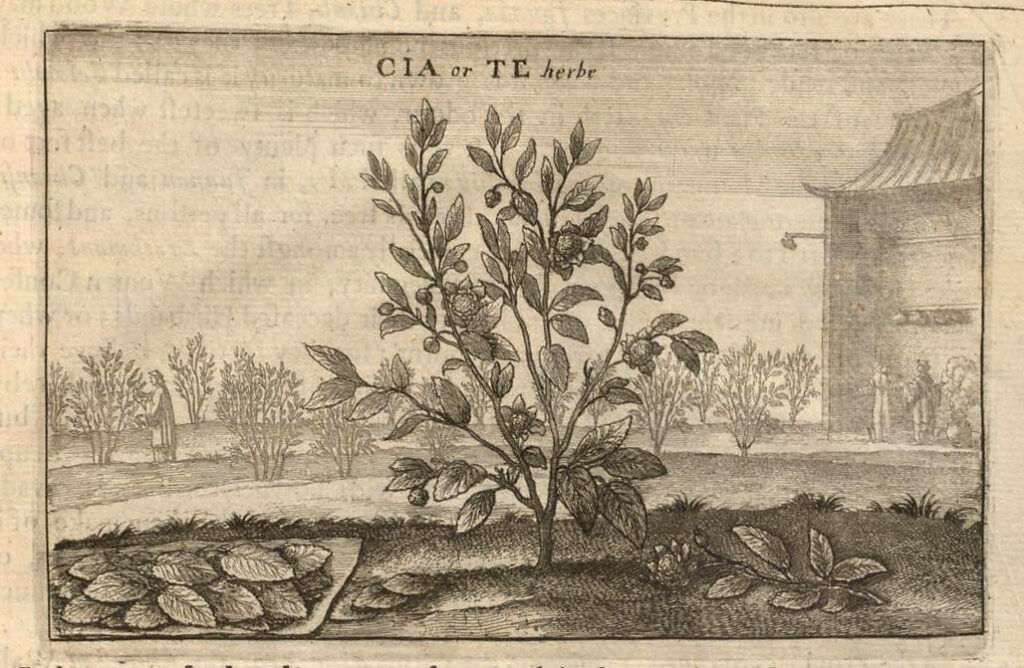
The applied sprigging on this teapot corresponds to Wedgwood’s description, being ornamented ‘with the tea branch in relief’ as depicted in Johan Nieuhof’s An Embassy from the East-India Company, of the United Provinces, to the Grand Tartar Cham or Emperour of China, published in the first English edition in 1669 by John Ogilby[ii], page 87.
A legal case was brought against the Elers brothers by John Dwight of Fulham in 1693. He accused them of employing a former workman of his, John Chandler, in order to gain an insight into the practices employed at his pottery in Fulham. It is suggested that there was something unique about the wares that the Elers brothers were producing, as the case was not upheld but instead an amicable resolution was found whereby the Elers brothers were allowed to continue producing redwares after this date. This idea is reinforced by the fact that the earliest reference to red clay from Staffordshire in John Dwight’s notebook was made shortly after the legal dispute in November of 1963.
So, while there is no archaeological evidence to suggest what type of wares they produced, a body of works has come to be accepted as Elers-ware. These pieces are characterized by their fine quality, a particular hardness and smoothness of body, the fact that they are slip cast and lathe turned. They are also connected by a coherent set of unusual forms that bear repeated features such as acorn finials, sprigged decoration which has often sprung in places, and speak to a slightly earlier production than most of the other Staffordshire potteries. There are also examples with Dutch gilt-metal mounts, which indicate significant trading links to The Netherlands and the Continent.
Condition:
Some losses to the sprigging, two small chips to the rim
References:
Elliot 1998
Gordon Elliot, John & David Elers and their contemporaries, (Jonathan Horne Publications 1998)
—————————————————————————————————————————
[i] Elliot 1998, p. 18.
[ii] For a discussion of the use of Nieuhof’s engravings on English pottery see Grigsby 1993, pp. 172-183.