

Decorated in blue, yellow, green and iron-red with a Chinese lady on a terrace within six floral panels on the border.
Leslie Grigsby discusses a similar dish in her catalogue of the Longridge Collection noting that this type of flower painting and palette occur on English delft from about 1695 into the 1730s[1]. She also suggests that the markings on the reverse, after those on Chinese Kangxi porcelain, suggest a Bristol attribution referring to a study made of the markings to the reverse of delftware in Frank Britton’s catalogue of the Bristol Museum’s delftware[2].
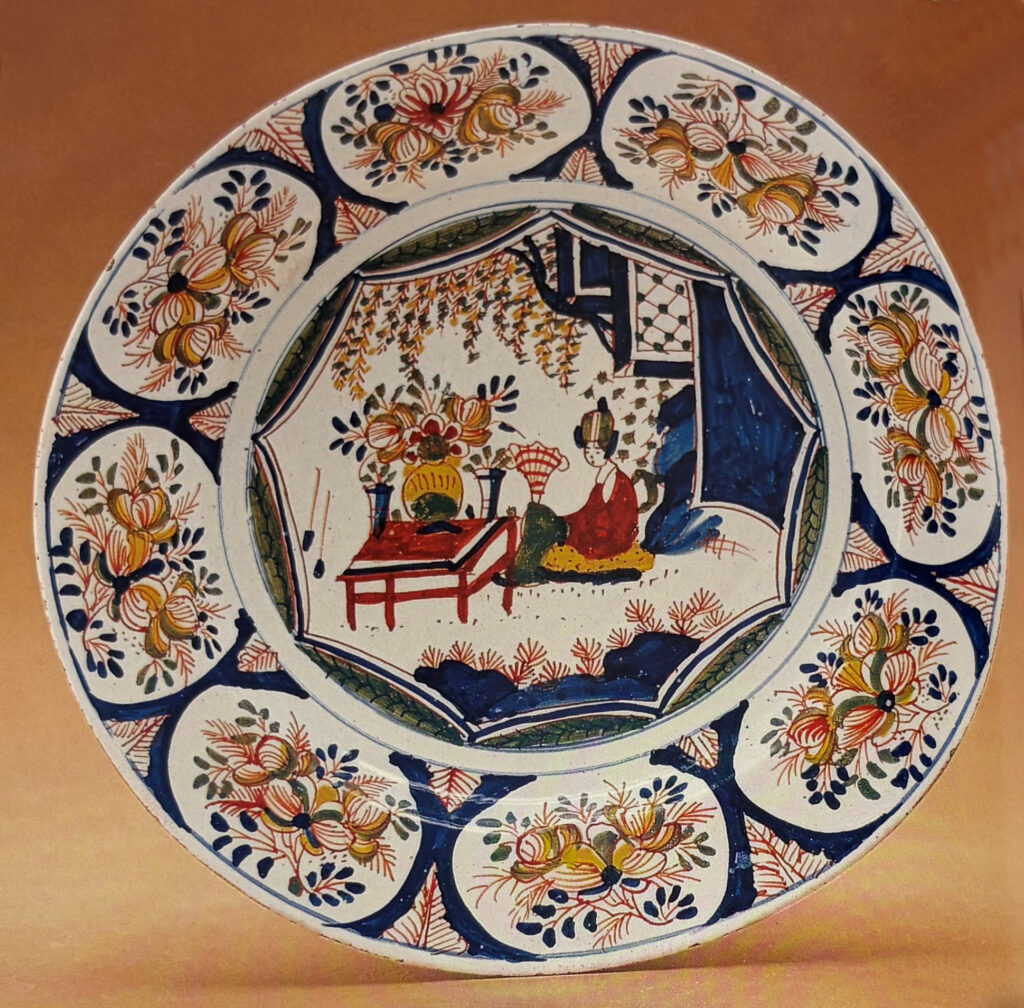
While similar, our dish differs in some respects, having stronger, more thickly applied colours and strong blue border, The flower sprays are also contained in a wide bevelled frame rather than the oval one of the Longridge collection. These features fit more neatly with a date closer to 1710.[3]
Condition:
Small chips, no restoration
References:
Britton 1982
Frank Britton, English Delftware in the Bristol Collection, (Sotheby Publications 1982)
Lipski & Archer 1984
Louis L. Lipski and Michael Archer, Dated English Delftware, London: Sotheby Publications (1984)
Grigsby 2000
Leslie B. Grigsby, The Longridge Collection of English Slipware and Delftware, (Volume 2), Jonathan Horne Publications, 2000
——————————————————————————————————————————————————-
[1] Grigsby cites a bowl dated 1709 with the arms of the Worshipful Company of Carpenters, illustrated in Britton, p. 31, and another dish dated 1734 for a comparison to the oval frames around the border
[2] The study looked at 65 dishes with these markings. He says that 34 of the 65 pieces bore potter’s marks, and two even had ‘WP’ marks of the William Pottery. While he suggests that these markings do not occur on English wares from other pottery centres, they are found on Dutch Delft of the late 17th century and Britton posits that this sort of decoration may have migrated with a workman from Holland.
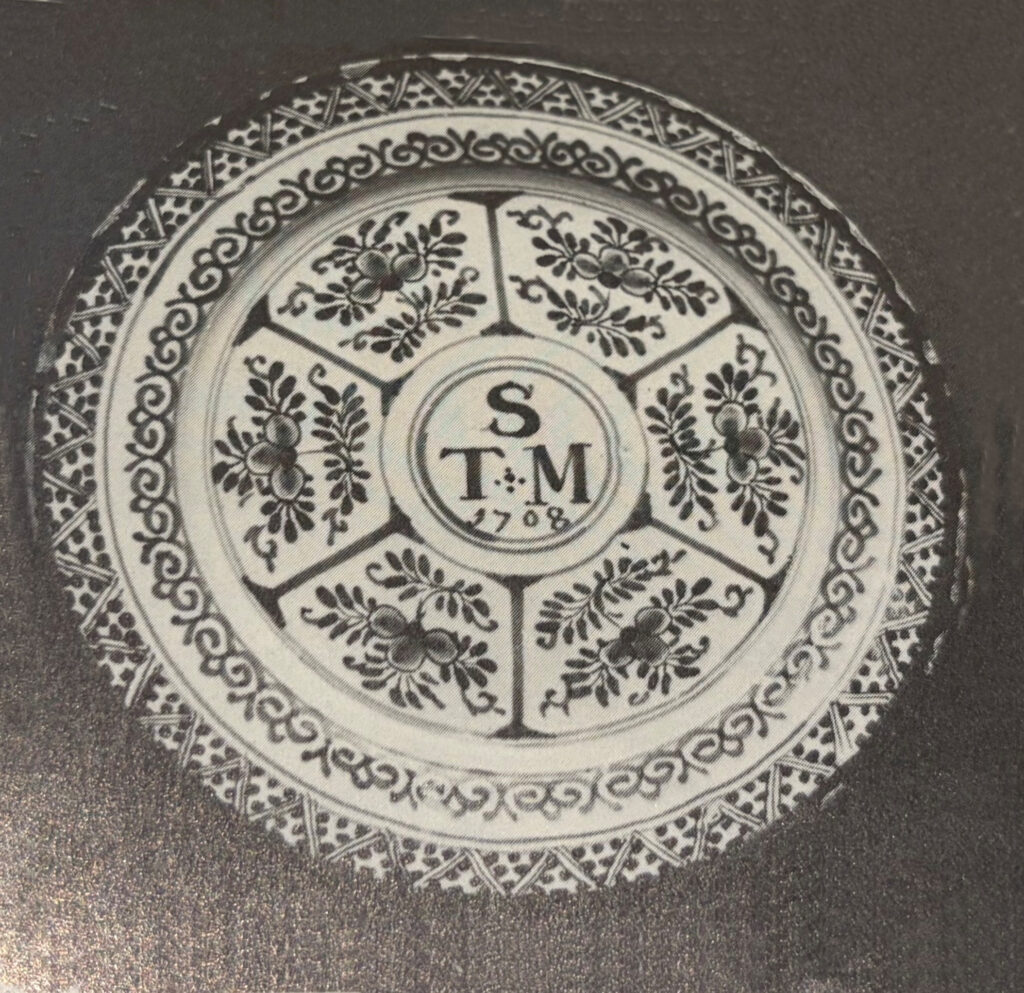
[3] See Lipski & Archer 1984, pp. 68-69 nos. 243 &251 for two dishes dates 1705 and 1708, and p.72 for no. 269 dated 1712
Price: £2,900
