
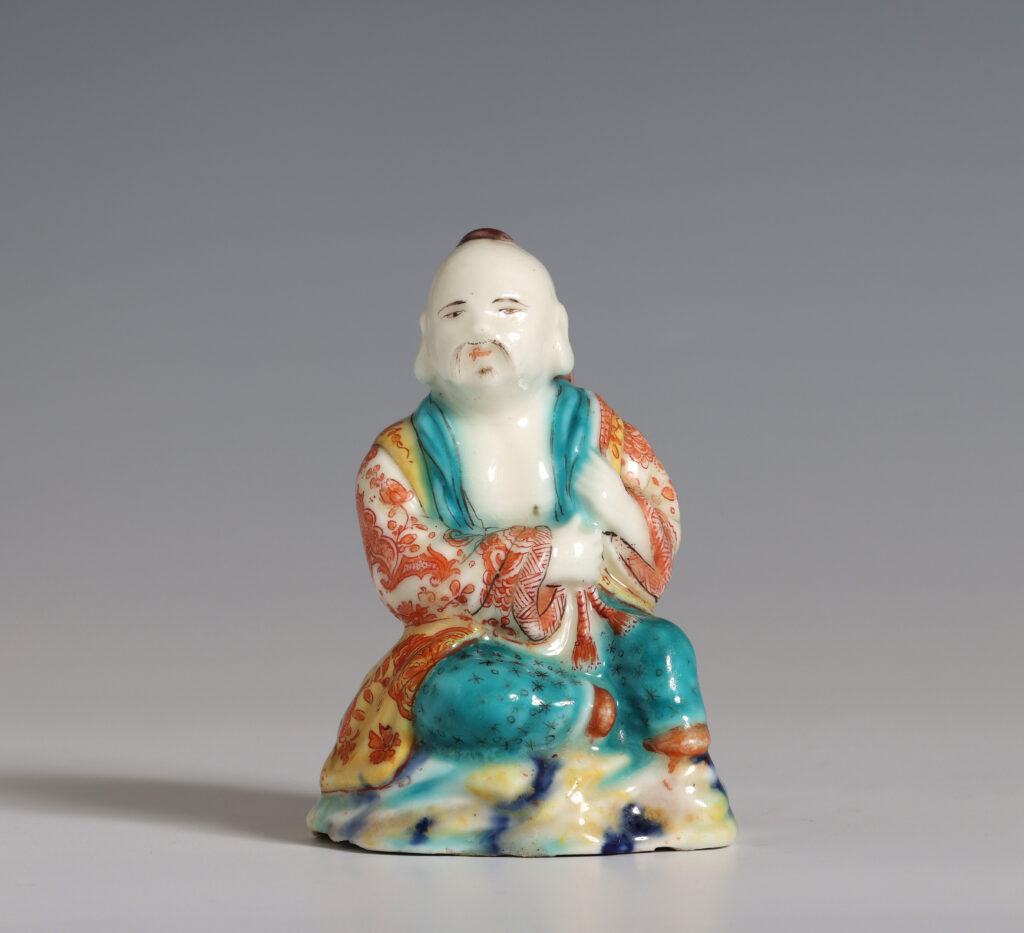
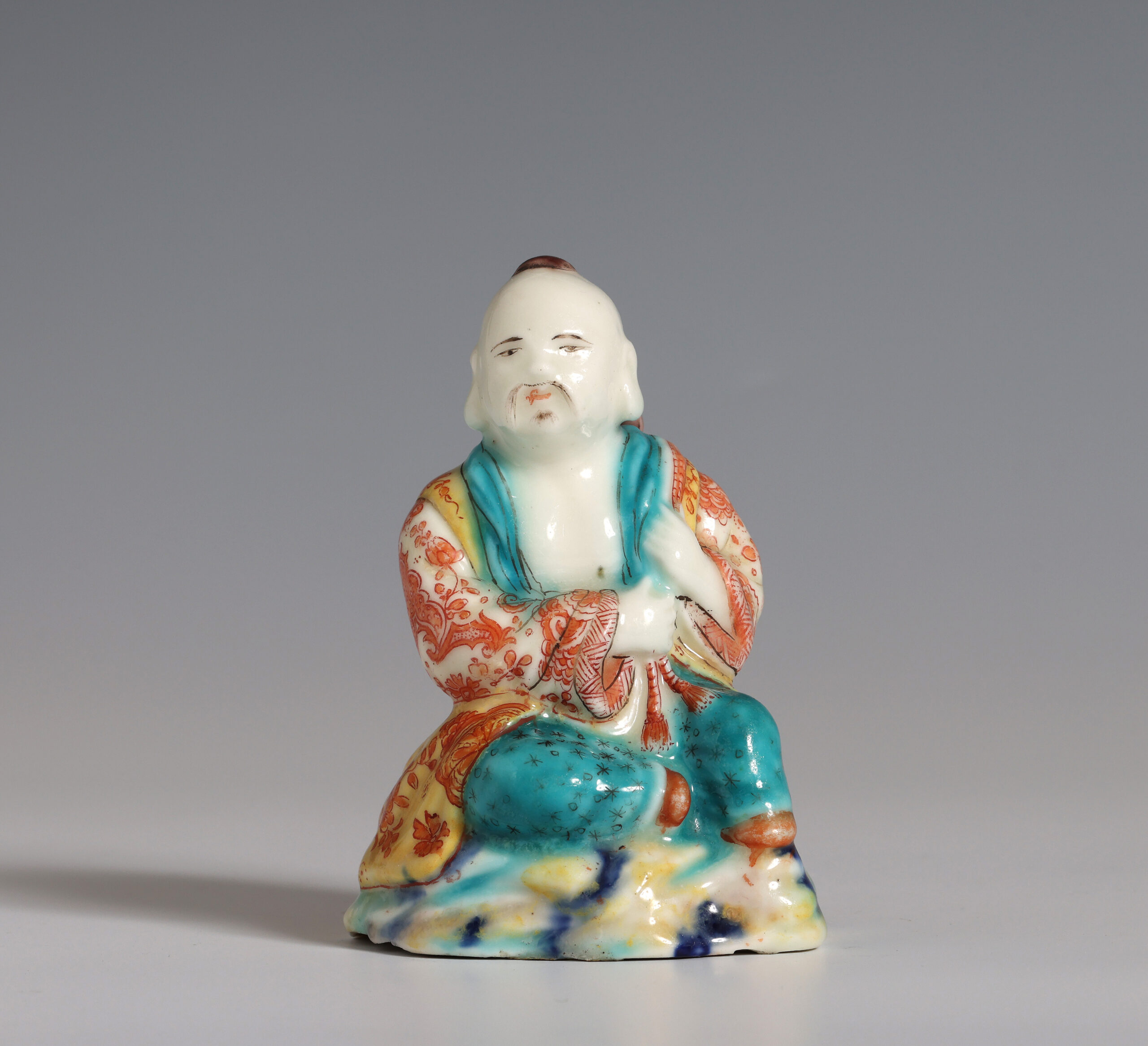
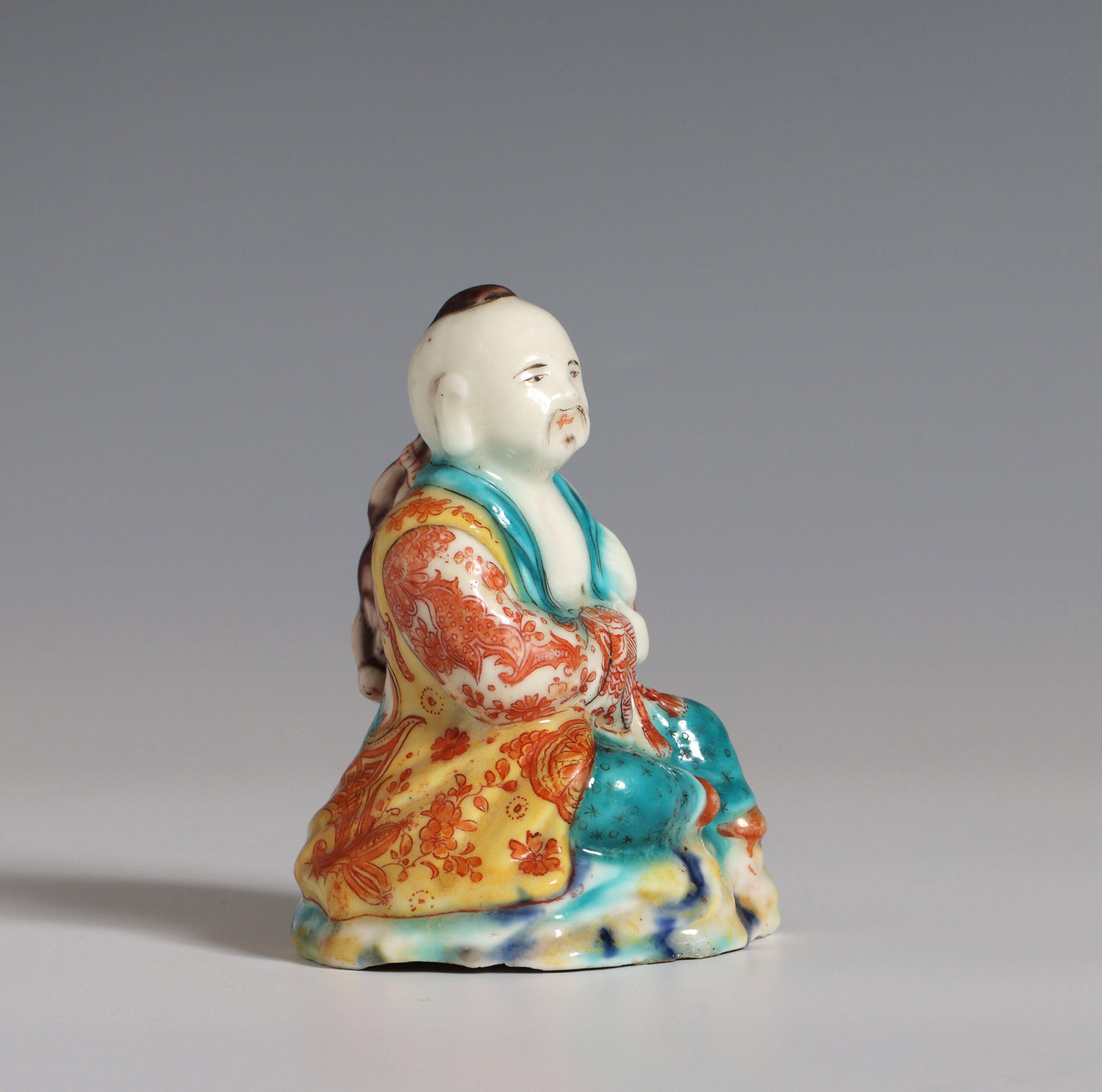
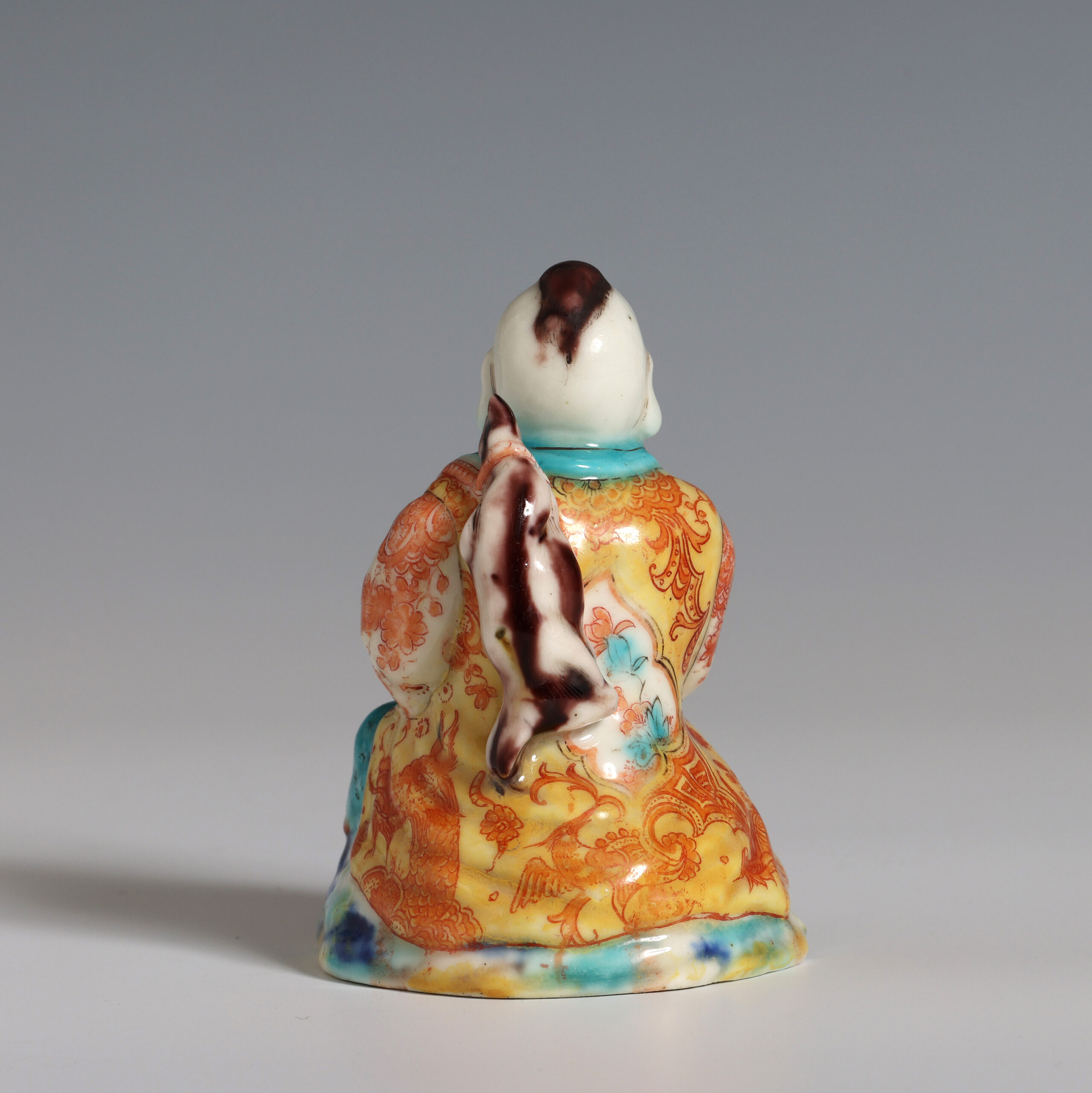
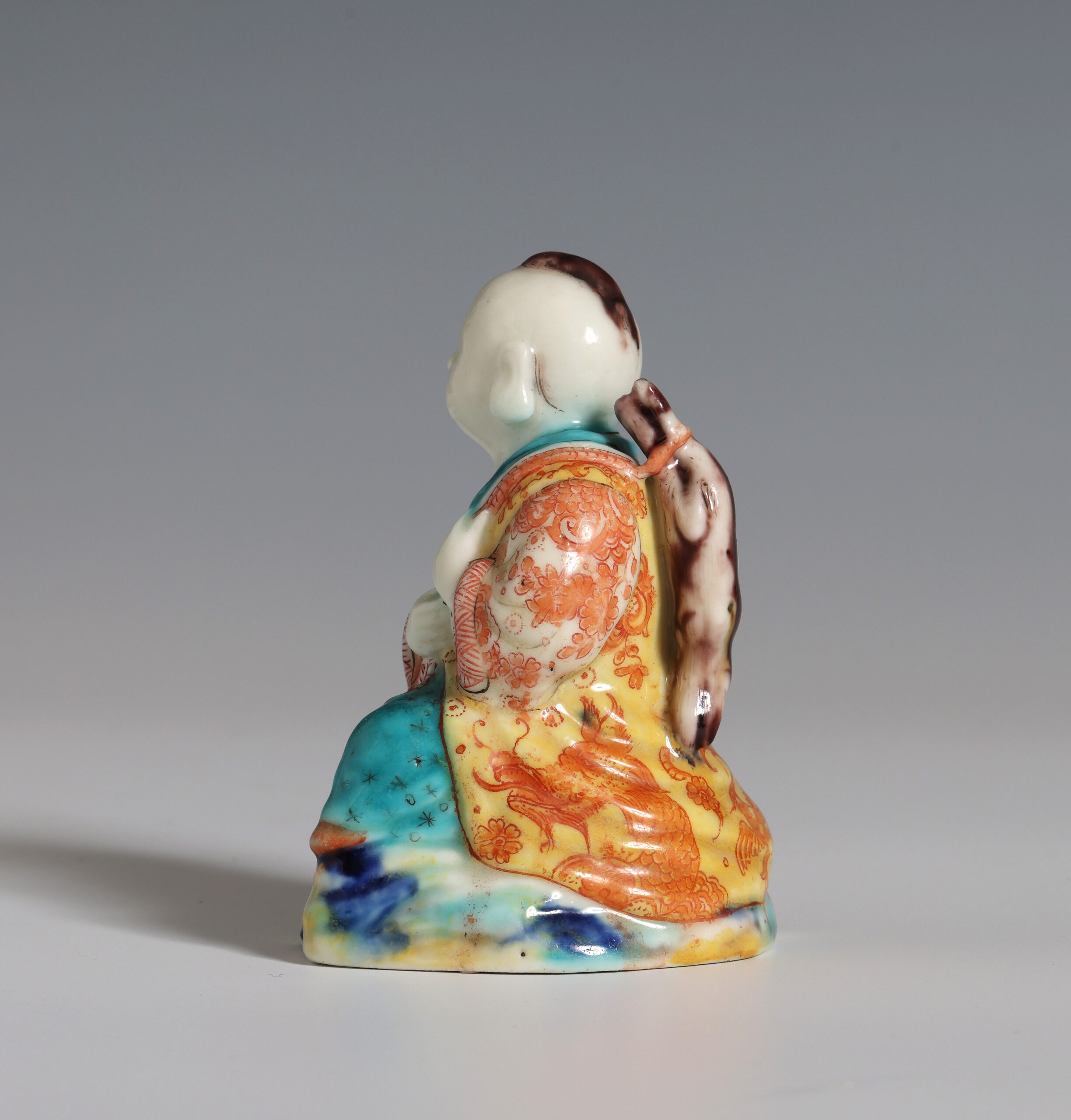
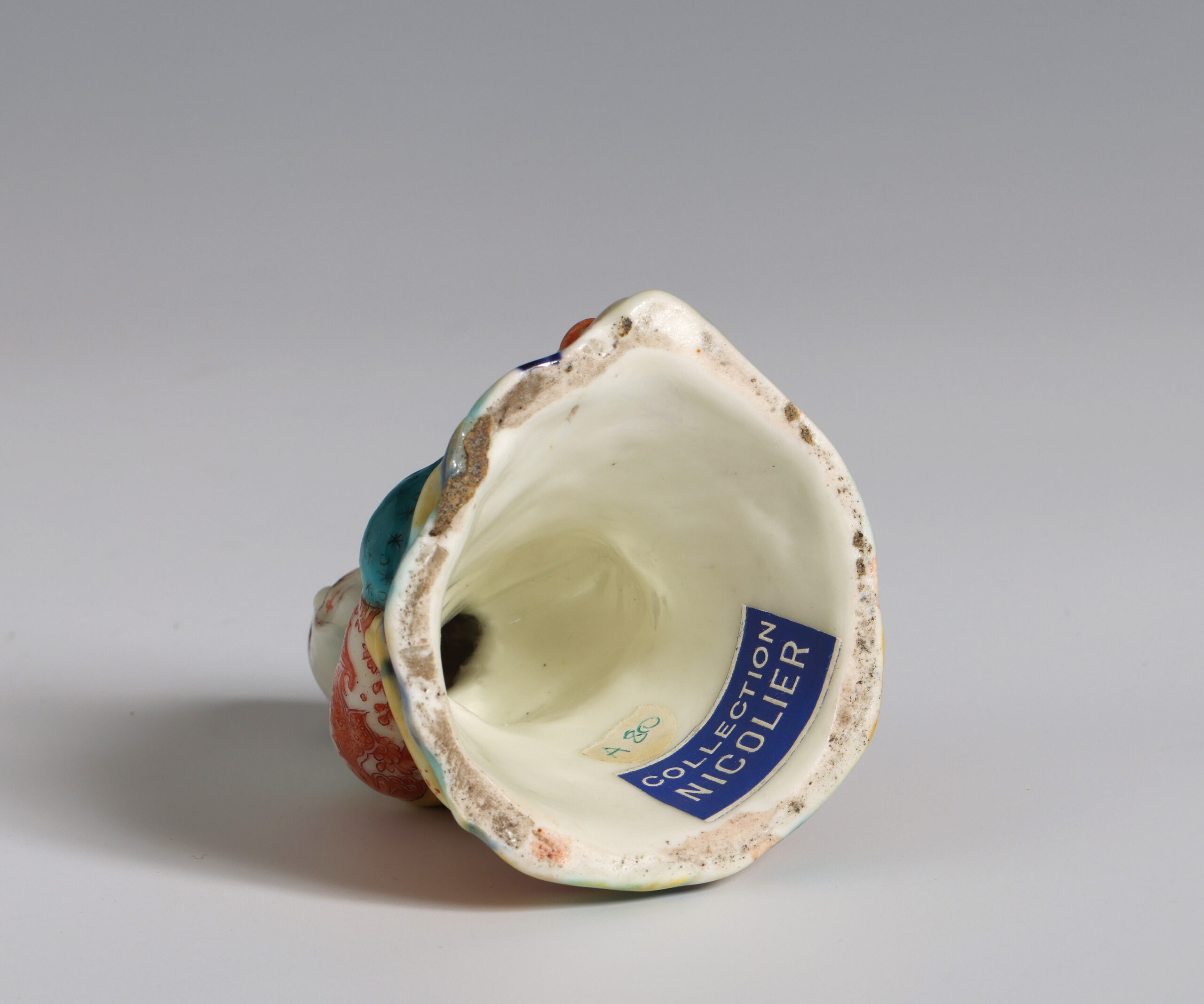
Modelled after a Japanese Arita original of a loose-robed boy with a hare slung over his left shoulder tied with a rope. The painter has added a moustache to transform him into an adult.
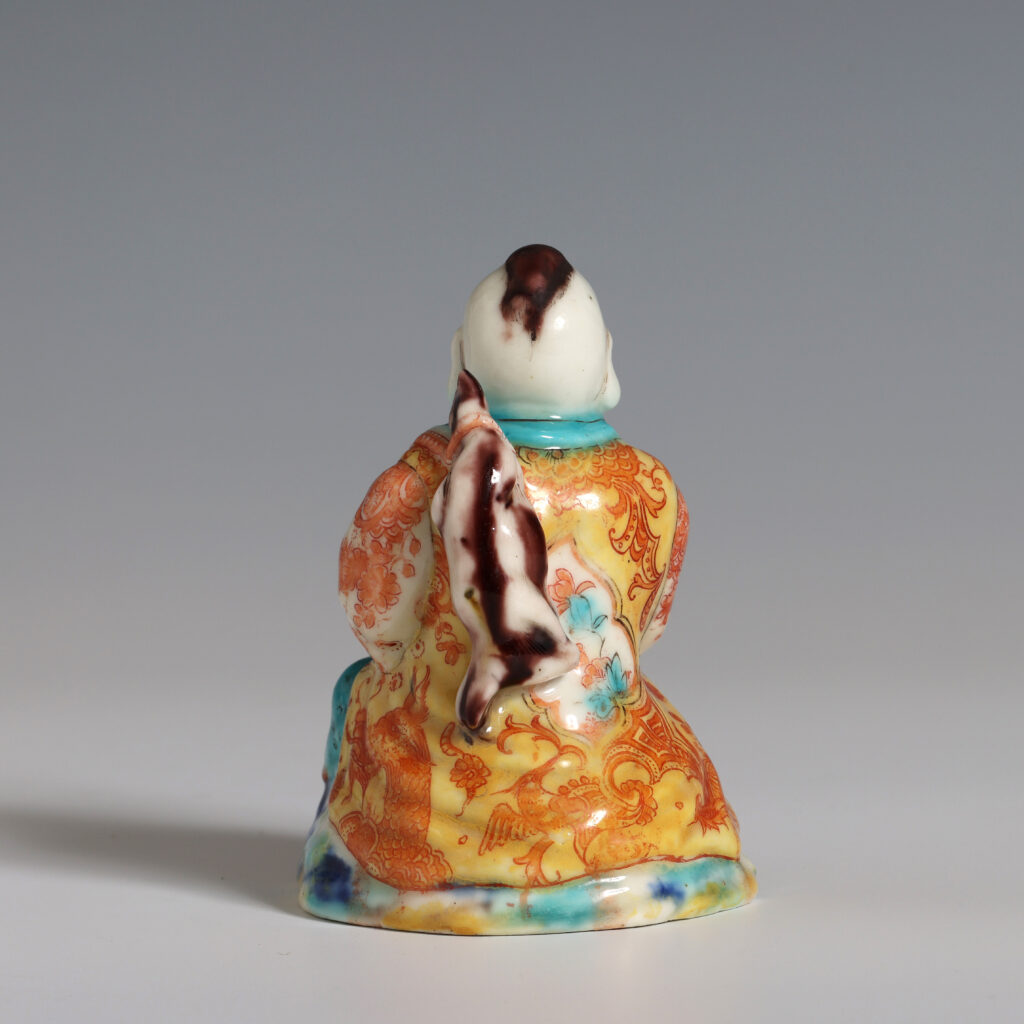
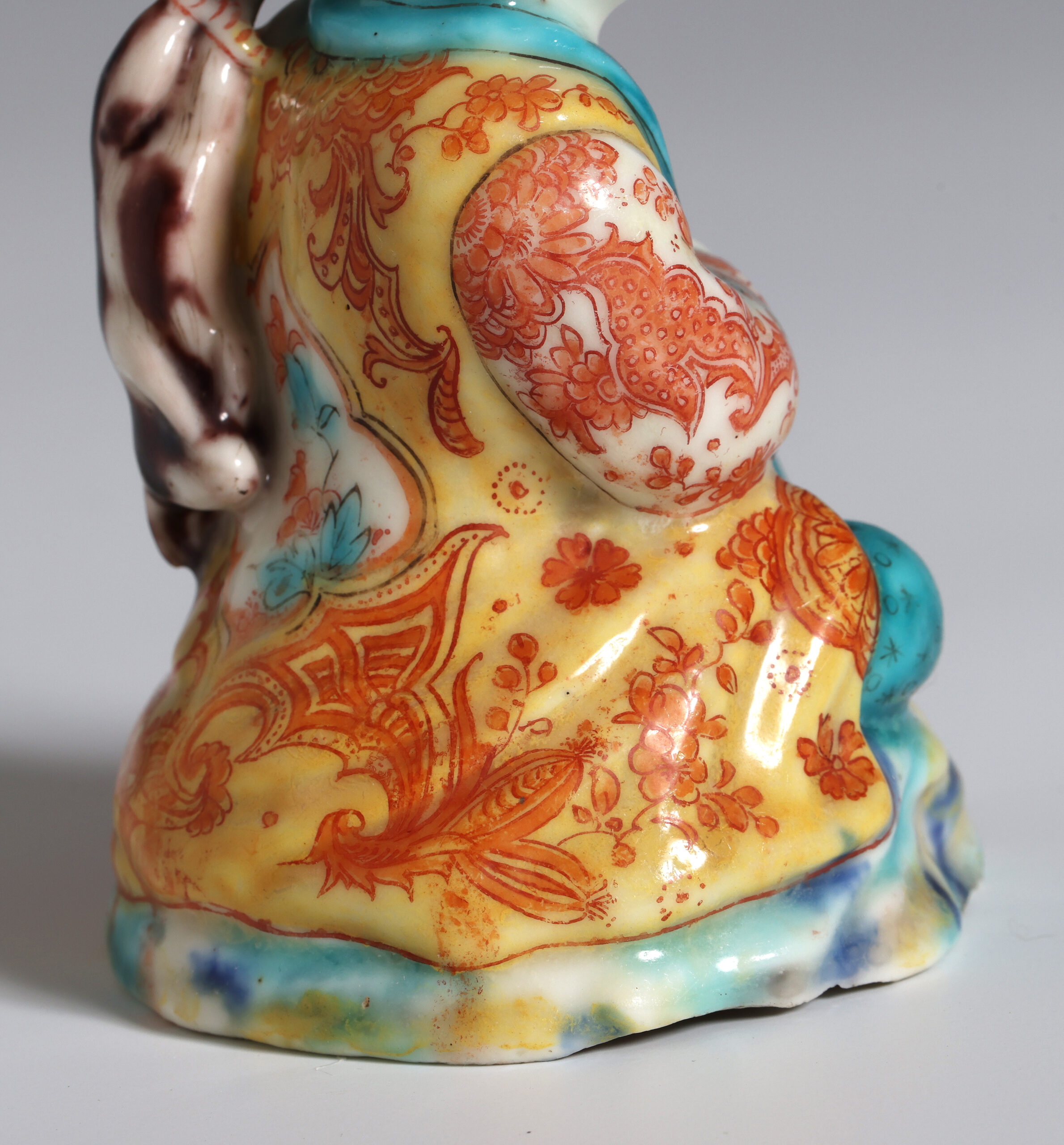
The figure is decorated with grand feu colours of cobalt blue, antimony yellow, copper turquoise blue and mauve from manganese which are all fired in the first firing under a clear lead glaze. Further decoration of black outlines and especially detailed and imaginative ornament in iron-red has been added in a subsequent low or petit feu firing.

Some variants of this model have the painted ‘DV’ mark that identifies them as products of the factory François Barbin (1691-1765) established under the protection and patronage of Louis-François-Anne de Neufville, duc de Villeroy (1695–1766). Our figure is slightly larger than most and the lack of a ‘DV’ mark make it possible that it was made at François Barbin’s Paris workshop. There is documentary evidence that Barbin made porcelain in his Paris premises but no marked or signed pieces are known.[i]
François Barbin (1691-1765) was apprenticed at the porcelain factory of Antoine Pavie (d.1727) in the Faubourg Saint-Antoine in Paris from about 1705. In 1720 Barbin rented premises nearby on the rue de Charonne where he and his wife Marguerite set up a faïence and porcelain factory and raised their family.[ii] As well as running his own workshop Barbin helped the distinguished scientist René Antoine Ferchault de Réaumur (1683–1757) in his porcelain experiments of about 1729 in the nearby rue de la Roquette, where he worked part time with the young Louis de Bourbon Condé, comte de Clermont (1709–71), a great promoter of science and the arts, and younger brother of Henri Louis, duc de Bourbon, prince de Condé, the patron of the Chantilly factory. Réaumur gives a detailed description of Barbin’s use of grand feu colours with petit feu decoration added in a subsequent firing, confirming his use of this uncommon combination in Paris.[iii]
Barbin had been able to make porcelain without interference in Paris from about 1720, in defiance of the privilege granted to Saint Cloud. This was probably due to the protection of powerful patrons such as Réaumur and the comte de Clermont. Indeed in a court case of 19th November 1733 Barbin had no hesitation in describing himself openly as a ‘manufacturier de faïence et de porcelaine’ before a commissaire de police.[iv] However, on 1 April 1735, when these patrons were no longer around to protect him, la communautés des faïencières obtained an ordonnance which allowed them to have his works seized.[v] Barbin stated that having been a manufacturer in the rue de Charonne for fourteen years, evidently without official authority, he now sought (and obtained) protection from the duc de Villeroy.[vi] Barbin then established the factory in the hamlet of Villeroy in around 1736, where it continued until 1748, when it moved to the nearby village of Mennecy.
The legal case provides clear proof that Barbin and his wife were making porcelain in Paris in the 1720s and early 1730s. Indeed, it is possible they continued to make it even after the establishment of the Villeroy factory, since Marguerite and her daughters remained in rue de Charonne until the 1760s. For obvious reasons, any porcelains made by Barbin in Paris are very unlikely to be marked, which makes them hard to identify.[vii]
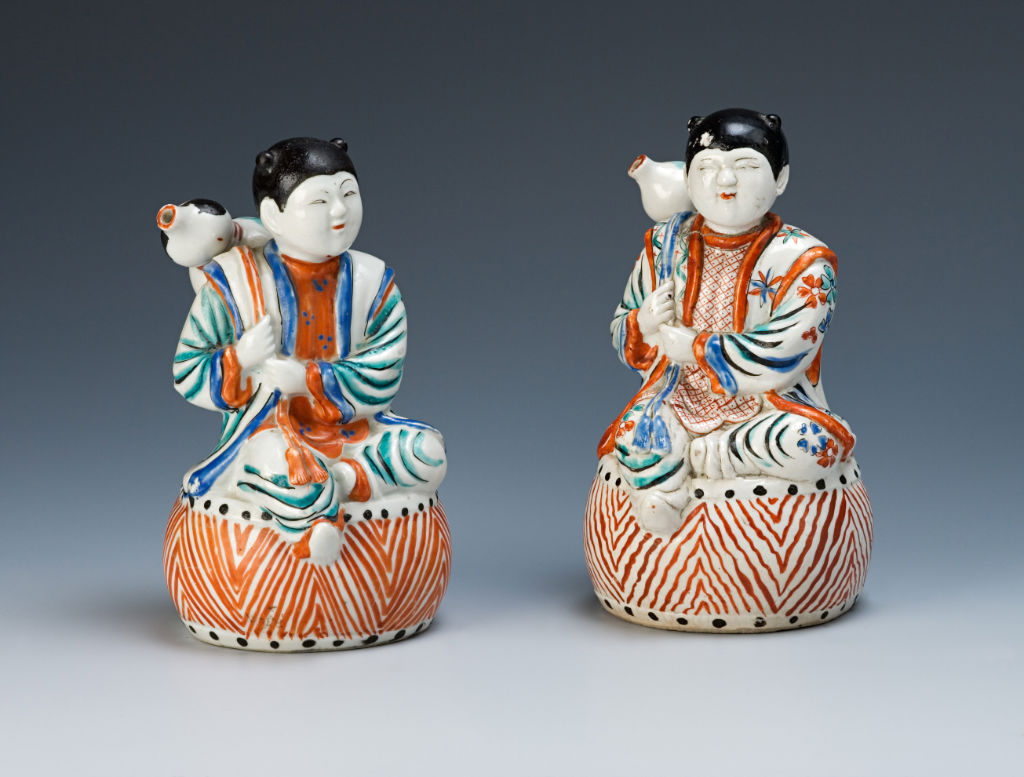
A pair of Kakiemon figures of youths, Circa 1670-80, Burghley House
We have not been able to find a Japanese Arita figure with a hare slung over his shoulder but the pendant figure of a boy seated on a drum with a gourd does exist in Kakiemon porcelain. An example is recorded in the 1688 inventory of Burghley House: ‘My Lords Dressing Roome…. China over ye Chimney…..2 figures with Juggs att theire backs.’[viii]
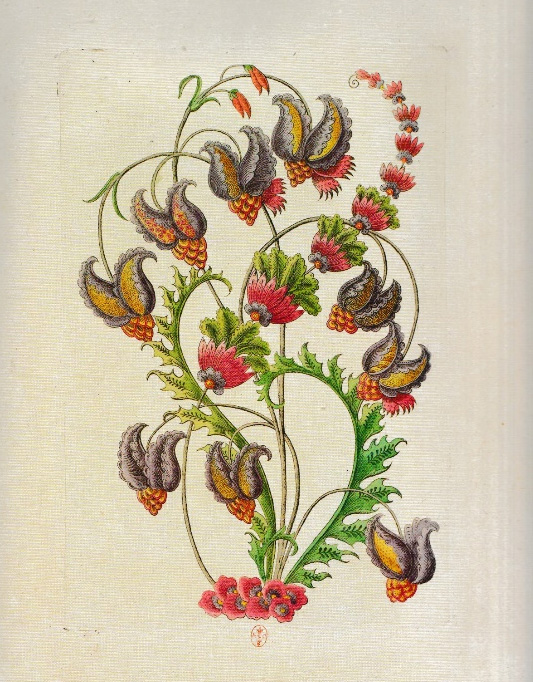
Jean Antoine Fraisse, Livre de Desseins Chinois, Tirés d’Après des Originaux De Perse, Des Indes, De La Chine et Du Japon, 1735, Pl. 44
The rich floral decoration of the robes, derives from Indian chintzes or indiennes fashionable in France since the second half of the seventeenth century. These were either copied directly from the fabrics themselves, or from the plates Jean-Antoine Fraisse (c. 1680–1739) published in his Livre de Desseins Chinois (1735) for the prince de Condé. We know Barbin had access to this volume, presumably from the library of his patron, because a pair of Villeroy seau à bouteille in the Cleveland Museum of Art takes their design directly from this source.[ix] The snarling dragon is a particularly imaginative flourish of the skilled decorator.
Condition:
Good
Provenance:
Collection Nicolier
References:
Brittle Beauty 2023
D’Agliano, Lehner-Jobst, Manners, Savill, Schwartz and Munger, Brittle Beauty: Reflections on 18th-Century European Porcelain, (Ad Ilissvm, 2023)
The Burghley Porcelains 1986
The Burghley Porcelains: An Exhibition from the Burghley House Collection and Based on the 1688 Inventory and 1690 Devonshire Schedule, (Japan Society Gallery, 1986), Catalogue to the exhibition shown at Japan House Gallery, New York, May 15-July 27, 1986
Duchon 2016
Nicole Duchon, Tendre porcelaine de Mennecy Villeroy, 2016
Fraisse 1735
Jean Antoine Fraisse, Livre de Desseins Chinois, Tirés d’Après des Originaux De Perse, Des Indes, De La Chine et Du Japon, 1735. (Reprinted 2011 – Éditions Monelle Hayot)
Manners 2020
Errol Manners, ‘The Early Sculptural Porcelain of François Barbin at Villeroy and Paris’, Journal of the French Porcelain Society, vol. VIII, 2020
————————————————————————————————————————————————————————————————————–
[i] Both marked and unmarked Villeroy-Barbin pieces often, but not always, have an opaque tin glaze.
[ii] Duchon 2016, p. 17.
[iii] Manners 2020, p. 78 & 79 and also entry no. 37 in this catalogue.
[iv] Duchon 2016, p.18.
[v] Duchon, 2016, p. 24. Duchon notes that in the papers of commissaire Rémy there are a number of instances of seizures of porcelain over a period of some months aft-er 1 April 1735.
[vi] Duchon p.18.
[vii] See Brittle Beauty 2023, no 33, pp. 214-217.
[viii] The Burghley Porcelains 1986, p. 221, no. 89.
[ix] Cleveland Museum of Art, Inv. no. 1947.60.1, John L. Severance Fund.
RESERVED