
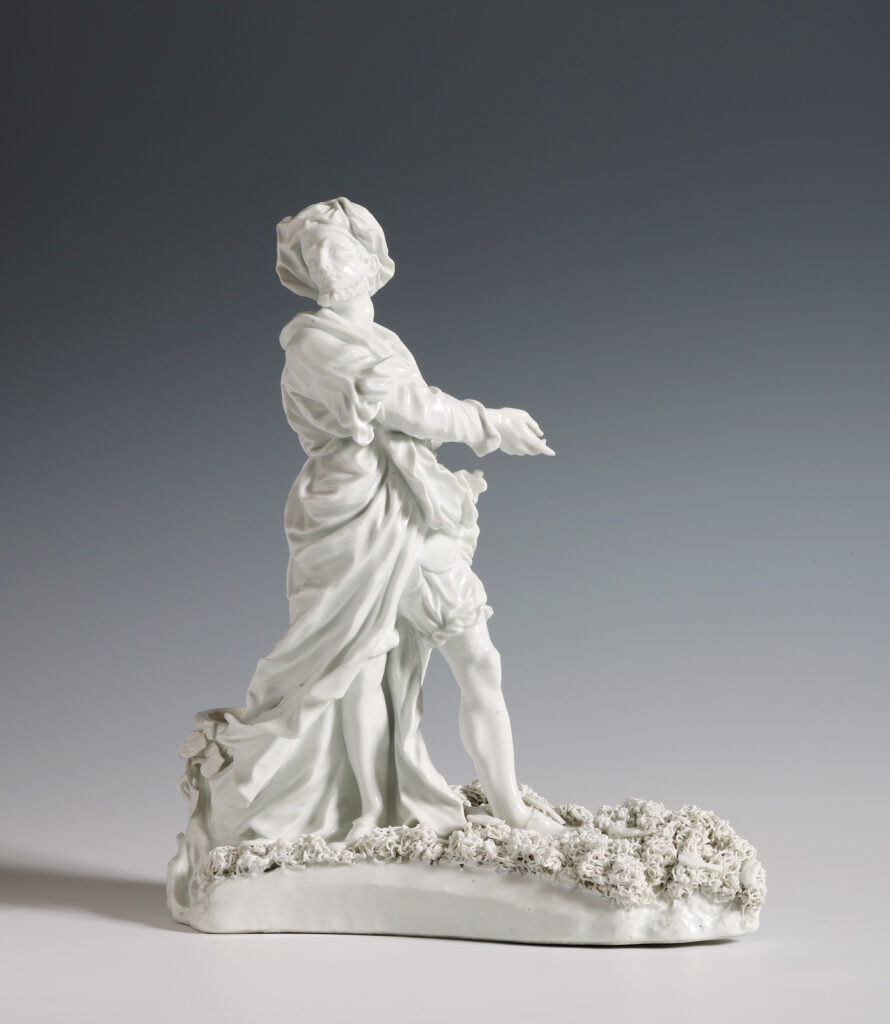
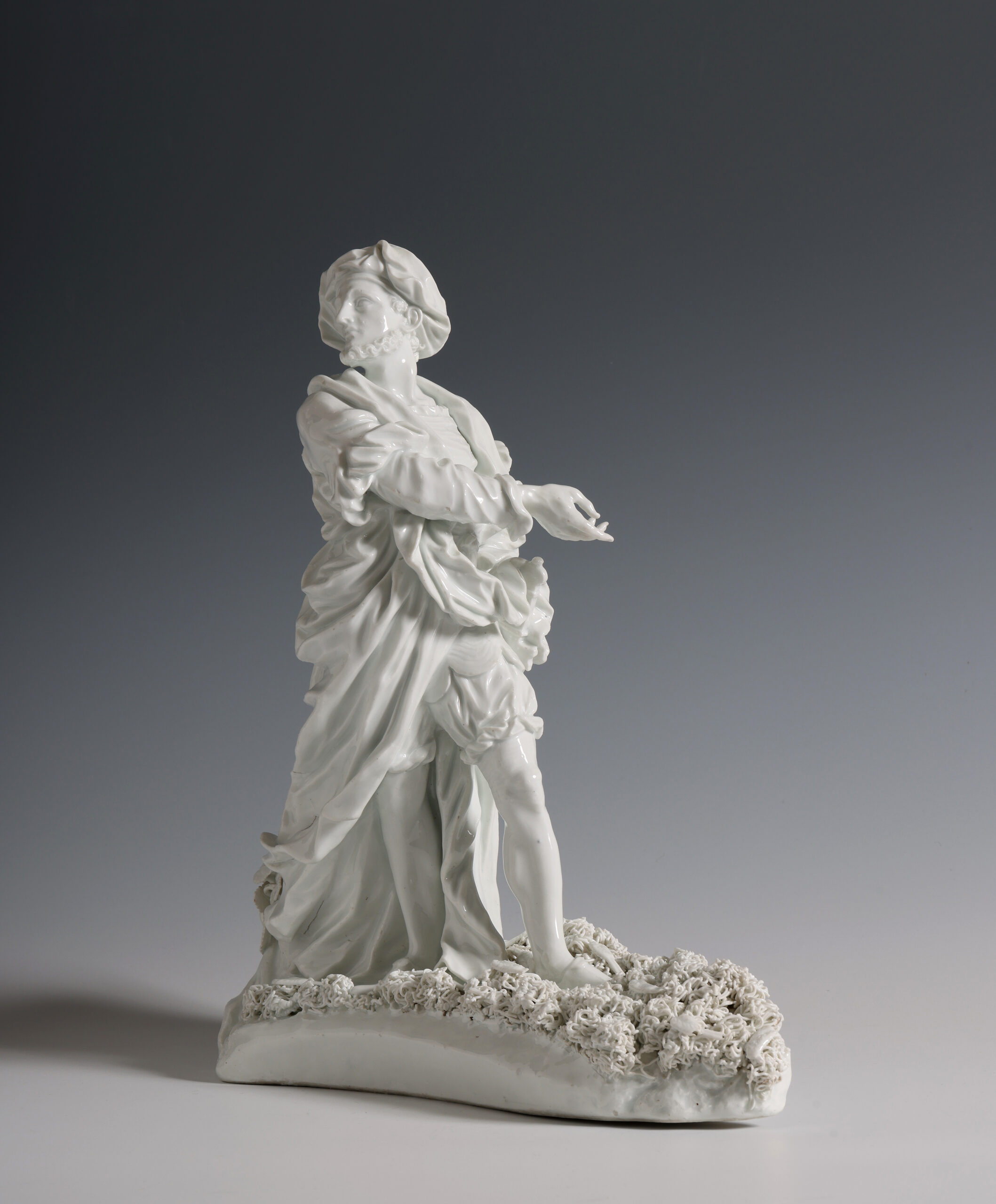
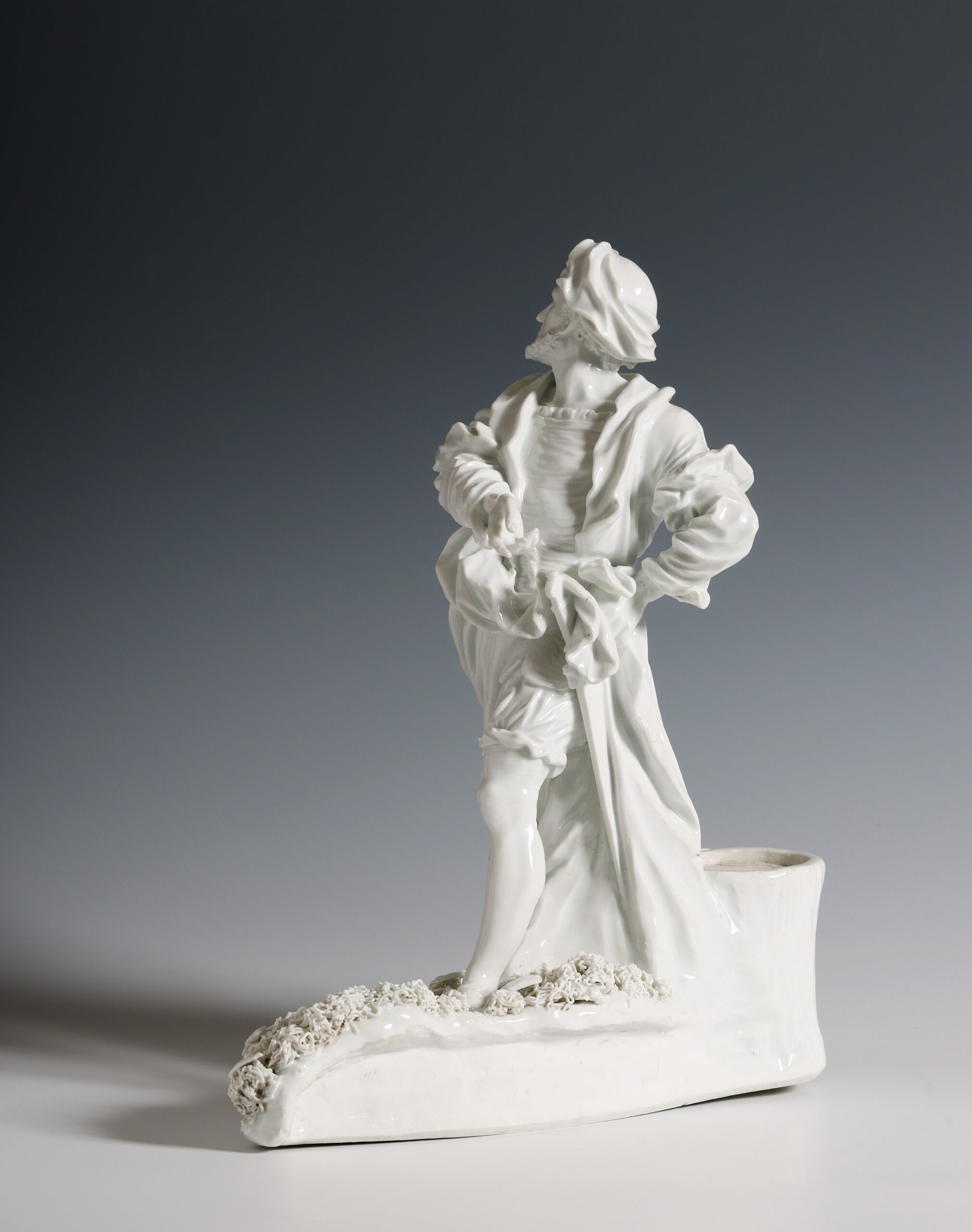
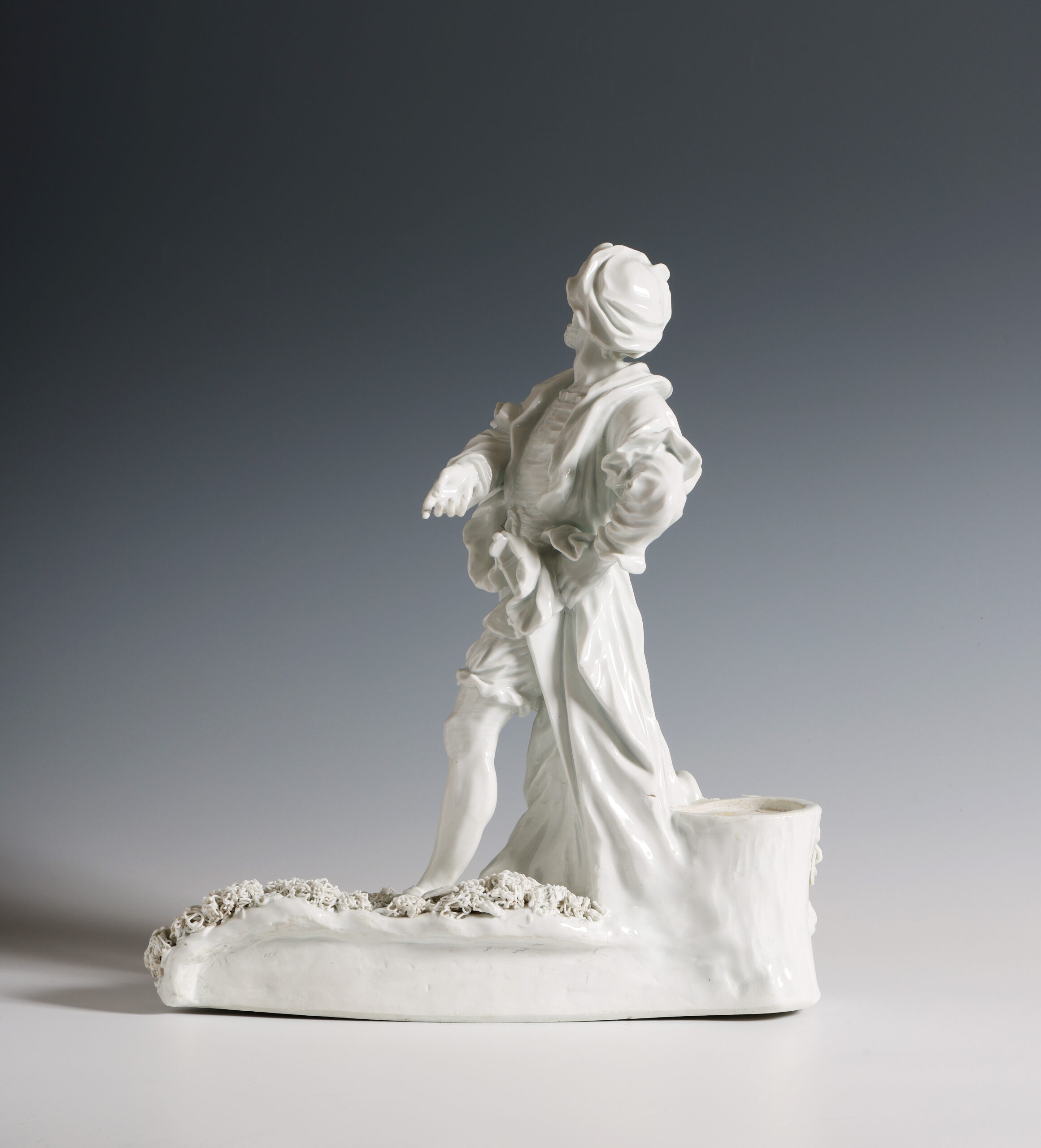
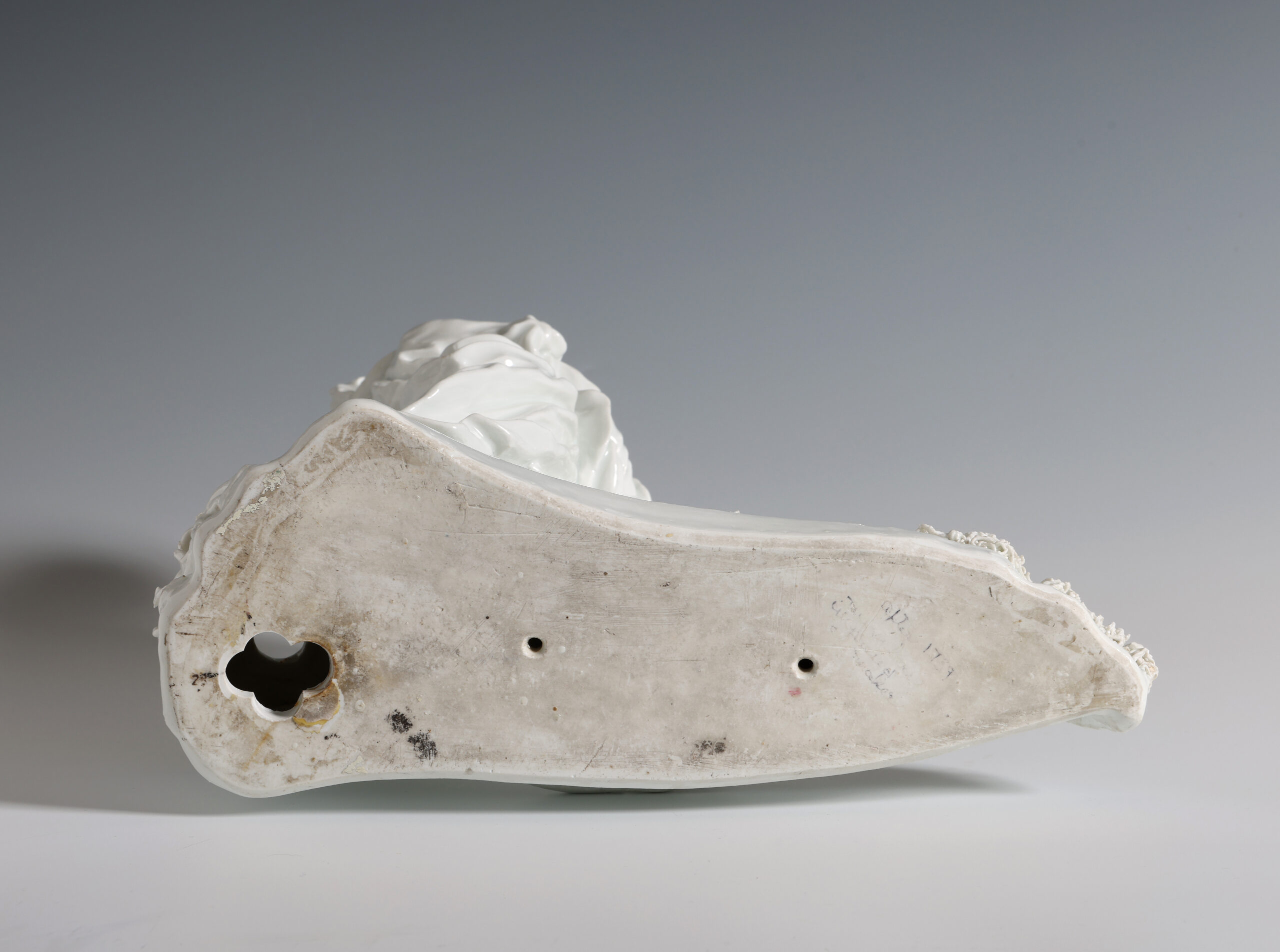
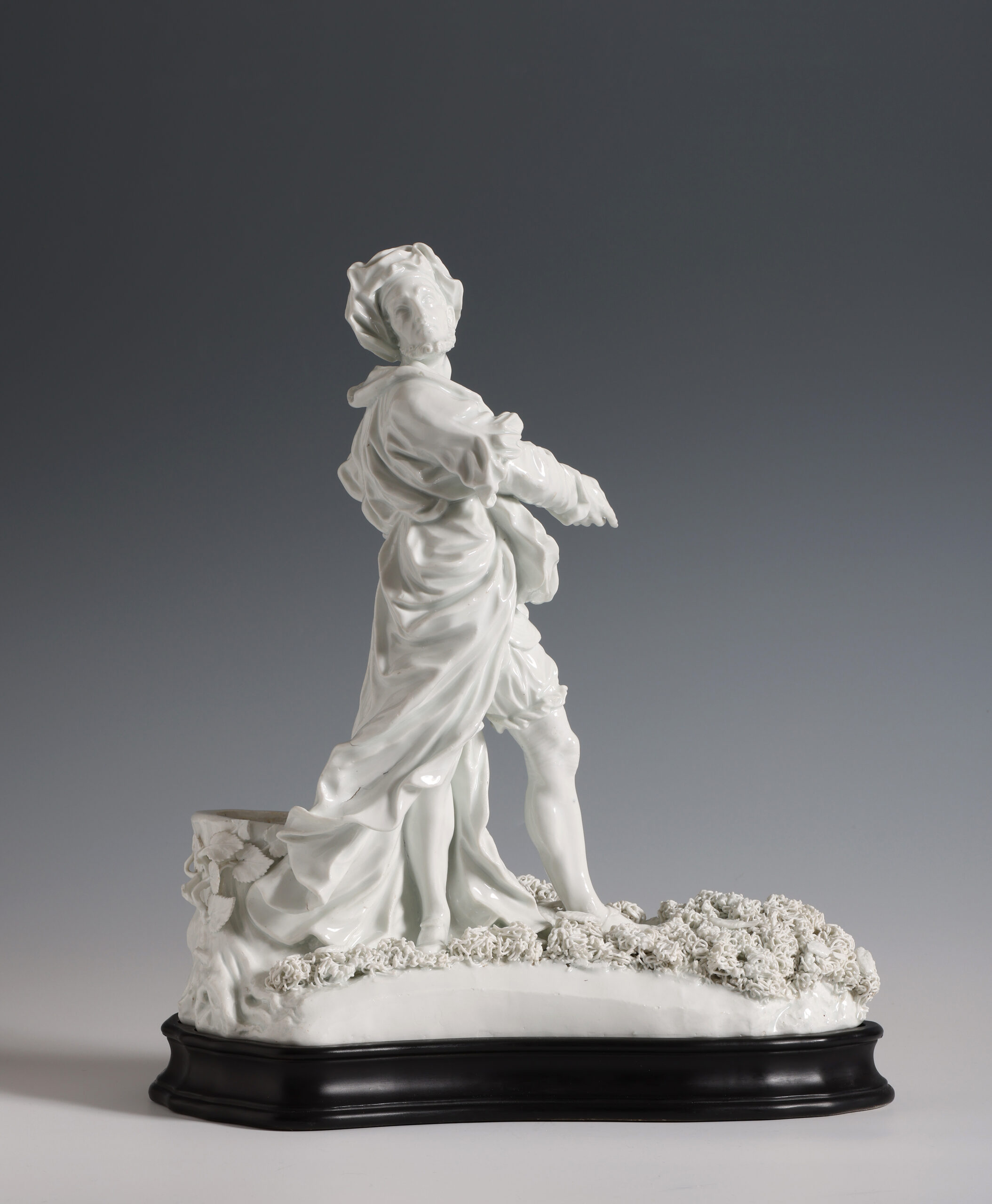
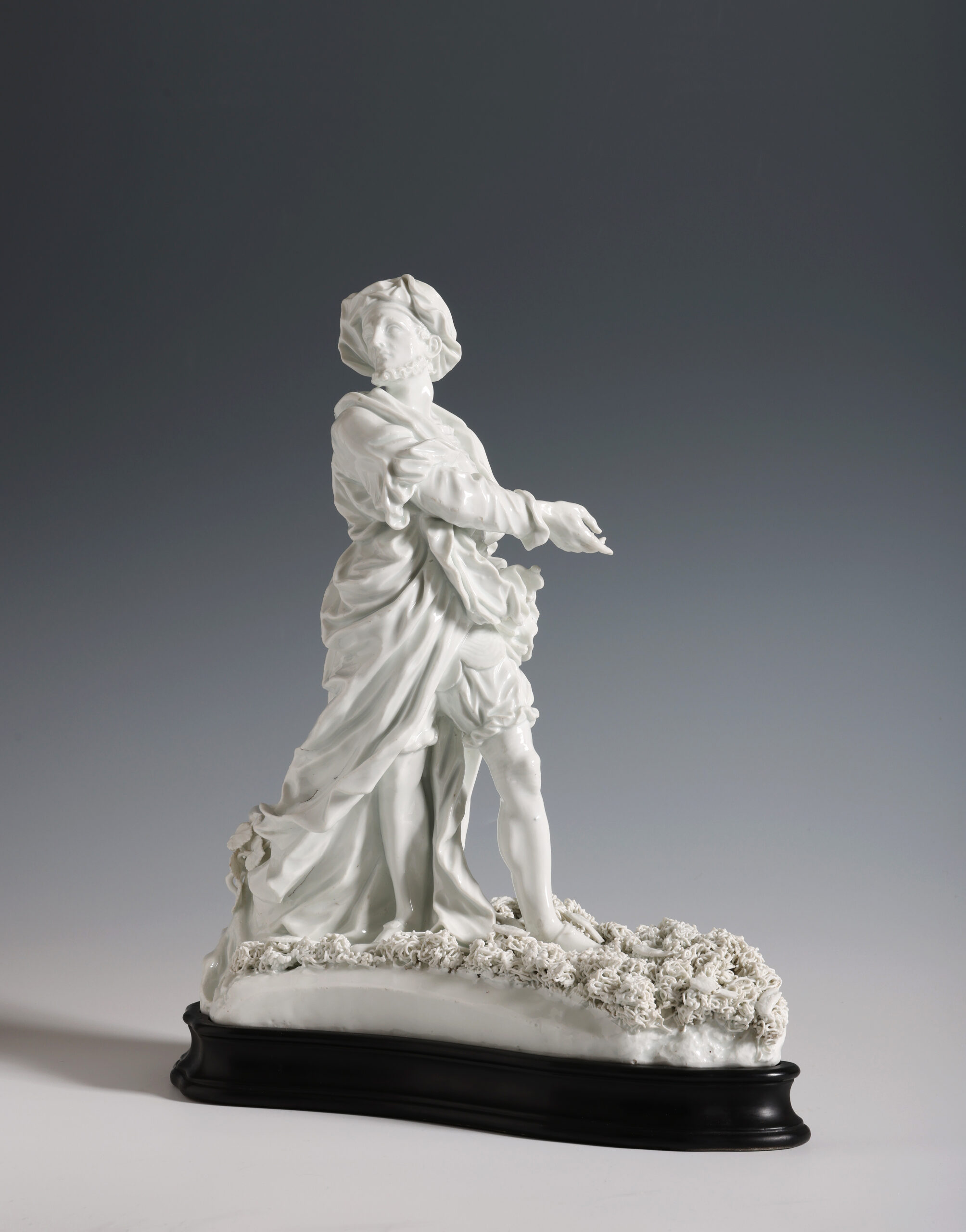
This standing figure of the commanding officer is an element from one of J. J. Kaendler’s most important creations, the huge group of the ‘Death of St Francis Xavier, the Apostle to the Gentiles’ modelled between 1738-41. Saint Francis was the primary patron saint of the Saxon royal house, the Wettin.
Kaendler describes the artistic conception, design, modelling, and production work of this group in more detail than any of his other works.[i] He records making four figures of St Francis Xavier for this group, which presumably means that four complete groups were made.
The group portrays the death St Francis Xavier in 1552 on the island of Shangchuan off the south coast of China whilst trying to get to the mainland. He was accompanied by a Jesuit student called Álvaro Ferreira, a Chinese man called António, and a Malabar servant called Christopher.
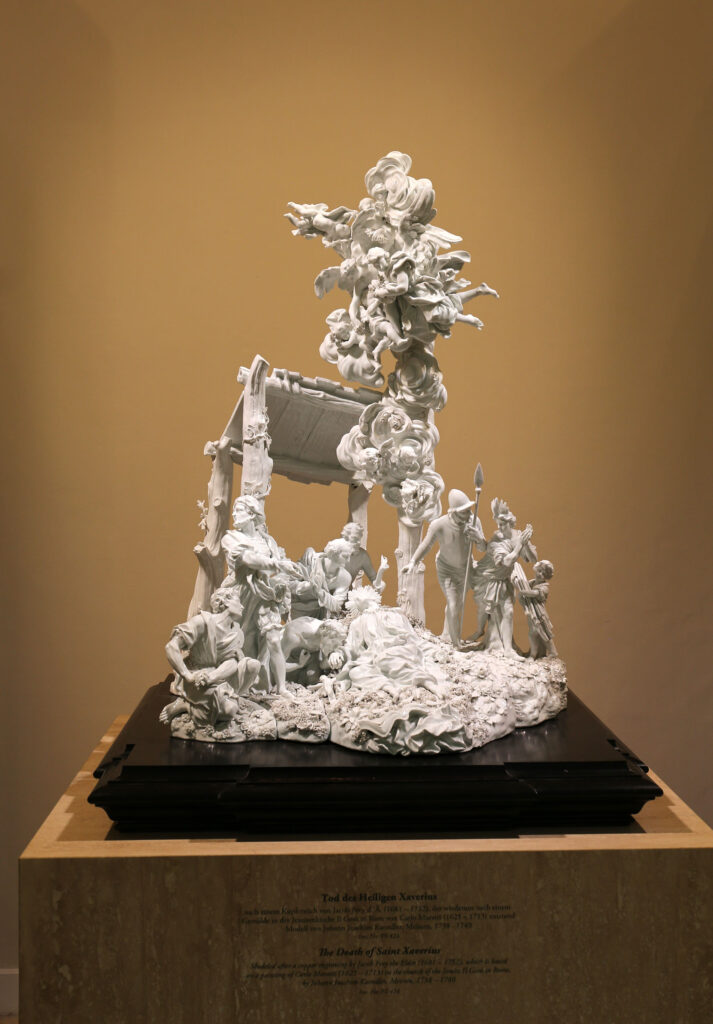
‘Death of St Francis Xavier, the Apostle to the Gentiles’
101 cm high, the Zwinger, Dresden
The best-preserved of these groups is the one from the Saxon Royal Collection, in the Porzellansammlung Zwinger, Dresden. Even this is not complete as the kneeling figure on the left is a modern replacement.[ii]
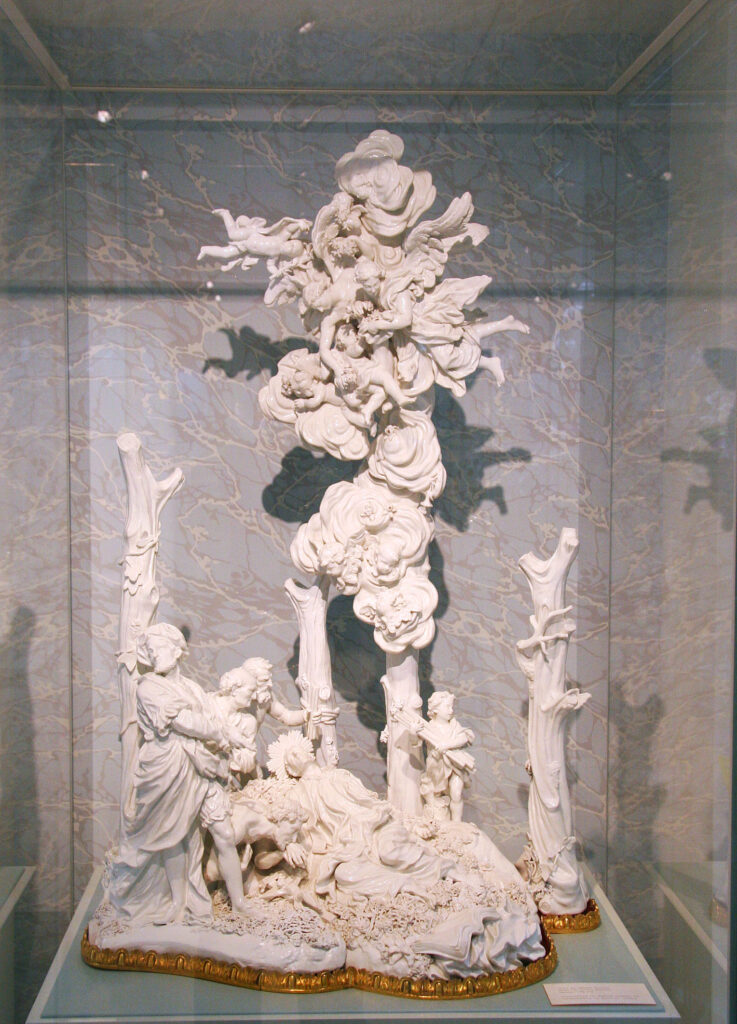
Kunst und Gewerbe Hamburg
Elements of another group are in the Museum für Kunst und Gewerbe in Hamburg.[iii]
The Kunstgewerbemuseum in Berlin has a partial, disassembled set (without the standing officer), in storage at Schloss Kopenik. The Seattle Art Museum just has a St Francis figure.[iv]
It is probable that our figure comes originally from either the Berlin group or possibly a group that included the Seattle St Francis.
The group or ‘tableau’ was commissioned in 1738 but took five years to complete according to the three-dozen work reports signed by Kaendler between March 1738 and May 1743. The work reports seem to indicate the model was entirely his work, except for various wooden supports carved by Johann Gottlieb Ehder (c. 1716-1750) in April and May 1743.
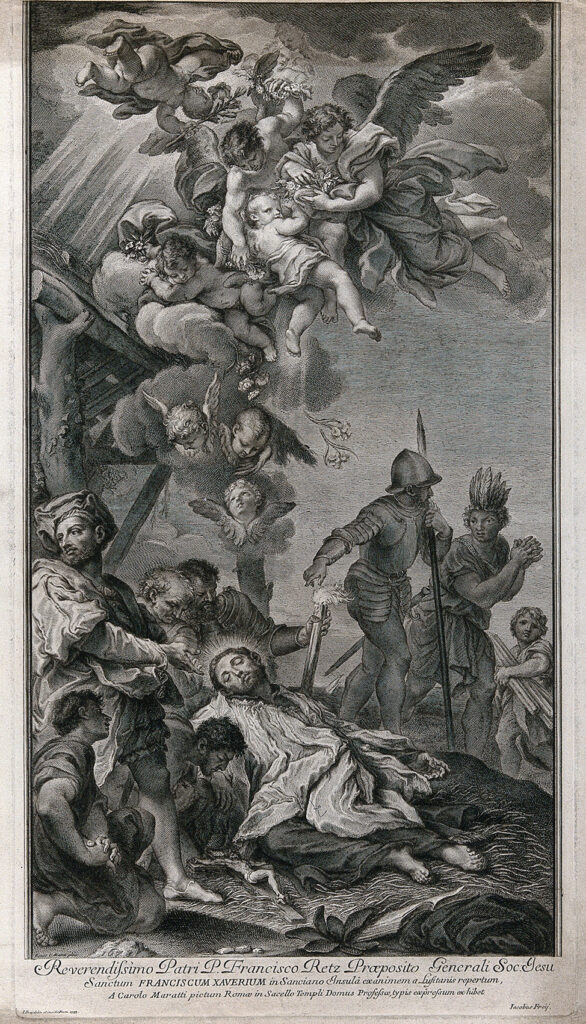
The death of Saint Francis Xavier
Engraving by Jacobus Frey the elder, 1733, after Carlo Maratta, 1678
Wellcome Collection, London (38164i)
The source used was the engraving by Jacobus Frey after Carlo Maratti’s masterpiece, The Death of Saint Francis Xavier (1674–1679), the altarpiece in the San Francesco Xavier Chapel at the Church of Il Gesù in Rome, the mother church of the Society of Jesus. The print was supplied directly by the court.[v] It is remarkable how closely Kaendler followed the graphic source.
Kaendler’s work report for March 1738, starts:
“The first halo, which was completed last month, was assembled to the required dimensions, adjusted as needed, the flowers attached to it, and brought into proper condition. Work continues on the large scene of St. Francis, and two figures have been completed: the commanding officer, dressed in Indian attire, wears a large banded cap on his head. The other figure depicts a young man kneeling on one knee, with his hands clasped, turning toward St. Francis, also in foreign attire. Work has already begun on the other figures.”
The complete and extensive transcription of the worksheets for the group are published by Sarah-Katharina Andres-Acevedo, Die autonomen figürlichen Plastiken Johann Joachim Kaendlers und seiner Werkstatt zwischen 1731 und 1748, (2023) pp. 68 to 72.
I am grateful to Maureen Cassidy-Geiger for sharing the relevant extract from her paper The Art of Devotion: Religious Sculpture from the Royal Porcelain Manufactory at Meissen, ca. 1710-1790 for the catalogue of the forthcoming exhibition in Dresden ‘Porzellan und Passion – Glaube und Herrschaft in der europäischen Porzellanplastik’ which is planned for September 2028.
Condition:
Restoration to four fingers of right hand [not the thumb]. The ebonised wooden base is modern.
Provenance:
Patricia Hart Collection
References:
Andres-Acevedo 2023
Sarah-Katharina Andres-Acevedo, Die autonomen figürlichen Plastiken Johann Joachim Kaendlers und seiner Werkstatt zwischen 1731 und 1748, (2023)
Emerson 2000
Julie Emerson, Jennifer Chen, Mimi Gardner Gates, ‘Porcelain Stories: From China to Europe’, (Seattle Art Museum, 2000)
Gröger 1956
Helmuth Gröger, ‘Johann Joachim Kaendler ; Der Meister d. Porzellans’, (Wolfgang Jess Verlag Dresden 1956)
Lehner & Mayr 1988
Johann Lehner and Hans Mayr, Ecclesia Triumphans Dresdensis: Christliche Kunst am Hofe der sächsischen Könige von Polen, (Edition Tusch 1988)
Sponsel 1900
Jean Louis Sponsel, ‘Kabinettstucke der Meissner Porzellan-Manufaktur von Johann Joachim Kandler’, (Hermann SeemannNachfolger, Leipzig 1900)
Sold
[i] Gröger 1956, p.59.
[ii] Lehner & Mayr 1988 p. 100.
[iii] The Hamburg group was sold at Sotheby’s, London, 5 March, 1985, lot 175, from the collection of Leonard Morgan May, where it was described as ‘An extremely Rare and Important Meissen Group of the Death of St. Franciscus Xaverius.
[iv] Emerson 2000, pp. 212 & 213, pl. 14.3. Sponsel 1900 records two examples then known, the one in the Saxon Royal Collection and another with the Dresden antique dealer Salomon , this latter is presumably either the Berlin or the Hamburg group.
[v] See the forthcoming paper by Maureen Cassidy-Geiger, The Art of Devotion: Religious Sculpture from the Royal Porcelain Manufactory at Meissen, ca. 1710-1790, for the catalogue to the exhibition to be held in Dresden in 2028.