
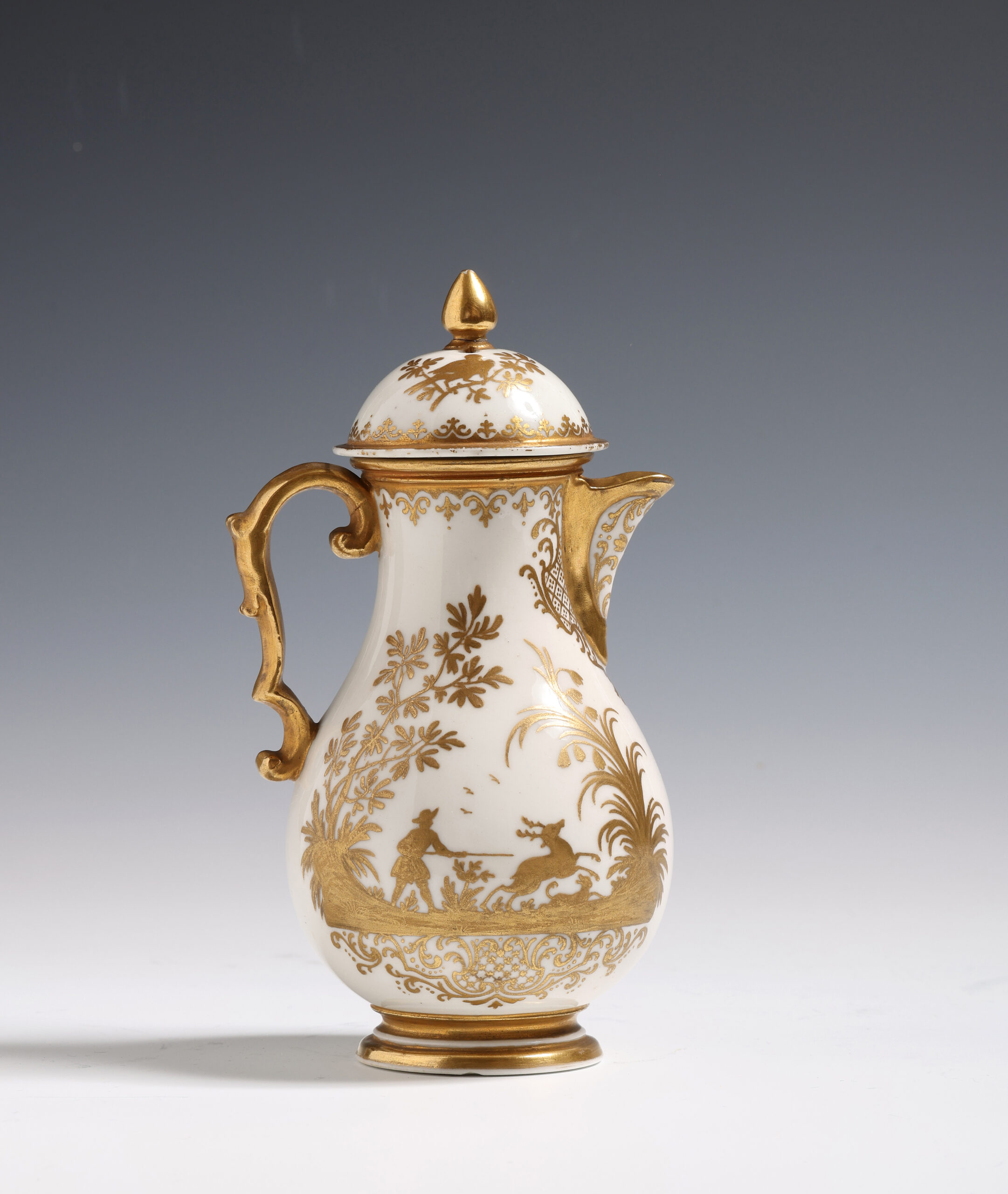
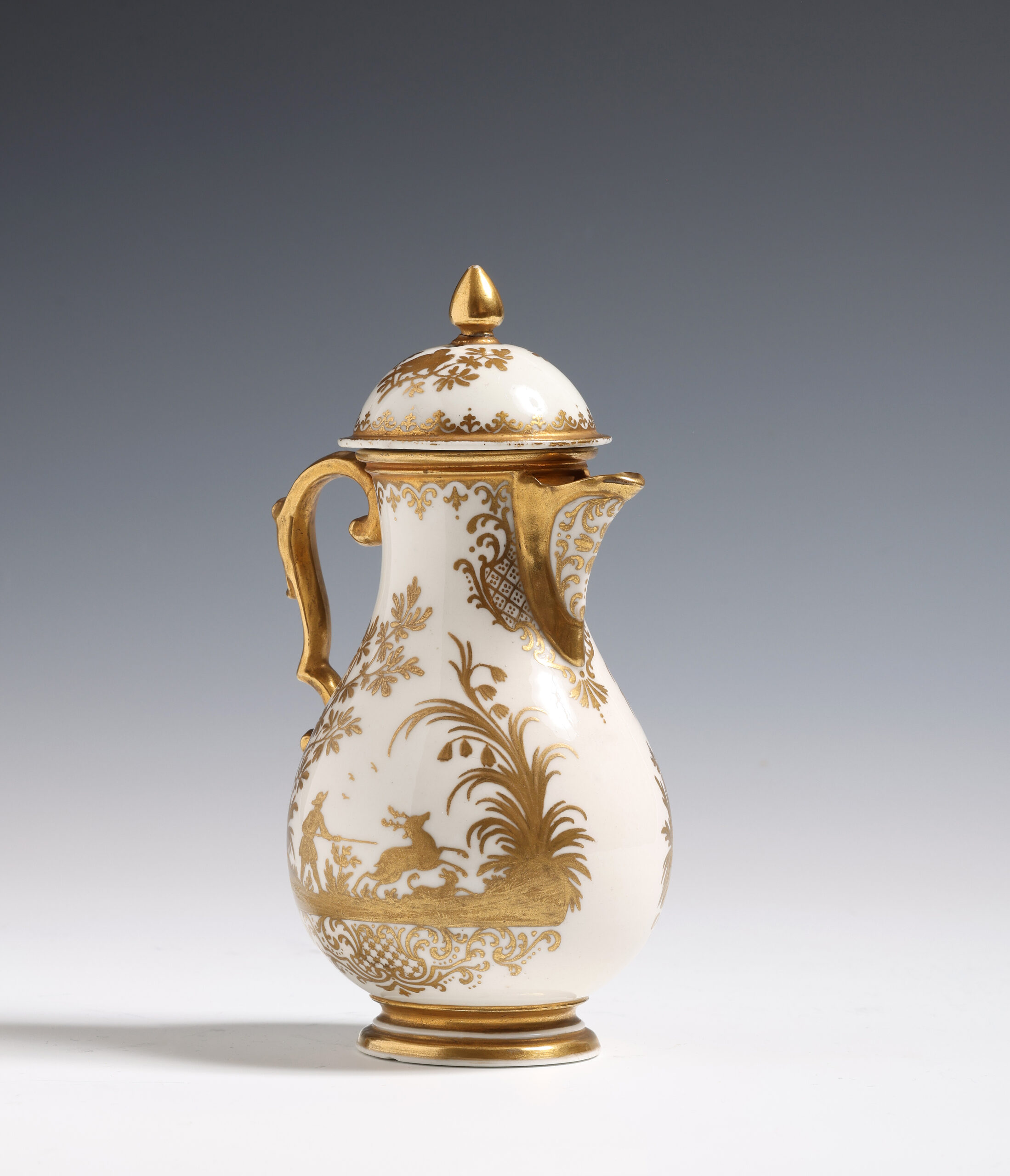
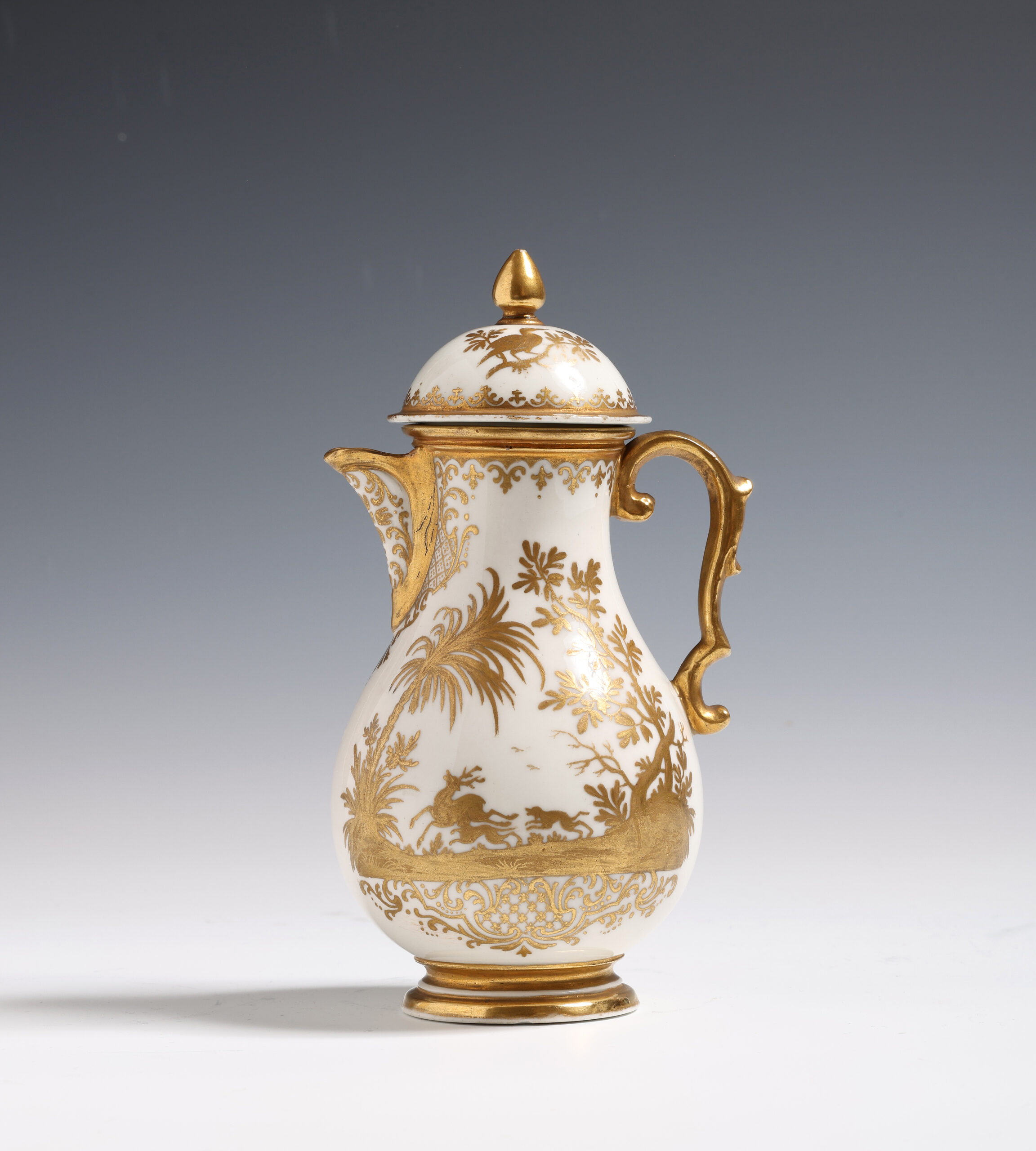
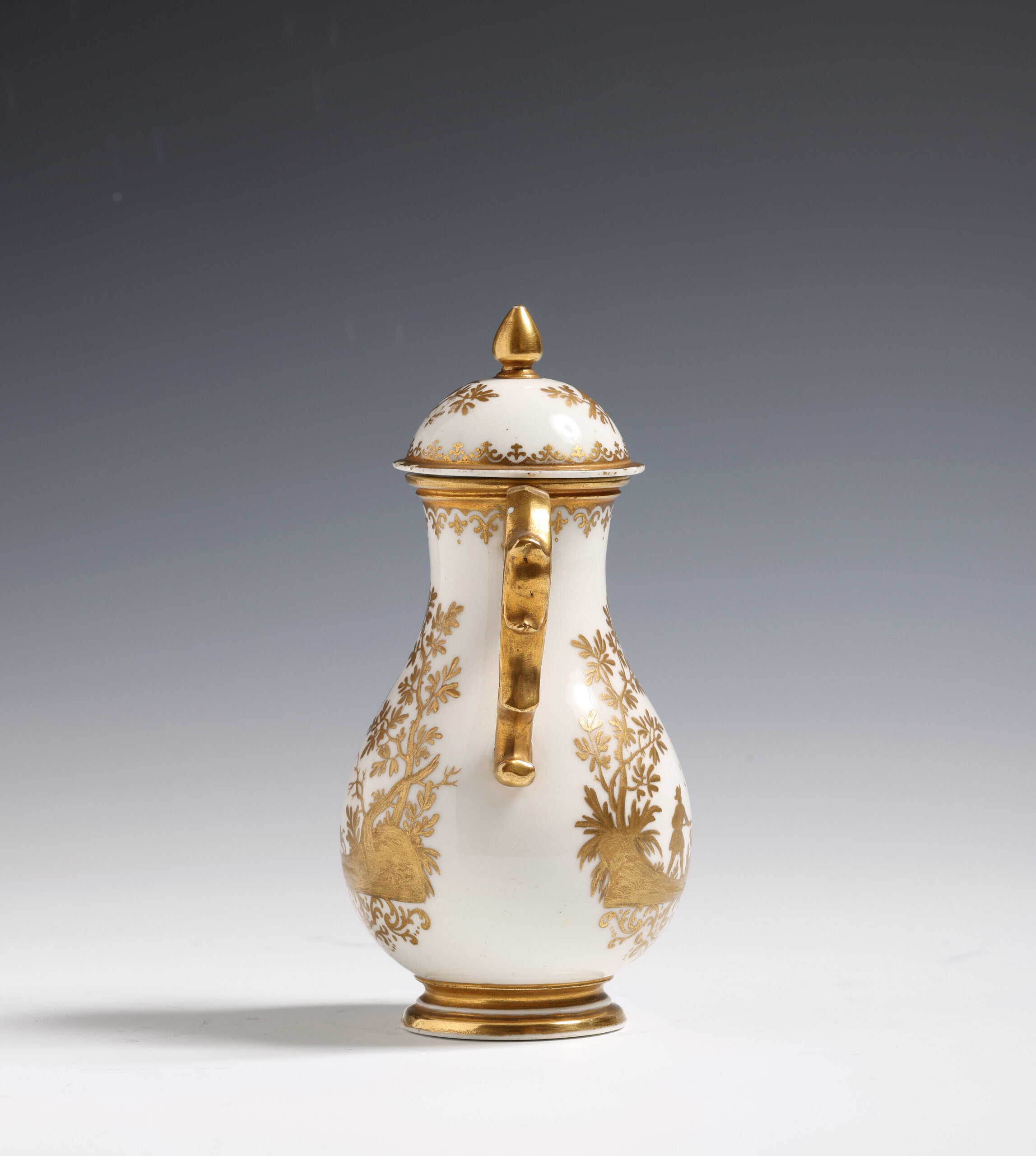
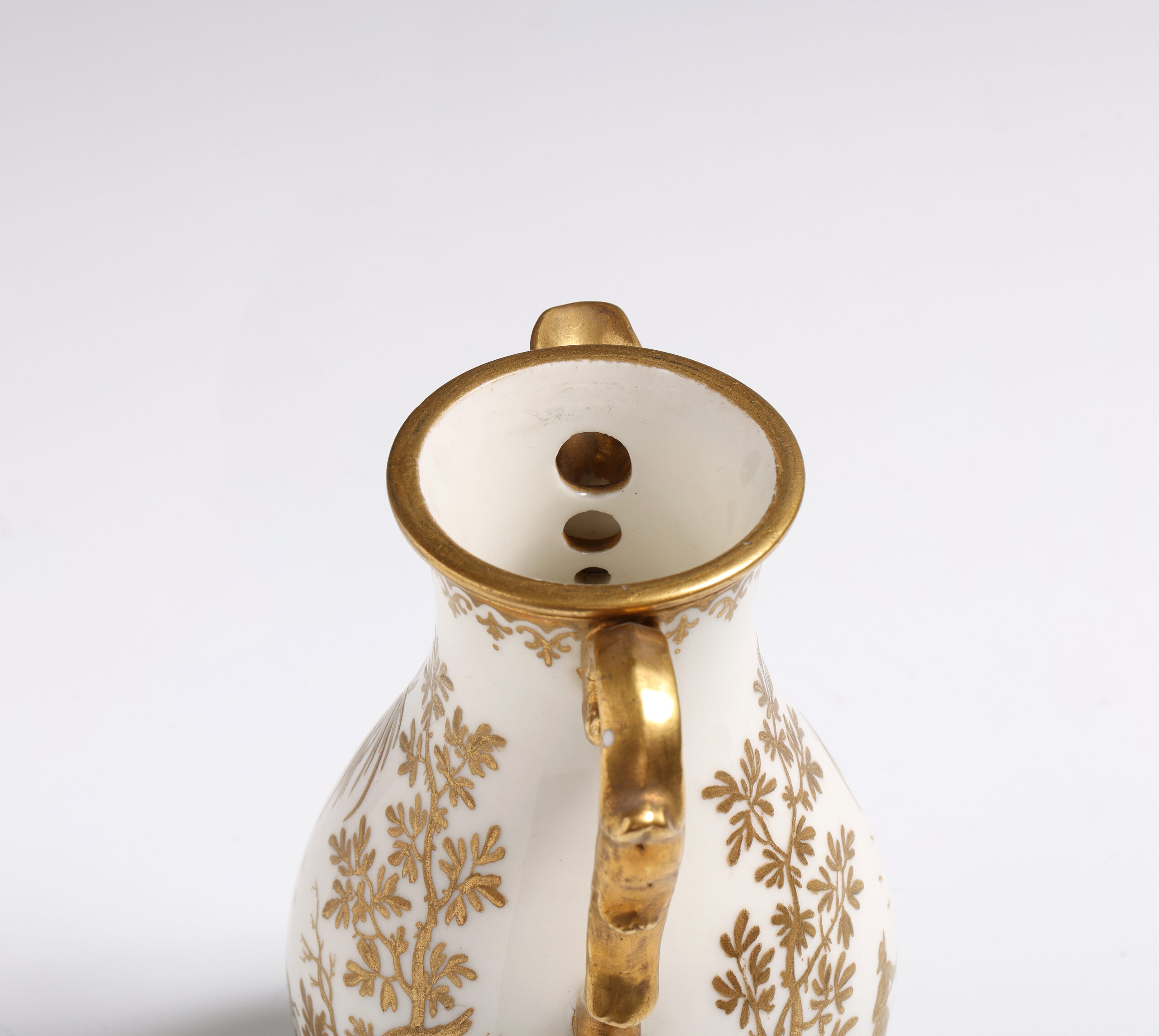
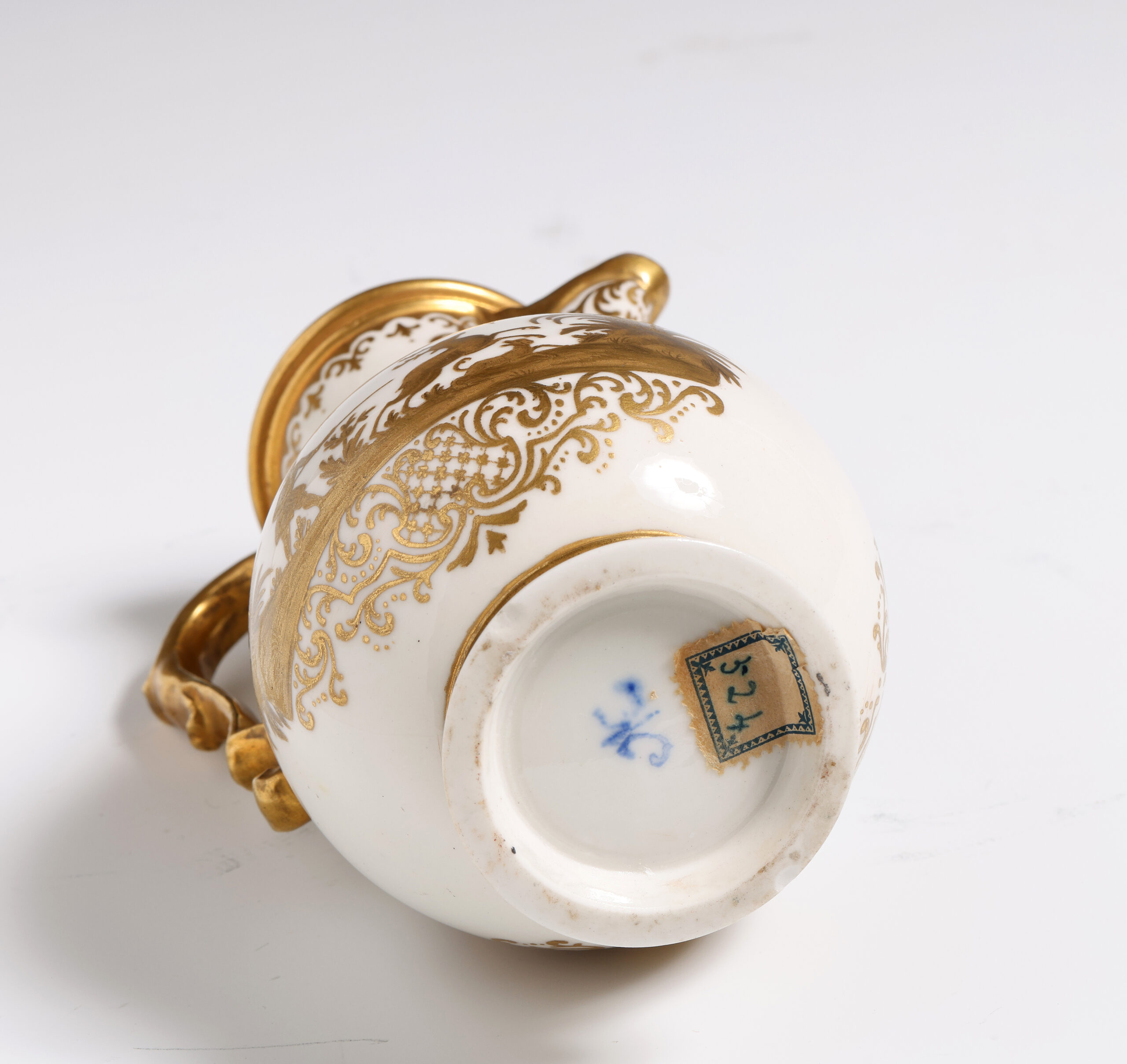
Of a Meissen form adapted at Capodimonte and gilded in the style of Meissen decorated in Augsburg in the workshop of Bartholomäus and Abraham Seuter. The scenes on each side show a deer being hunted by a man with a gun on one and being chased by dogs on the other.
The decoration of the coffeepot, from the border pattern to the hunting scene, the scroll and trellis decoration underneath, and birds on the lid are all exactly as you would find on a Seuter workshop decorated Meissen original. It would seem to have been copied directly from such an example. It would also seem that the artists at Capodimonte had a selection of Seuter-decorated pieces to copy from as other gold decorated pieces of this group have chinoiseries, as well as very rare examples derived from Jaques Callot designs that are also taken from Seuter originals. Angela Caròla Perotti points out that this copying exactly from Meissen is very different from the Watteauesque scenes painted by Caselli that are inspired by the Saxon taste but adapted to be recognisably Capodimonte.
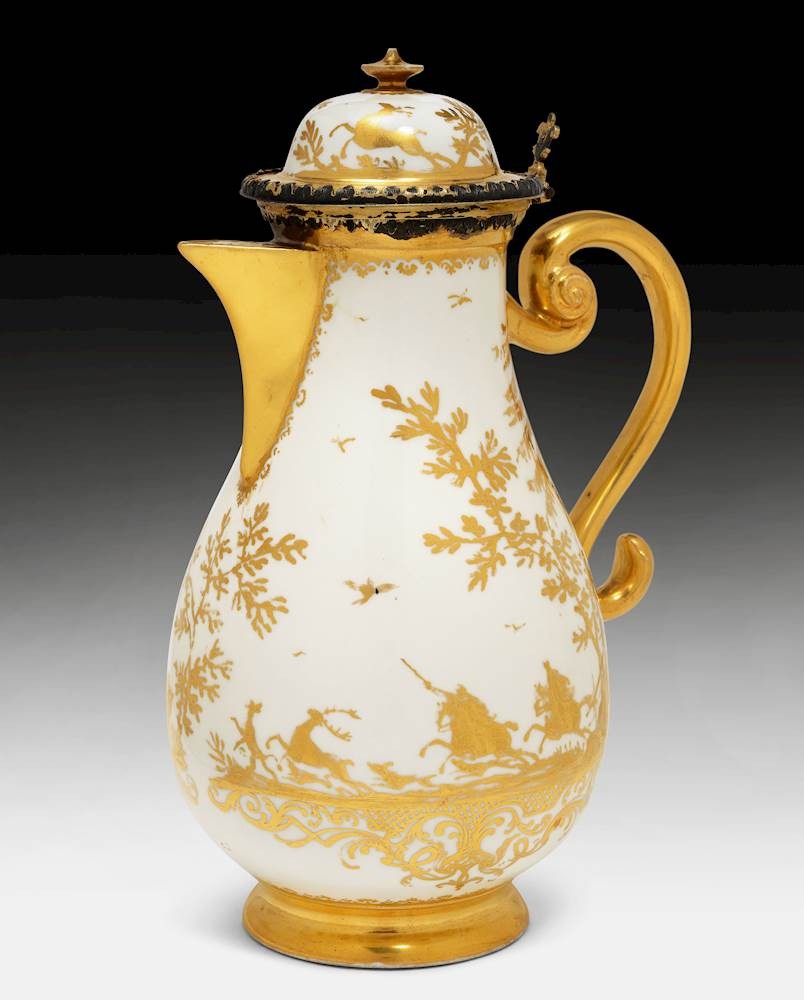
A Seuter-decorated Meissen coffeepot sold at Koller Auction in March 2025
Caròla-Perrotti suggests that this type of gold decoration was produced at Capodimonte for a short period ‘no longer than five years’, from 1747 to around 1752. She proposes 1747 as a start date based on records of requests from the Neapolitan ambassador to Paris for designs of ‘figure alla Cinese’. The ambassador recommended that they look to Augsburg or Nuremberg, which fits neatly with these pieces being copied from the Augsburg-based Seuter workshop.
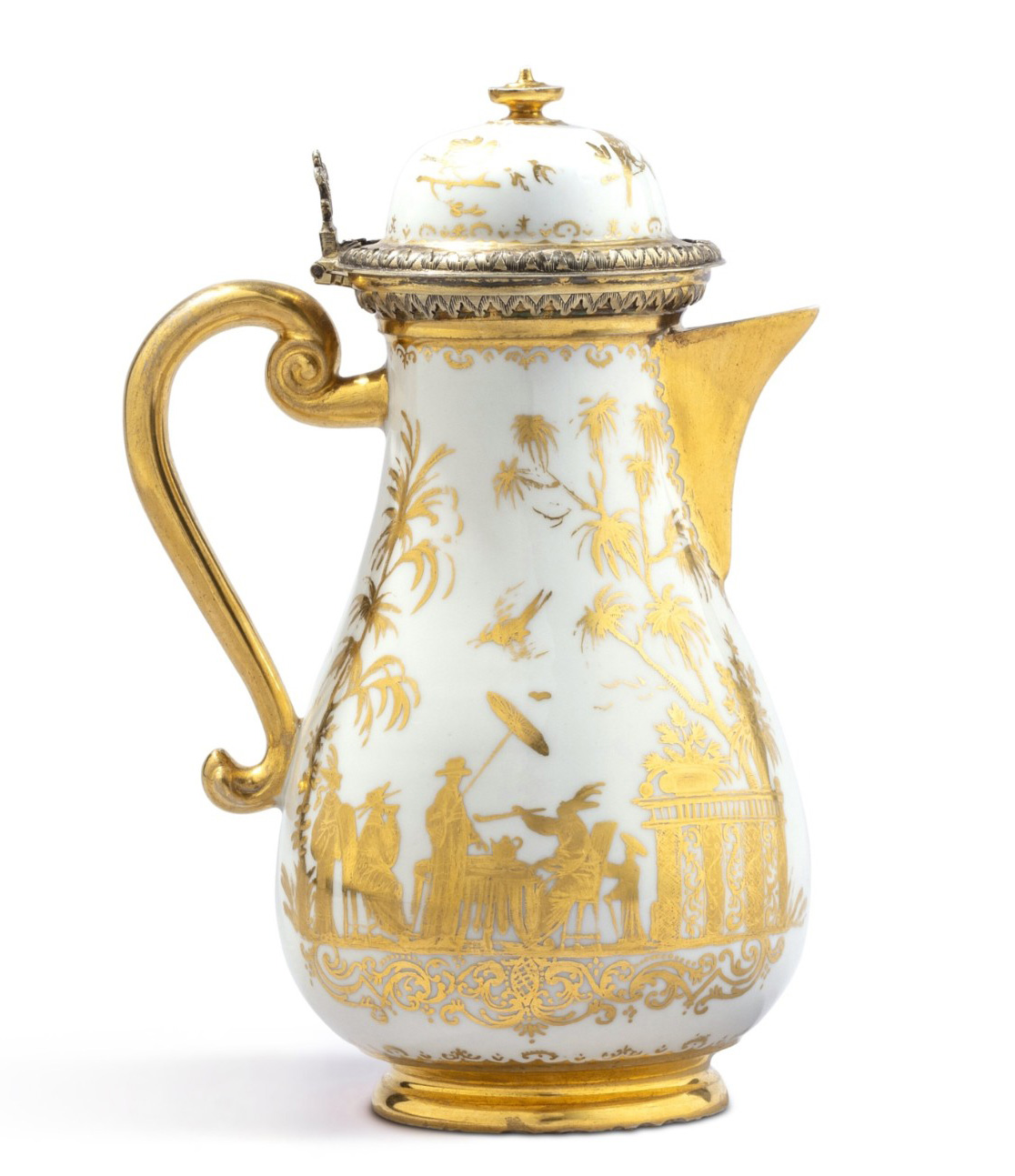
An example of chinoiserie decoration on Meissen from the Seuter workshop, sold at Sothebys in June 2026, Robbig sale
It is possible that the decoration was applied by Giovanni Remici, who was employed at the factory as a ‘gold beater’. He is known to have been a chemist who produced various coloured enamels for the factory, and also the powder used for gilding on porcelain. We have records that the powder for the gilding of porcelain was obtained by grinding a particular type of Hungarian coin or ungaro, or if this was not available, a Venetian zecchino. The gold powder was then refined with nitric acid and silver in a cupel. Remici was found guilty of adulterating the gold after an investigation ordered by Mayor Boschi and was suspended from the factory in 1752. Caròla-Perrotti points out that this verdict is inconsistent with the high quality of gilding found on these and other pieces from the period and suggests that the suspending of Remici from the factory had more to do with the Mayor Boschi wanting to overhaul the internal structure of the factory. It is also perhaps pertinent that this date fits with Caròla-Perrotti’s proposed dates for the production of these gold on white pieces.
Condition:
Coffeepot with very minor 0.5 cm flat oval chip to underside of footrim of pot; minute flake to gilding on handle; firing crack from time of manufacture to upper finial of handle; the cover with finial restuck; two small flat chips to rim of cover; minor typical wear to gilding on rim and spout.
Provenance:
‘Property of a Gentleman’, sold, Christie’s, London, 29 November 2011, lot 64
References:
Caròla Perrotti 1986
Angela Caròla-Perrotti, Le Porcellane dei Borbone di Napoli, Capodimonte e Real Fabbrica Ferdinandea 1743-1806, (Naples 1986)
Sanseverino 2025
Gonzalez-Palacios, Alvar, Andreina d’Agliano, Giovanni de Girolamo, et al: Arte e Porcellane Europee nella Collezione Vimercati Sanseverino / European Art and Porcelain in the Vimercati Sanseverino Collection. Livorno: 2025
See pp. 378-380, no. 90, for a teabowl and saucer with hunting scenes and further discussion of this type of decoration.
E & H Manners 2024
E & H Manners, Exhibition: Decorators of Ceramics and Glass, Independent, Itinerant and the Hausmaler, (June 2024)
See p. 105 for a discussion on the Seuter workshop
Price: £18,500
