
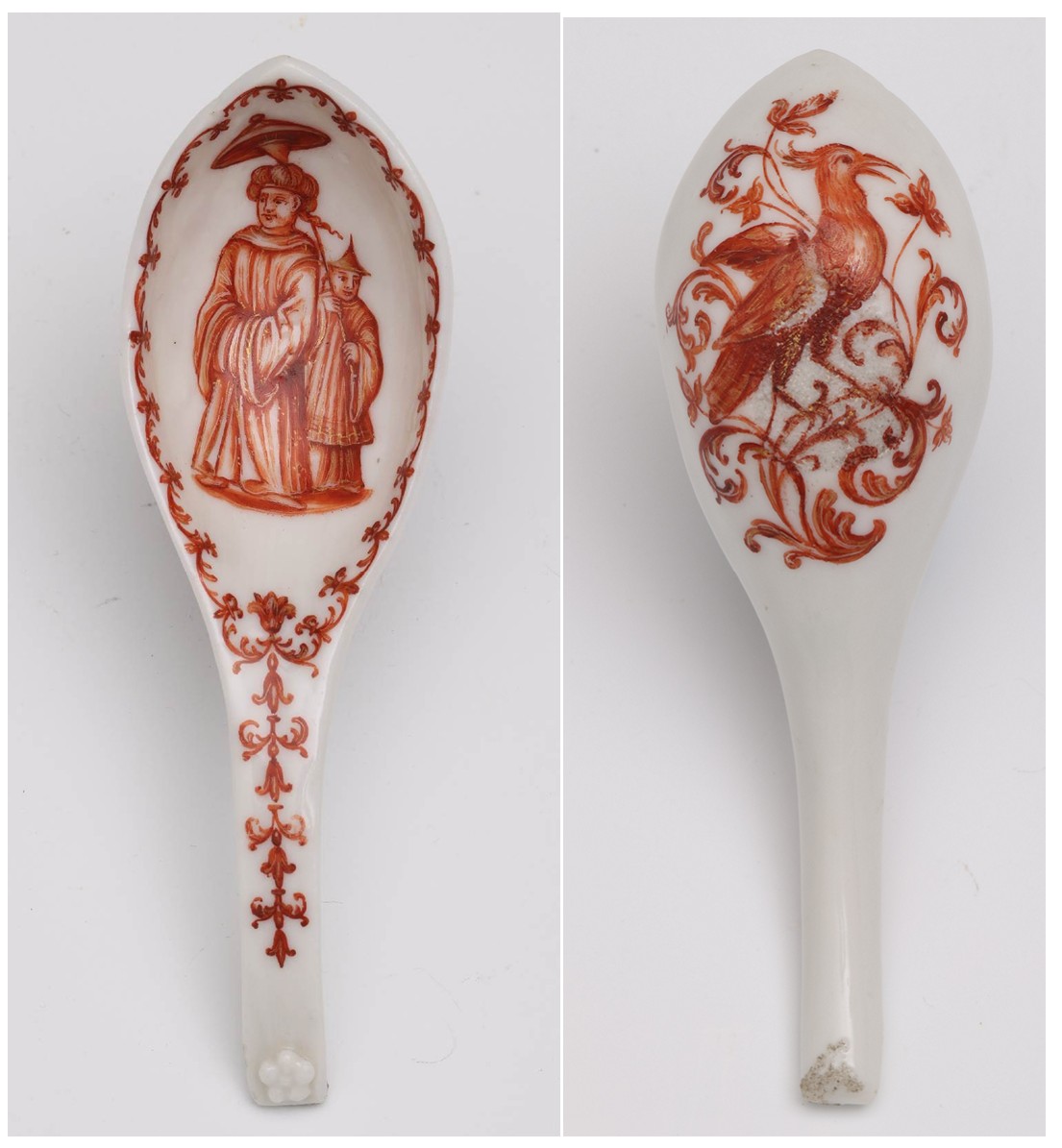
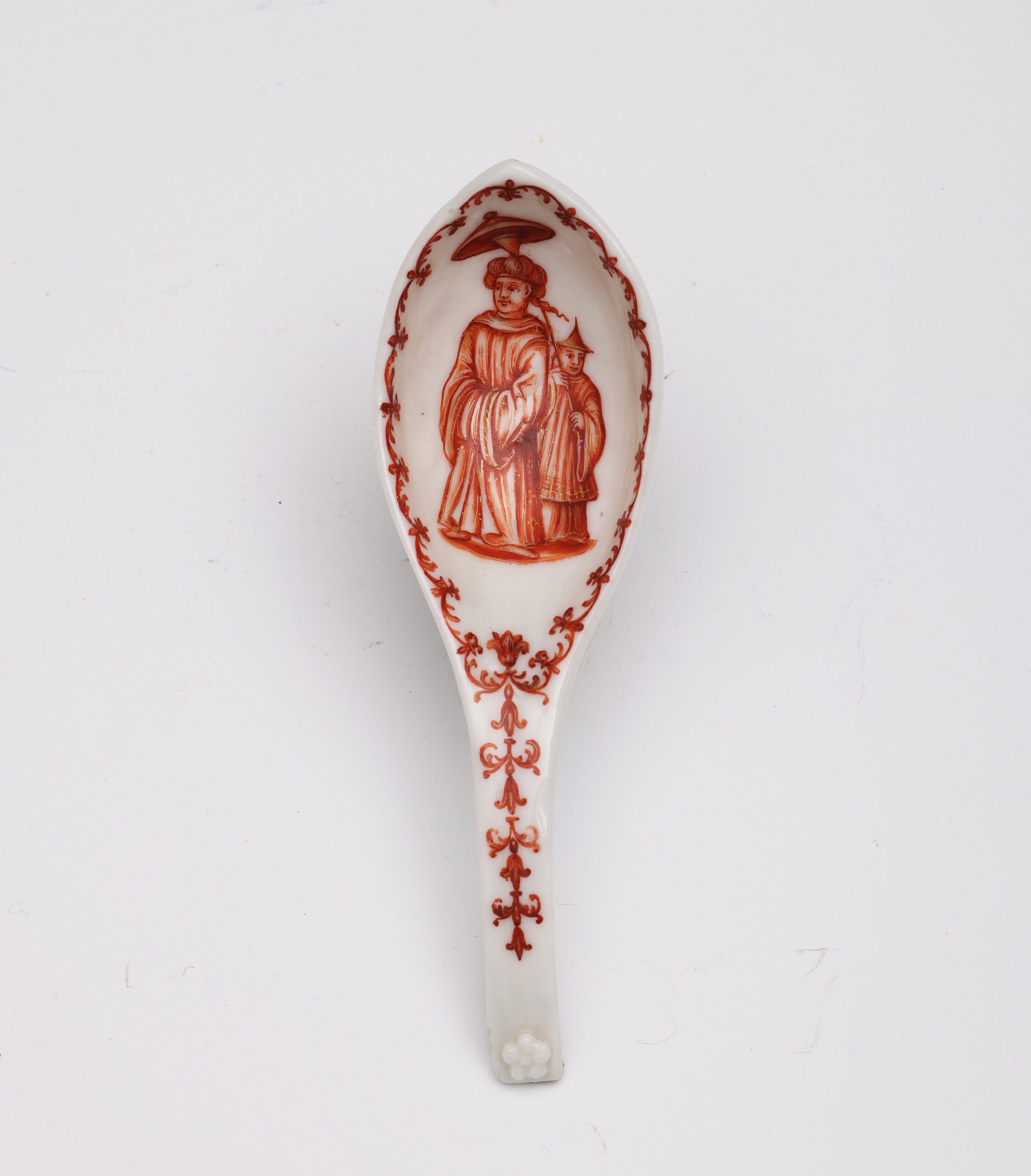
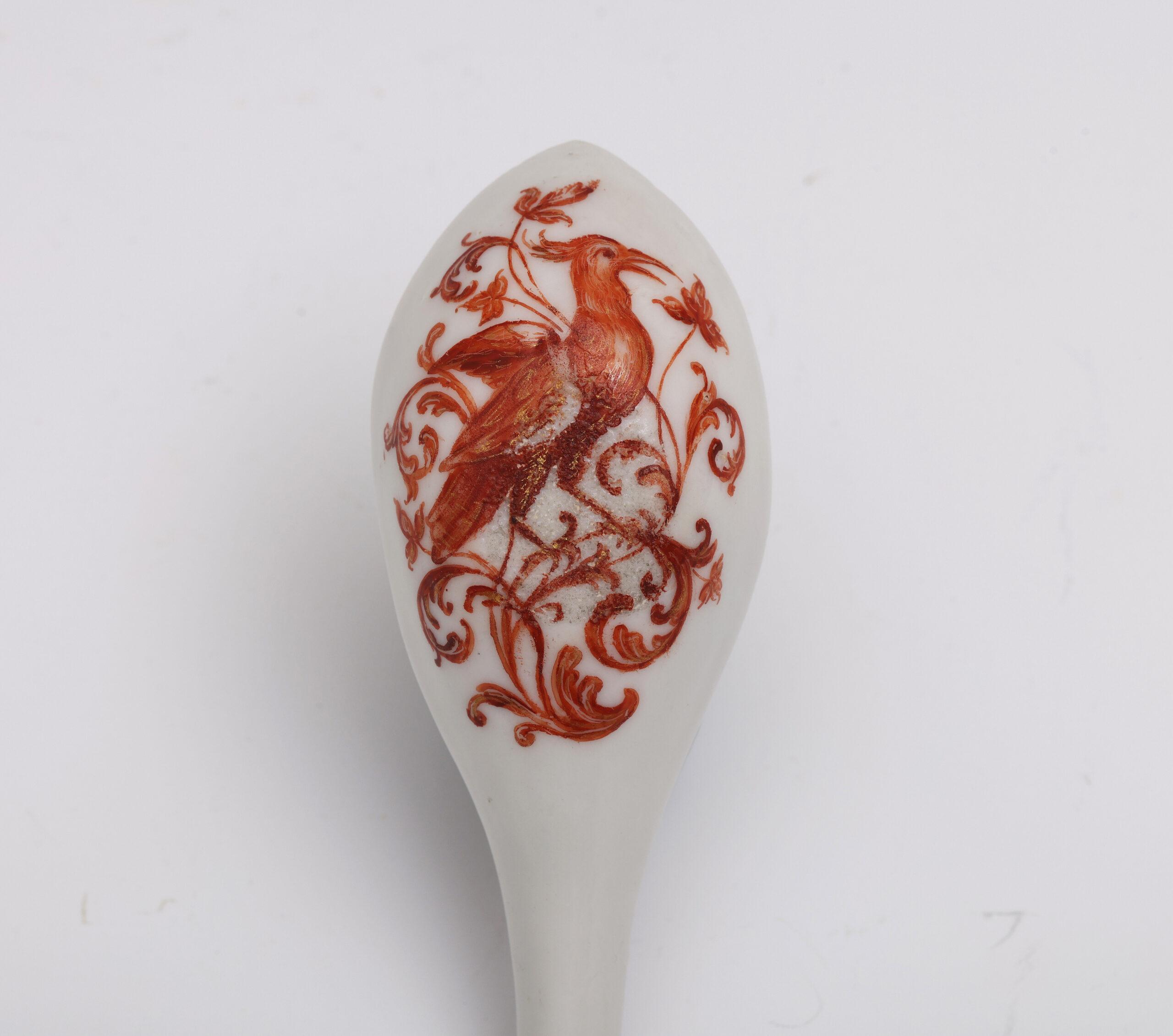
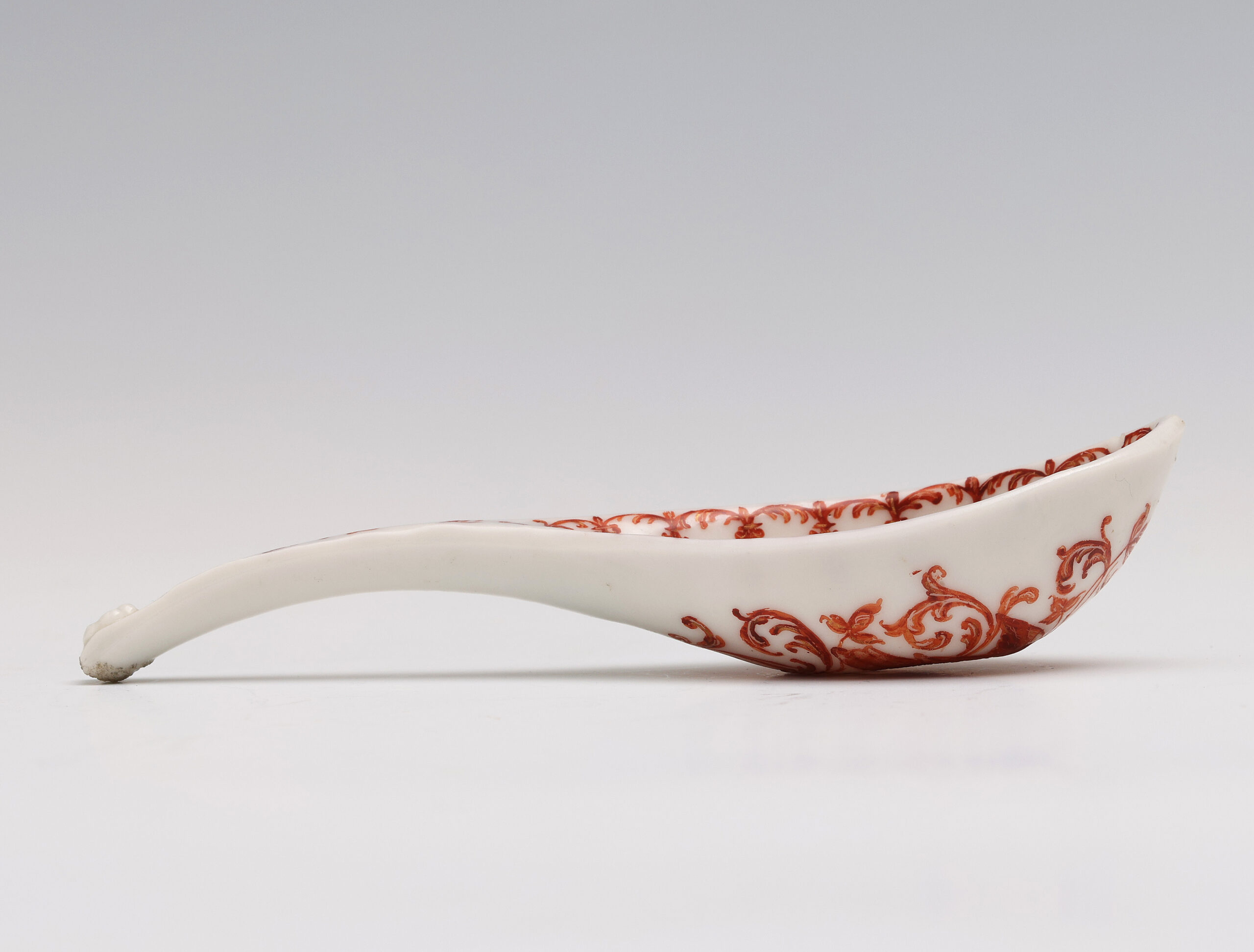
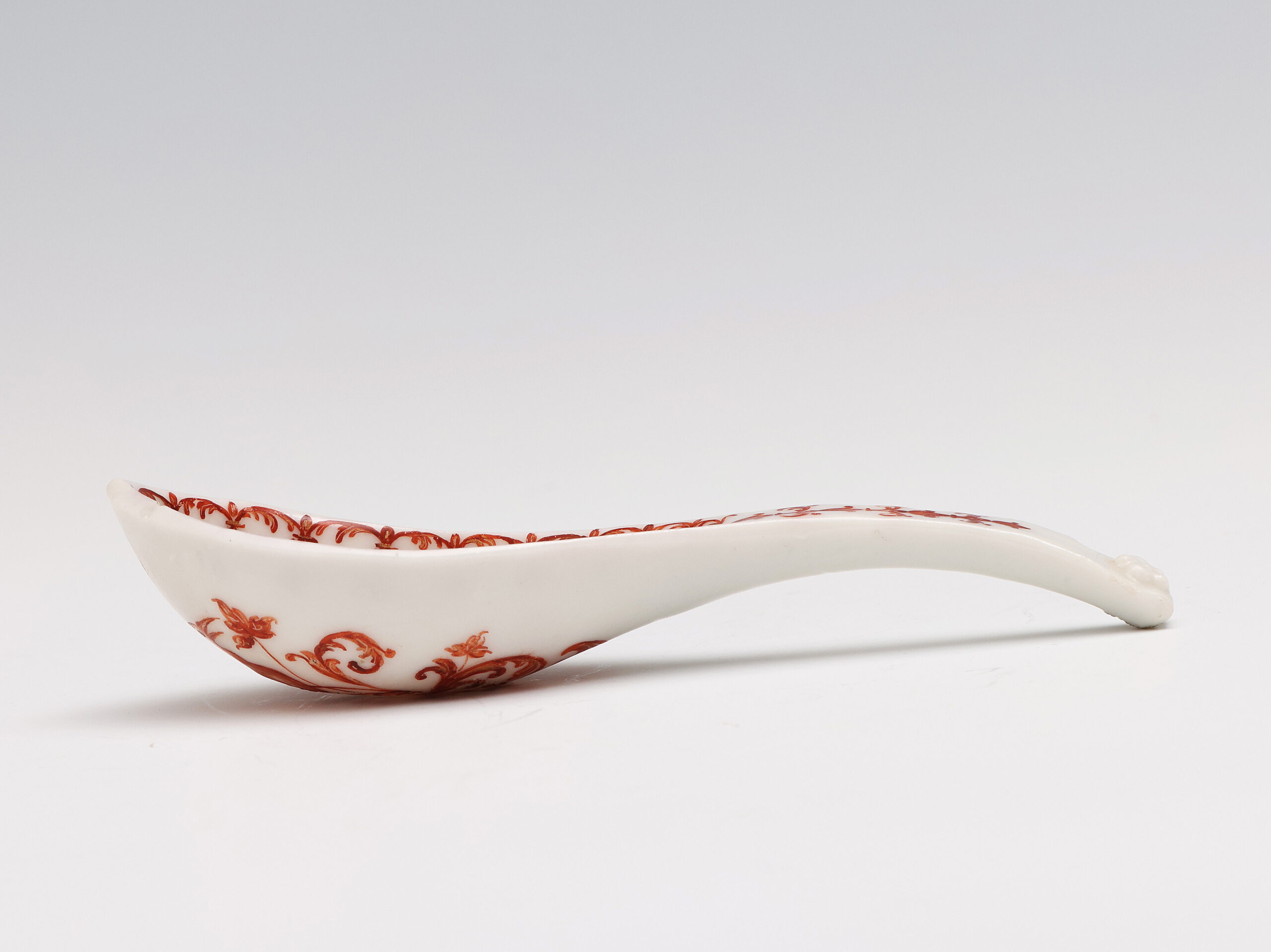
The shape of the spoon is that of a traditional Chinese broth spoon, with an arched handle that has an applied five-petalled flower on the end; and a deep bowl, that finishes with a pointed tip.
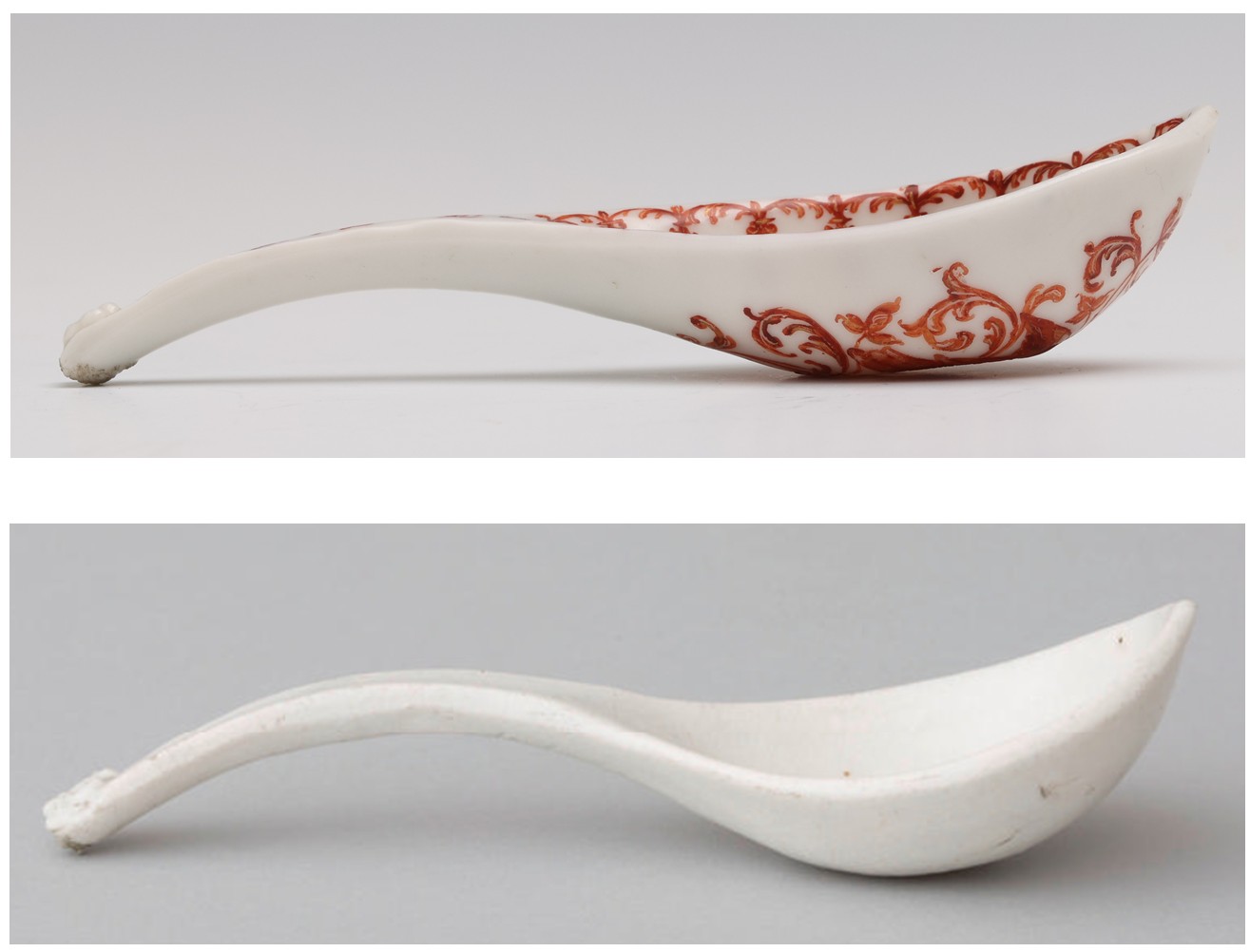
Porzellansammlung, Dresden (PO 8452/8453)
P. J. Donelly illustrates spoons of this form (plate 67b) and points out that whilst Augustus the Strong had them in Dresden, listed as round and pointed, they were domestic wares not intended for export.[i]
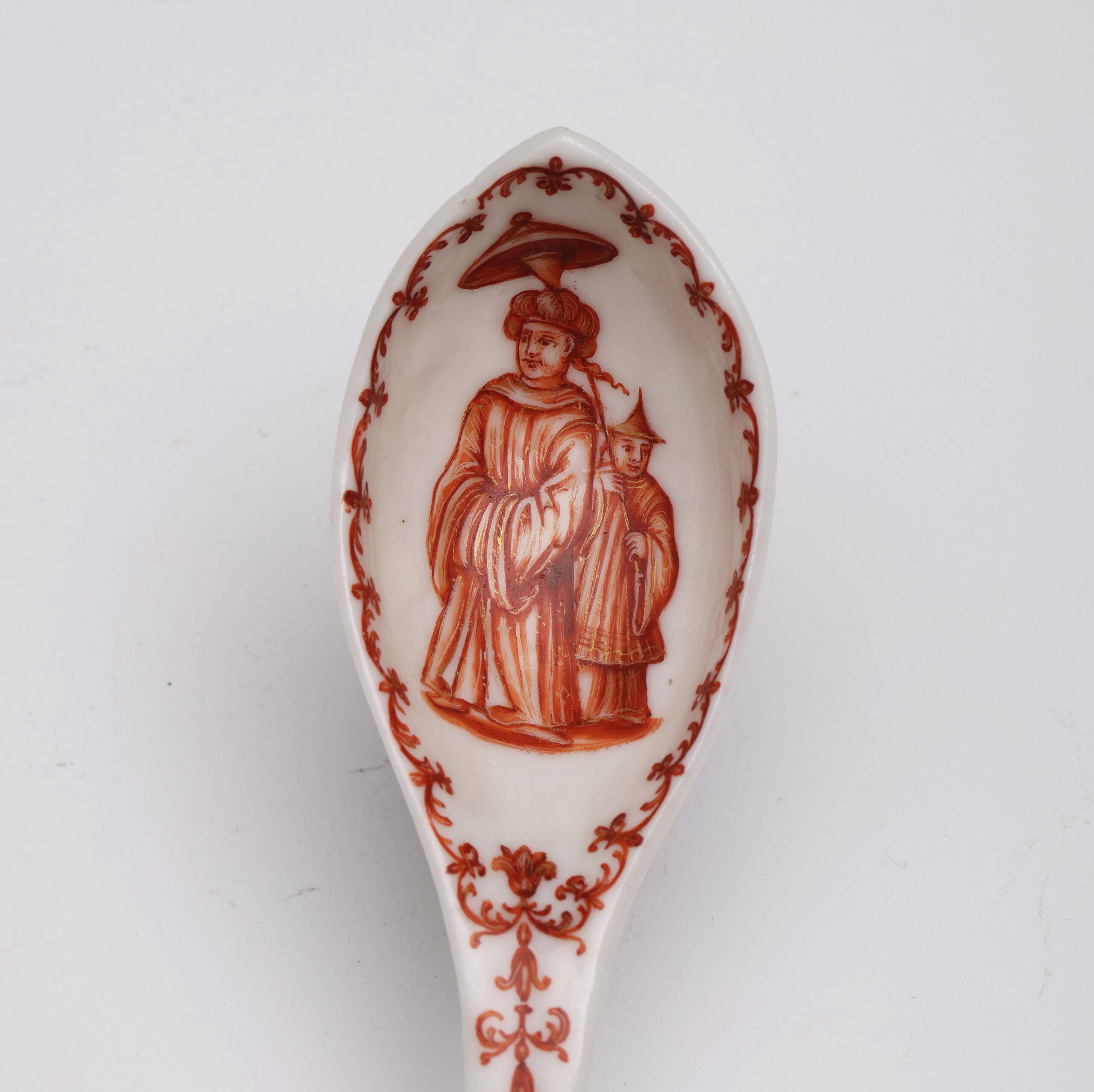
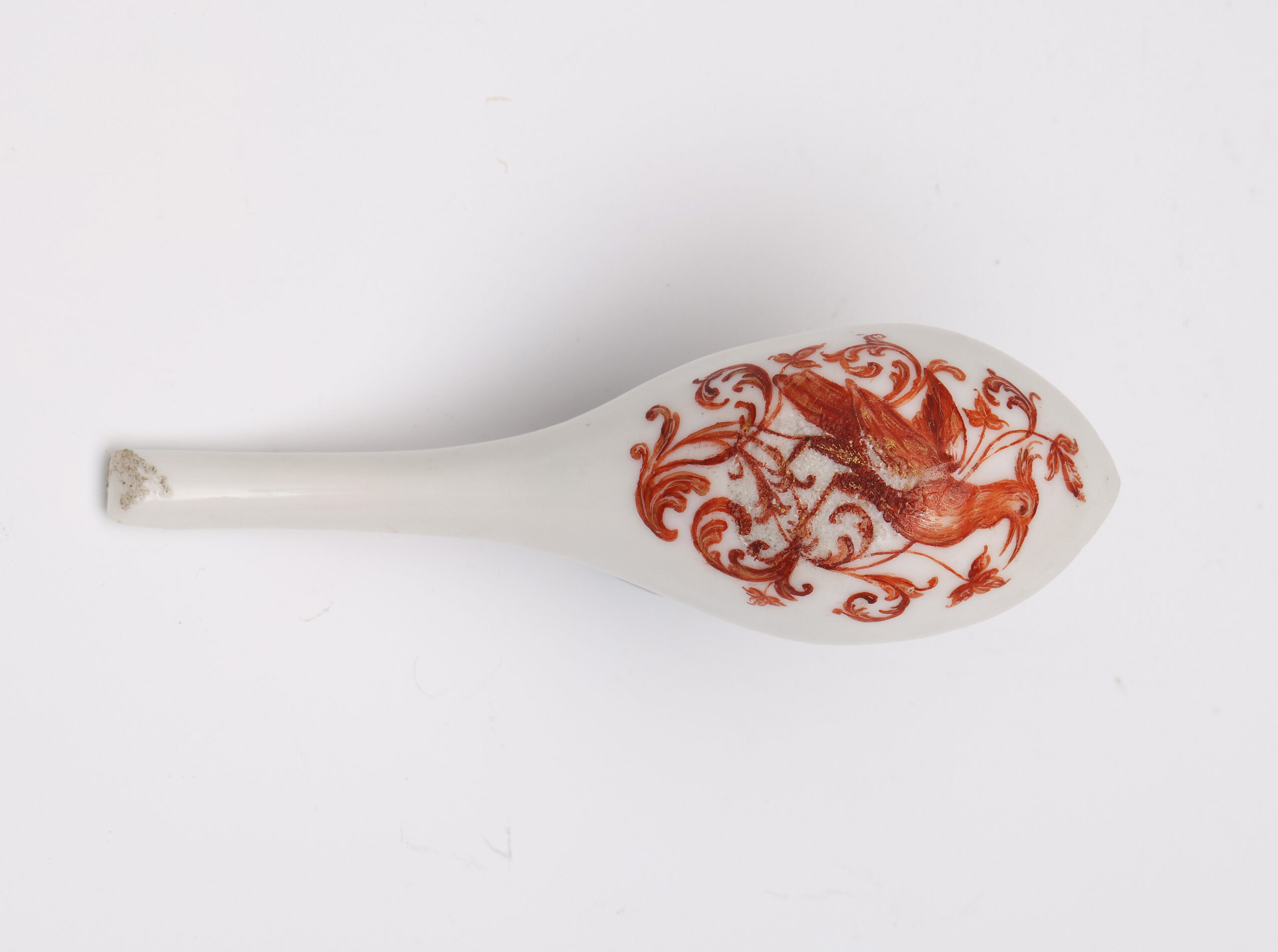
The decoration was executed in the workshop of Daniel and Ignaz Preissler, in iron- red with gilt highlights. The scene in the bowl of the spoon is loosely derived from a print by Pieter Schenk. The ornament around the rim of the spoon and down the handle is very characteristic of the Preissler workshop. On the reverse of the bowl is a bird amongst baroque foliate ornament.
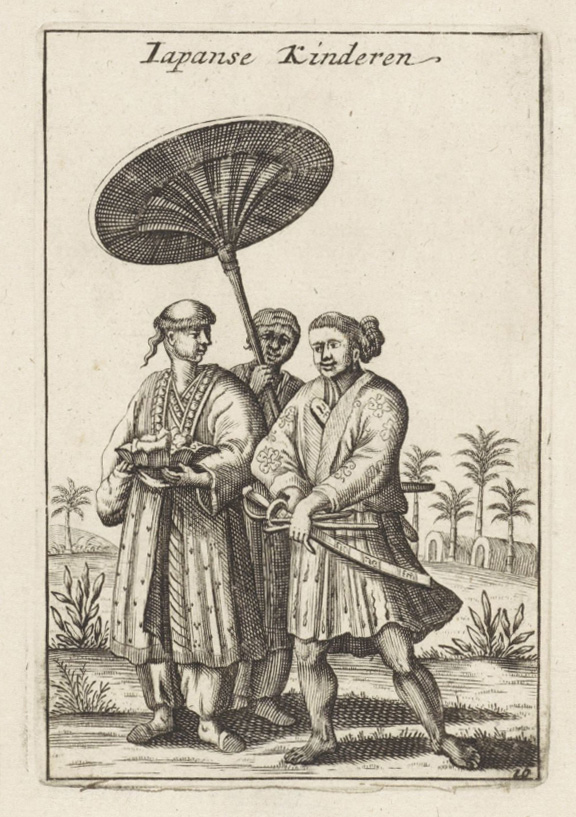
Engraving by Pieter Schenk, Rijksmuseum
There are no signed pieces by Ignaz Preissler although work of this type is generally considered to be by him. There is also the possibility of such a piece being by his father Daniel (although that is perhaps unlikely at this date) or by his younger brother Florián Preissler who is possibly the “Herr Preußler” who spent some years working for Johann Christian Kundmann in Wroclaw. Another artist – Tobiáš Hanuš (1695-1733) is also recorded as a porcelain painter on the Kolowrat estates at Rychnov.
Ignaz Preissler was one of the most skilled and prolific of all the outside decorators or hausmaler. With his father Daniel, a noted decorator of glass, Ignaz Preissler worked in eastern Bohemia at Kunštát (Kronstadt), for Franz Karl, Count Liebsteinsky von Kolowrat. Records state that he mostly painted chinoiseries (Indijanische Figuren und landschaften) but also ‘difficult poetic subjects’ (Poetische Mühesame). In 1731 Ignaz Preissler stated in a letter that he, like his father, considered monochrome painting in black or iron-red to be the finest and most subtle form of decoration.
Recent studies in the National Archives in Prague have shown that considerable numbers of pieces of porcelain and glass decorated in black or red enamels and gold on glass and porcelain as well as reverse paintings on glass were originally preserved in the possession of the Kolowrat family in their castle of Rychnov nad Knĕžnou. This suggests an efficient workshop responding to the lord’s needs; its activities can be traced from the late 17th century and through the 1730s.
This style of decoration is close to that of the earlier Nuremberg hausmaler who worked on faience and glass such as Johann Schaper and Johann Faber and it is possible that Daniel Preissler learnt his art there as a young man.
Condition:
Small chip to the rim of the bowl; kiln abrasions to the back of the spoon from where it has rested in firing.
References:
Manners 2024
E & H Manners, ‘Decorators on Ceramics and Glass’, (2024)
Brožková 2009
Helena Brožková,(ed.), ‘Daniel a Ignác Preisslerové, Barokné malíři skla a porcelánu, Prague Museum exhibition catalogue (2009) :
– Jaroslav Šůla, ‘Daniel and Ignaz Preissler, Bohemian Baroque Glass and Porcelain Painters and Their Families’, English summary, pp. 32 &32
– Helena Brožková,’ “Suae Excellentiae Pictores” Daniel et Ignatius Preissler’,
English summary, pp. 98 & 99
Donnelly 1969
P. J. Donnelly, Blanc de Chine: The Porcelain of Tehua in Fukien (Faber & Faber, London, 1969), plate 67 b
Pazaurek 1925
Gustav E. Pazaurek, Deutsche Fayence-und Porzellan Hausmaler, (Leipzig, 1925), Vol. I, pp. 214-218
Sold
[i] For the entry in The Porzellansammlung Dresden see: https://royalporcelaincollection.skd.museum/catalogue/1/object/2080?object=208000000135628&type=2